A jacket is not a T-shirt with sleeves. It has a shell, a lining, a front closure, a collar or a hood, and a set of trims that all have to agree with each other before the garment works. Get the shell wrong and the jacket never hangs right; get the rib wrong and it looks tired after a month; get the grading wrong and it will not close over the layer it was bought for.
This guide is written for brands, wholesalers, uniform and corporate buyers who are specifying custom jackets. It covers the types buyers actually order, the specification decisions that drive cost and lead time, and how to compare jacket manufacturers on the things that change the finished garment.
Shortlist a Jacket Supplier Against the Construction
Match the supplier’s evidence to the jacket you intend to order. Request a comparable sample or current close-ups of the closure, lining attachment, pocket construction and decoration. Ask who coordinates each operation and how provisional trims are recorded; a finished front photo alone cannot answer those questions.
| Development direction | Quote variables to lock | Approval check |
|---|---|---|
| Harrington | Shell, body and sleeve lining, rib, zip and puller | Collar stand, zip operation, hem recovery and fit over the intended layer |
| Utility jacket | Pocket construction, closures, lining and any wash finish | Pocket access, placket alignment and measurements after the agreed finish |
| Insulated puffer | Shell, fill specification, quilting layout, lining and hood | Fill distribution, quilting, mobility and closure; agree evidence for any performance claim |
Custom hardware, contrast materials, additional pockets, lining changes and decoration create separate sourcing or approval work. Ask for the quote to name these components and separate development charges, garment cost, packing and shipment scope. Confirm availability and minimum purchases before approving a custom trim.
NOVITA custom jackets: normally 100 pieces per style per color, with mixed sizes allowed. Sample development generally takes 7–14 days after requirements are confirmed; bulk production is 60 days after sample approval, subject to materials, quantity and customization. We do not produce leather outerwear.
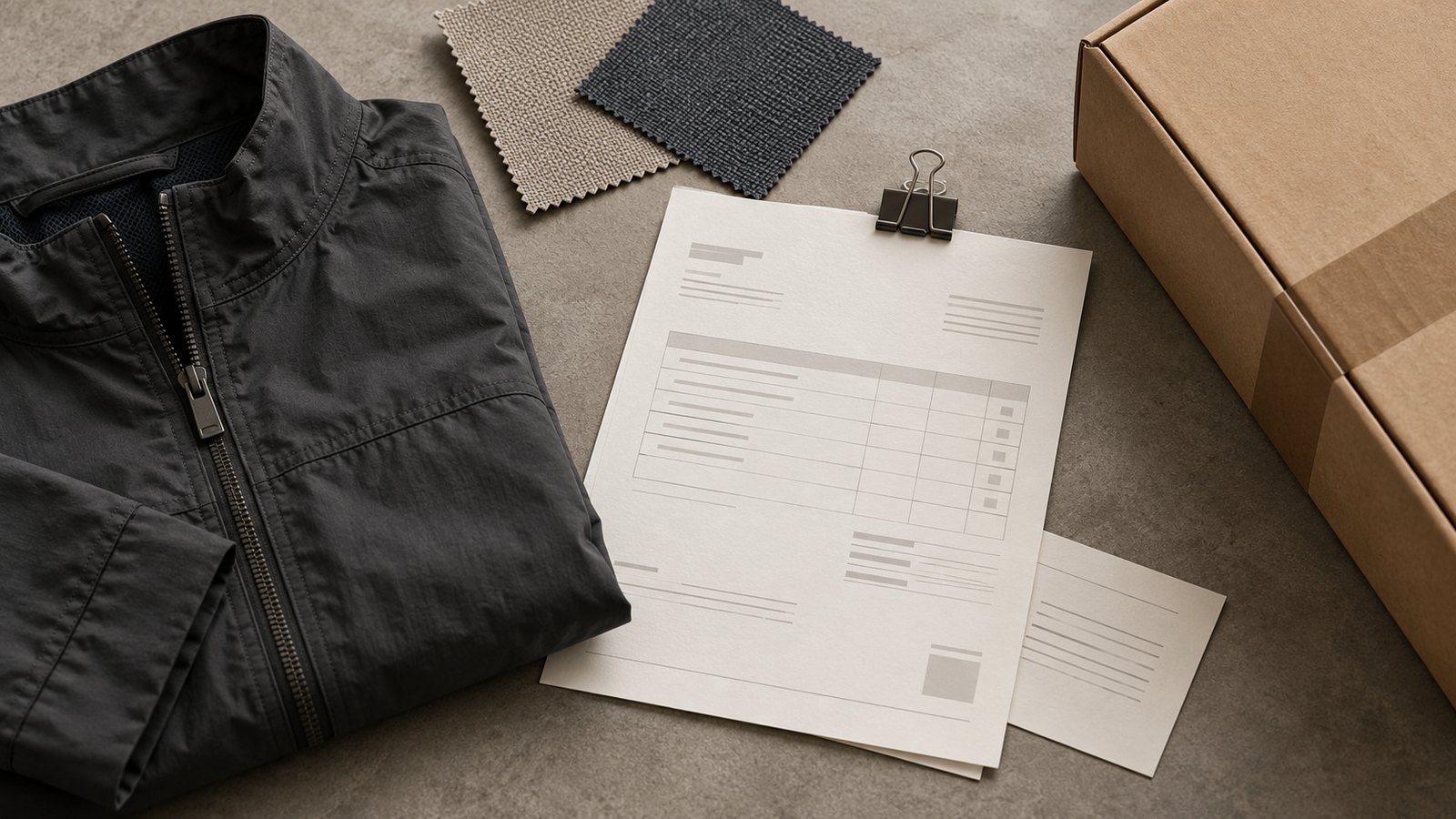
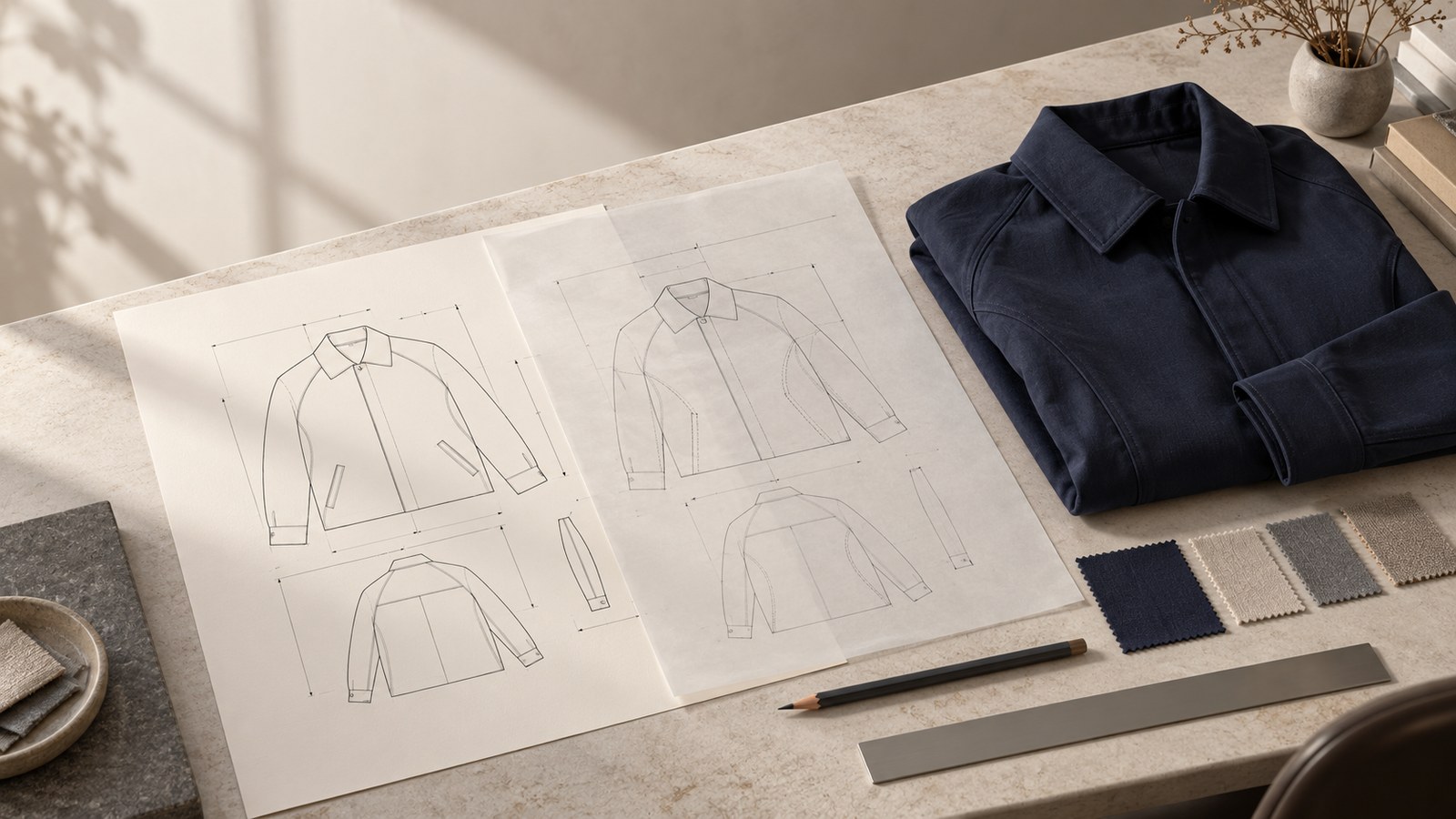
For an RFQ, send the front and back reference, shell and lining directions, closures and pockets, measurement chart and intended underlayer, logo files, quantity by color and size, packing and arrival deadline. Keep one versioned comment sheet for fit, materials and workmanship; list pending components before approving production. Browse the jacket range, then send the jacket specification or ask a sourcing question on WhatsApp.
The Jacket Types Most Buyers Start With
Most outerwear programmes begin with one of four shapes. They are not interchangeable — each one carries a different set of decisions.
| Type | What defines it | What to decide first |
|---|---|---|
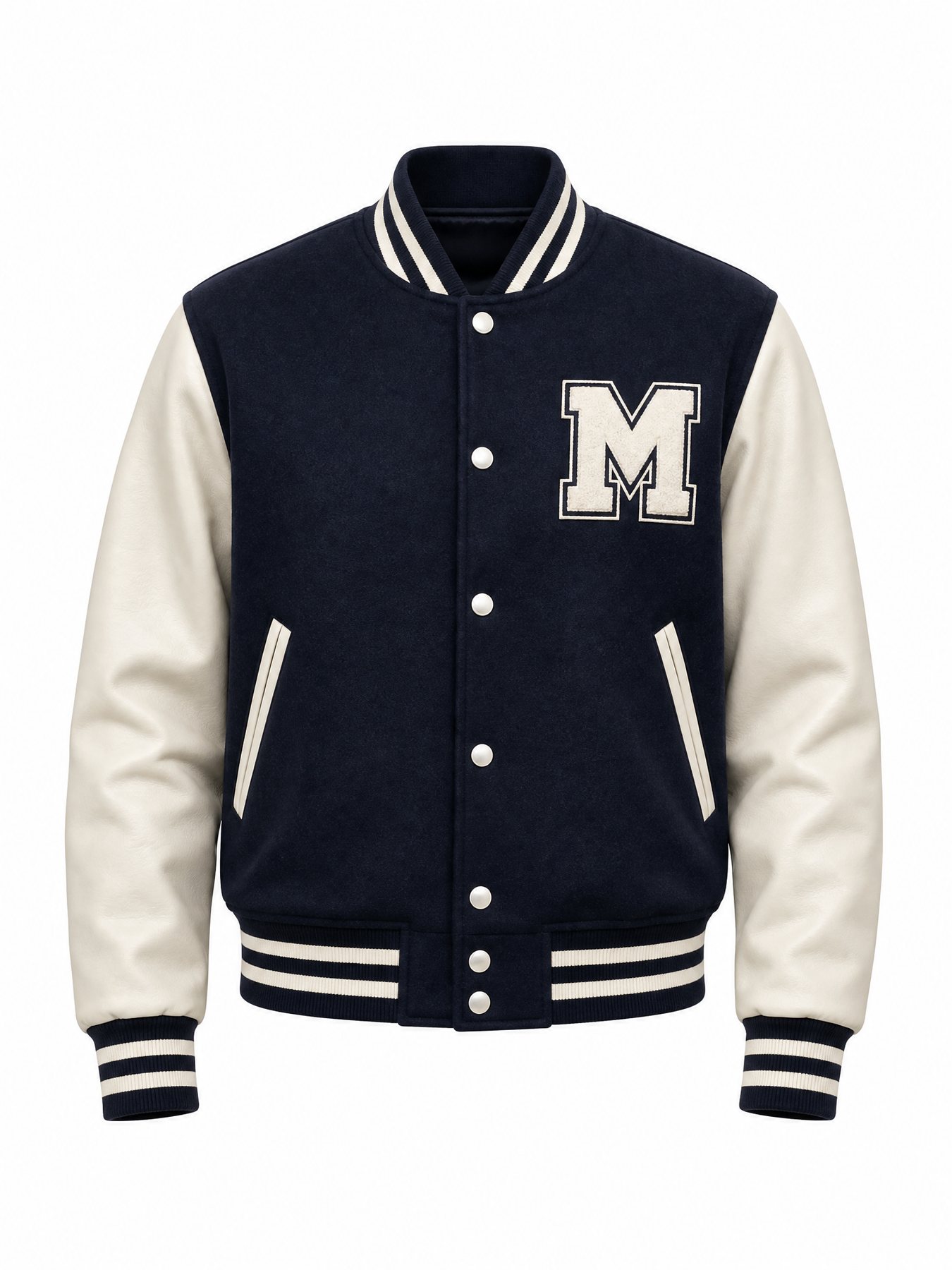
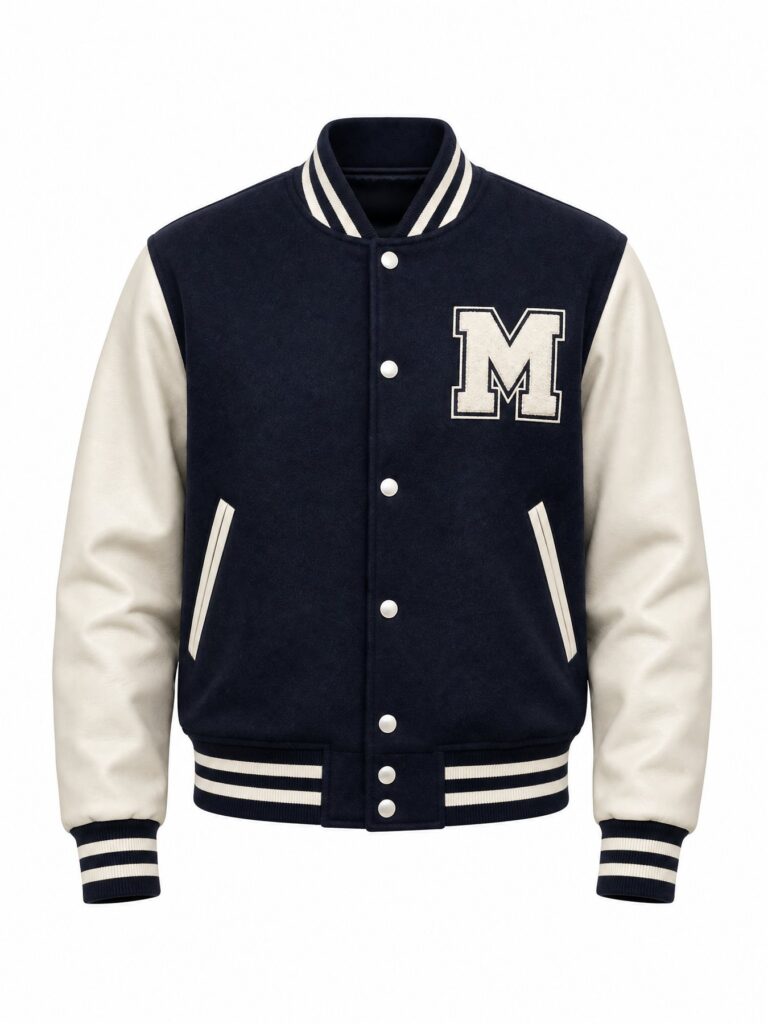
| Varsity / letterman | Contrast body and sleeves, striped rib collar, cuffs and hem, snap front, chest letter patch | Whether body and sleeves use the same fabric, and how the rib stripe is laid out |
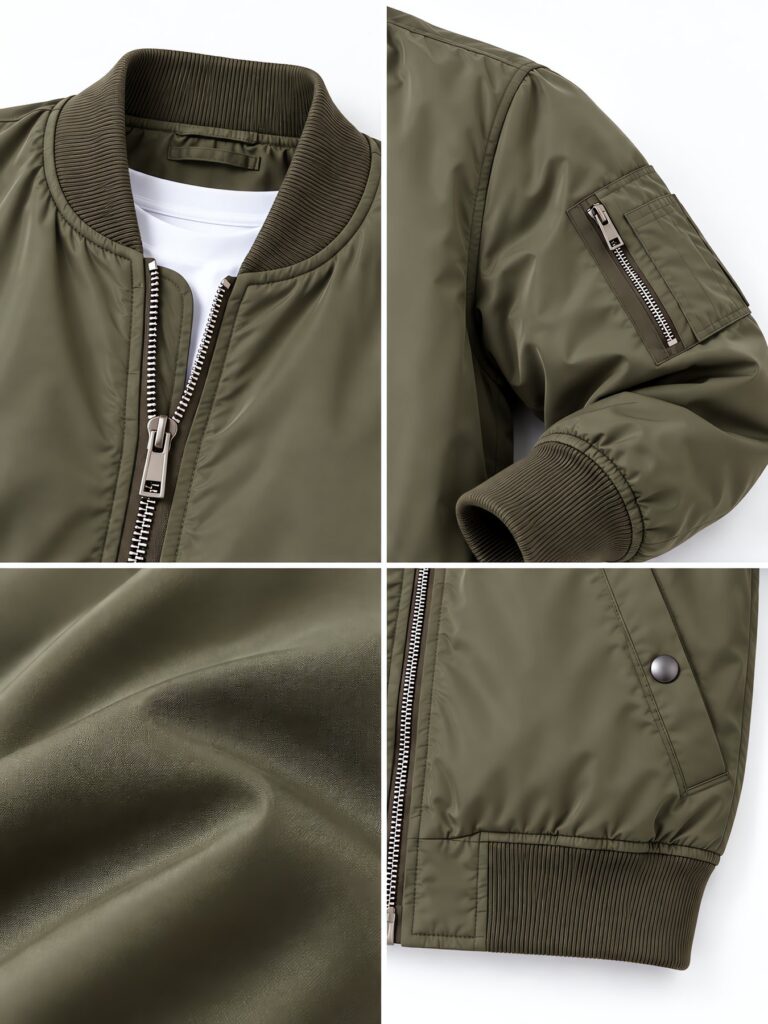
| Bomber | Rib collar, cuffs and hem, zip front, sleeve utility pocket | Shell hand and sheen, and whether the body is lined, quilted or left light |
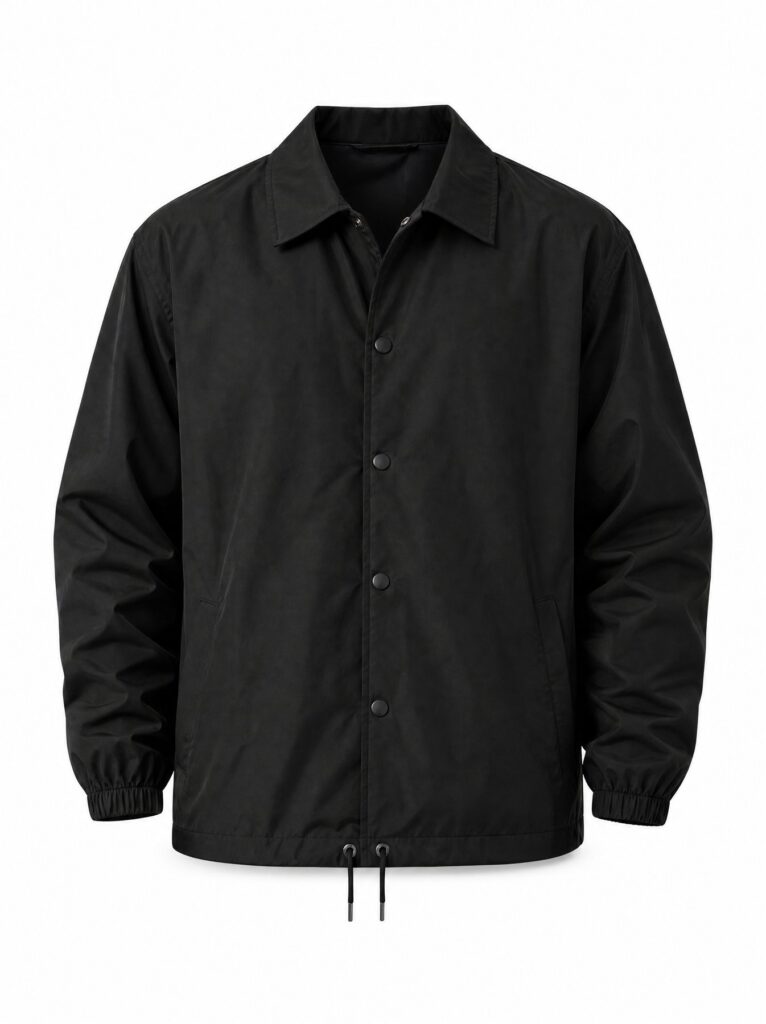
| Coach | Pointed collar, snap front, elasticated cuffs, drawcord hem | Snap versus button front, and how much structure the shell needs to hold the collar |
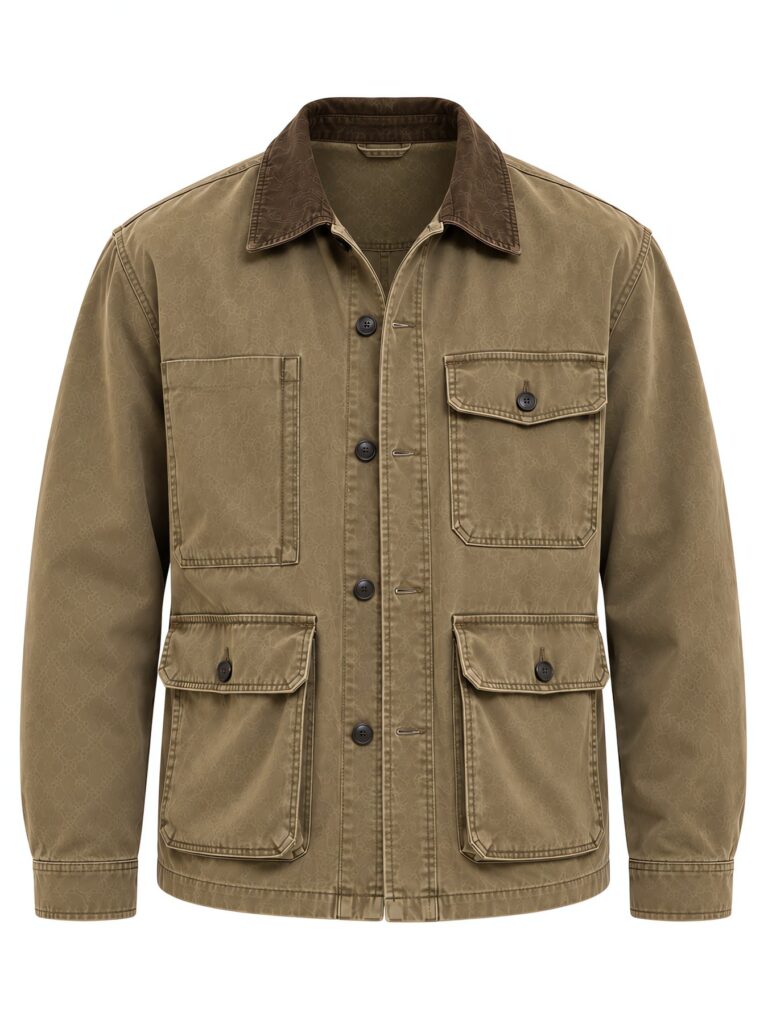
| Utility / workwear | Multiple flap pockets, contrast collar, button-plus-zip placket, garment-washed finish | Pocket count and placement, and whether the wash is part of the design |
Across all four types, three decisions repeat: what the shell is, how the front closes, and how the edges are finished. Agree those three and the rest of the specification usually falls into place.
Each of those four types is in production here — see our varsity jacket, bomber jacket, coach jacket and utility jacket.
The Rest of the Outerwear Range
Beyond those four, the same specification logic applies to the other outerwear shapes buyers ask for:
- Harrington — stand collar, zip front, ribbed hem; also built in a lighter linen-style shell for warm climates.
- Overshirt — a relaxed shirt-jacket that sits between a shirt and a jacket; usually the lightest item in the range.
- Denim trucker and denim shirt jacket — button front, chest pockets, and a wash decision attached to them.
- Field jacket — four flap pockets and a drawcord waist.
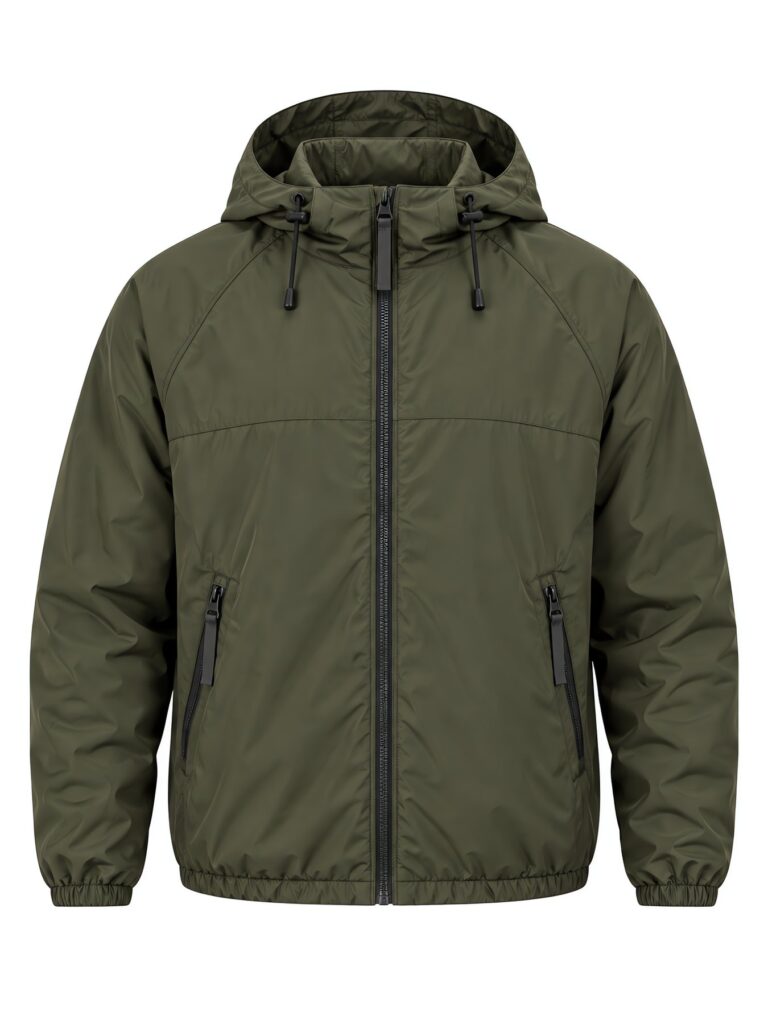
- Windbreaker / hooded shell — lightweight zip shell, hood with drawcord, elasticated cuffs and hem.
- Insulated puffer — short or long, quilted, with the fill decision driving both warmth and packability.
Shell Fabric: Decide Behaviour Before Numbers
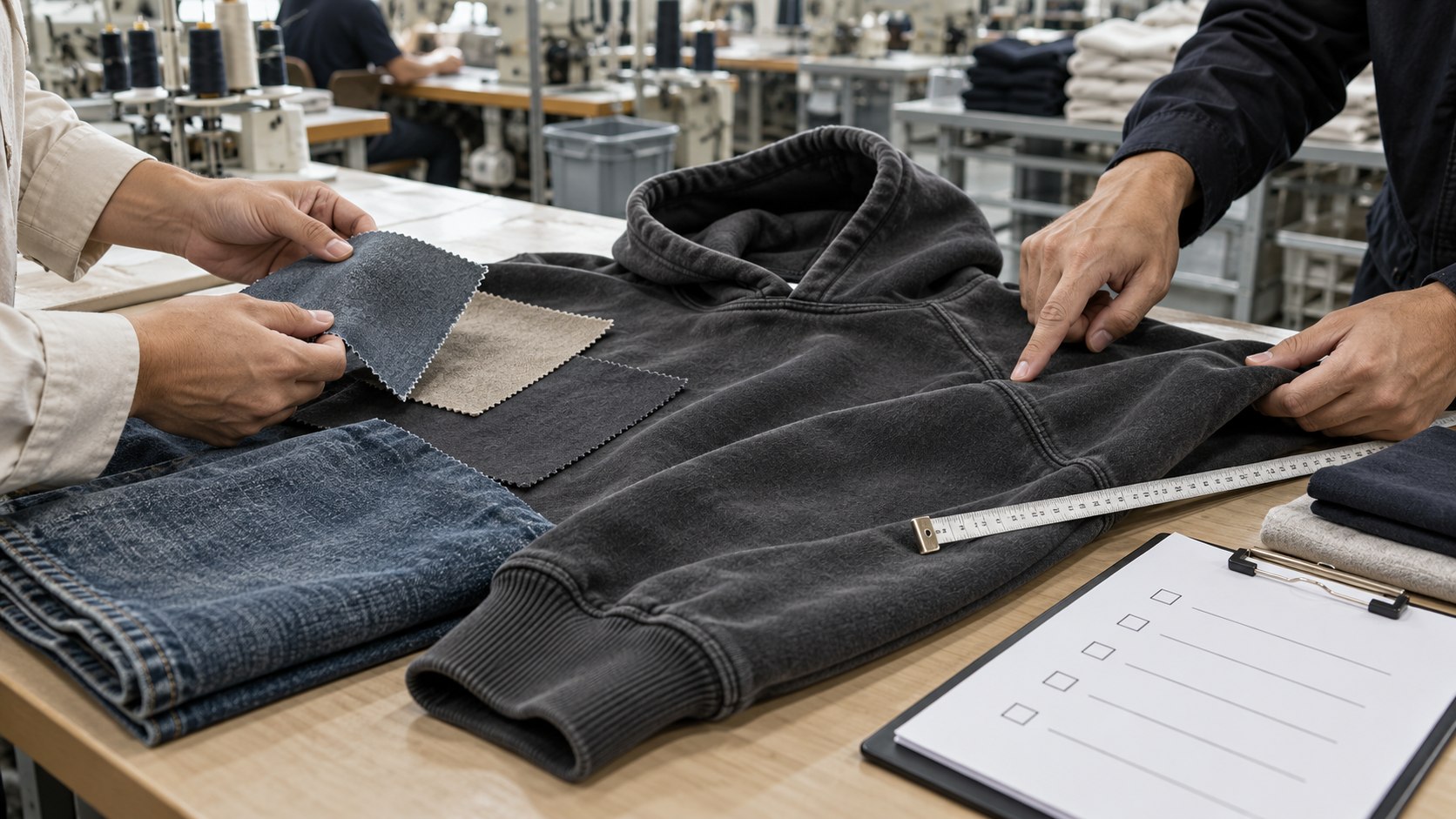
Buyers often arrive with a number — a weight, a denier, a composition — and treat it as the specification. It is only part of it. Two shells at the same weight can behave completely differently depending on how they are woven or finished, which is why the physical reference matters more than the figure on a data sheet.
What the shell actually has to do:
- Hold shape — a coach or utility jacket needs a shell with enough body to keep a collar standing and a placket flat.
- Take the decoration — a shell that will carry dense embroidery is a different choice from one that will carry a large printed panel.
- Handle the finish — if the design is garment-washed, the shell has to be chosen for how it ages, not just how it arrives.
- Feel right in the hand — matte or with sheen, dry or smooth. This is the judgement buyers make in five seconds and it is worth writing down.
The practical way to specify it: send a reference garment or a swatch you already like, describe the hand feel in words, state the care requirement, and ask for the shell to be confirmed on a sample rather than on a chart.
Lining, Fill and Interfacing
These are the parts of a jacket nobody photographs and everybody feels.
- Body lining and sleeve lining are separate decisions. The sleeve lining governs how easily the arm goes in and out — it is the single most noticeable lining choice in daily wear.
- Fill is optional. Plenty of jackets need wind protection and shape, not warmth. Deciding that early avoids paying for insulation the market does not want.
- Interfacing is what makes a collar stand. If a placket curls or a collar flops, the cause is usually the interfacing decision rather than the trims.
Even when the answer is “standard”, ask for the lining to be named in writing on the specification. “Standard” is not a specification.
Trims Decide How a Jacket Feels in the Hand
Trims are where a jacket gains or loses its perceived quality, and they are also where small changes add cost quickly.
- Rib — collar, cuff and hem rib is the most visible quality signal on a bomber or varsity. Recovery matters more than height: rib that stays put after wear reads better than rib that looks impressive in a photo.
- Zips — metal or nylon, and which puller. On a bomber the zip is often a design feature, so it should be specified rather than left to the factory. For sample and bulk acceptance checks, use our garment zipper inspection checklist.
- Snaps and buttons — snap front versus button front changes the whole read of a coach or utility jacket, and the hardware colour has to be agreed alongside the shell.
- Drawcords and toggles — cord diameter, colour and whether the ends are finished or knotted.
- Pockets — patch, welt or flap; and whether the pocket is functional, decorative, or both.
Fit and Size Grading for Outerwear
A jacket is worn over something. That single fact drives grading, and it is the most common thing missing from a first tech pack.
- Decide the layer. If the jacket has to close over a hoodie, the chest and upper-arm measurements have to be set with that layer in mind, not on a bare body.
- Body length and hem width change the silhouette more than any other two measurements — and they are the easiest to get wrong from a photo.
- Sleeve length method should be stated: from centre back, or from shoulder seam. Half the disputes in outerwear sampling come from this one line.
- Shoulder drop decides whether the jacket reads tailored or relaxed.
Decoration on Outerwear
Jackets carry decoration differently from knitwear, because the shell is usually firmer and the garment is usually heavier.
- Letter patches and chenille patches are the signature varsity treatment, and they need a backing decision plus a placement check against the placket and pocket positions.
- Chest embroidery is the standard corporate and uniform route.
- Screen print, heat transfer, digital and foil suit lighter shells and larger graphic areas.
- All-over sublimation belongs to sportswear-style shells where the print is designed with the panels rather than applied over them.
Two things cause most decoration problems on outerwear: dense embroidery on a shell that cannot support it, and a placement that was approved on a flat artwork instead of on the garment. Confirm size and position on the sample, not on the drawing.
Sampling: What a Jacket Sample Has to Prove
Use the jacket sample approval checklist to record the review. A jacket sample is not a colour check. It has to prove the parts that only appear in three dimensions:
- The shell has the right hand feel and the right amount of body.
- The collar or hood stands and holds its shape.
- The zip runs cleanly from the hem to the throat without waving the placket.
- The rib recovers, and the rib stripe lines up at the seams.
- The lining does not grab the sleeve when the jacket goes on.
- The decoration sits where it was approved, at the size it was approved.
Sample development generally takes 7–14 days once fabric, measurements, construction details and workmanship requirements are confirmed. If the timeline depends on a custom rib, custom hardware or a new shell, that should be visible in the plan rather than discovered later. The wider process — fit sample, revision, pre-production sample — is covered in our guide to clothing sample development.
Bulk Ordering: MOQ, Lead Time and What Moves Them
- MOQ: 100 pcs per style per color. Mixed sizes are allowed within the run.
- Ready stock styles: selected in-stock styles may start from around 50 pcs, subject to stock availability.
- Bulk production: generally 60 days after sample approval, depending on quantity, fabric availability and how much of the garment is customised.
What actually moves a jacket order’s lead time is rarely the sewing. It is a custom rib, a custom puller, a new shell that has to be sourced, or a decoration that needs its own approval round. If any of those are in the design, they belong in the timeline from the start.
On quality: AQL 2.5 inspection can be arranged on request, and the inspection scope should be agreed in writing with the order. Our apparel quality control checklist covers what that inspection actually looks at on outerwear.
Buyer Specification Checklist for Jackets
Send these together and a jacket quotation becomes comparable between suppliers:
- Jacket type and a reference image
- Shell: reference swatch, hand-feel note, care requirement
- Body lining and sleeve lining
- Fill: yes or no, and the warmth target if yes
- Rib: colour, stripe layout, recovery expectation
- Closure: zip, snap or button, plus hardware colour
- Collar, hood, and any contrast panel
- Pockets: number, type and position
- Drawcords, toggles and cord ends
- Decoration: method, artwork, size, placement, backing
- Measurement chart, including the layer the jacket must fit over
- Size ratio, colourways and quantity per colourway
- Labels, hangtags and packing
- Delivery date and destination
How to Compare Jacket Manufacturers
Once the specification is written, the comparison stops being about price and starts being about capability. The questions that separate suppliers:
- Is outerwear a category for them, or an add-on? Ask to see the same type you are specifying, not a generic catalogue.
- Can they show construction detail? Rib, zip, pocket and hem close-ups tell you more than a front shot.
- Who owns the shell decision? A supplier who can source and confirm the shell is a different partner from one who only sews what you send.
- Can they handle decoration in-house? A jacket with a patch and an embroidered logo crosses two processes; splitting them across vendors adds a coordination step and a failure point.
- What do they say about MOQ per colour and sample lead time? Vague answers here usually predict vague answers later.
- Do they ask about the layer? A supplier who grades outerwear without asking what it is worn over has not built many jackets.
If you are still deciding how much of the development to hand over, our comparison of OEM and ODM clothing manufacturing sets out where the line usually falls.
Frequently Asked Questions
What is the MOQ for custom jackets?
100 pcs per style per color, with mixed sizes allowed within the run. Selected in-stock styles may start from around 50 pcs, subject to stock availability.
How long does a jacket sample take?
Generally 7–14 days after the fabric, measurements, construction details and workmanship requirements are confirmed. Custom rib, custom hardware or a new shell can extend that. Use the jacket sample approval checklist to record the fit, lining, closures and trims before signing off.
How long does bulk jacket production take?
60 days after sample approval, depending on quantity, fabric availability and the level of customisation.
Do you make leather jackets?
No. Our outerwear range covers varsity, bomber, coach, utility, harrington, overshirt, denim trucker, field, windbreaker and insulated styles — we do not produce leather outerwear.
Can you add embroidery, patches or print to a jacket?
Yes. Embroidery, chenille and letter patches, screen print, 3D puff, digital print, foil and heat transfer are all handled in-house, which matters when one jacket carries both a patch and an embroidered logo. See our garment decoration and finishing overview for a comparison of techniques.
Do you support OEM, ODM and private label?
Yes. We work as an OEM partner from your tech pack, as an ODM partner where development is shared, and as a private label producer under your own labels and packaging. Our apparel manufacturing services set out how those three models differ in practice.
Develop Your Custom Jackets With NOVITA
NOVITA is a men’s casualwear OEM, ODM and private label manufacturer. Production runs at our own garment factory in Foshan, Guangdong, which has been operating since 2006, while Changsha Novita International Trade Co., Ltd. handles international sales, contracts, USD payments and export coordination. Explore our clothing manufacturing capabilities in China for the broader menswear range.
Our outerwear line covers varsity, bomber, coach, utility, harrington, overshirt, denim trucker, field, windbreaker and insulated jackets — you can see the current range on our custom jacket manufacturing page.
Send us your reference image, shell swatch, measurement chart and the layer the jacket has to fit over, and we will come back with fabric options, MOQ, sample timing and a production plan. Contact us to start the specification.