By NOVITA Editorial Team. Revised October 27, 2026.
A jacket can look correct in a front-view photograph and still fail the fitting. The zipper may pull the placket out of line. A sleeve lining may catch when the wearer puts the jacket on. A utility pocket may be in the right place on the drawing but difficult to use on the finished garment.
Sample approval should settle these details before bulk production. The buyer needs a physical reference, a current specification and a written record of what has been accepted. This checklist is designed for apparel brands reviewing custom Harrington, utility, bomber and other casual outerwear samples.
The Factory Tour zipper-sewing clip provides a visual example of one assembly operation. It is not evidence that a specific jacket sample, facility or order has passed approval; verify closure workmanship and fit against your own agreed sample.
Identify the sample you are actually reviewing
Begin with the sample identity. A comment on an earlier prototype should not accidentally become an instruction for the final pre-production version.
Record the style code, sample version, date, base size, colorway, fabric reference and purpose of the sample. Note whether it is a fit sample, a development sample or a proposed pre-production reference. List temporary components separately. A prototype made with a substitute zipper can help you judge fit, but it cannot approve the final zipper.
A useful approval header contains these fields:
| Style code | Sample version | Date received | Sample stage | Base size | Color | Shell reference | Lining reference | Tech pack revision | Reviewer | Decision |
|---|
The sample and tech pack must refer to the same version. If an email changes the collar height, add that decision to the controlled specification instead of leaving it in a chat thread.
Check fit on the intended layer
For outerwear, decide what the wearer is expected to put underneath the jacket. A lightweight Harrington worn over a T-shirt needs a different fitting check from a utility jacket intended to close over a hoodie.
Measure the garment using the agreed points of measure. Typical checkpoints include chest width, shoulder width or shoulder position, body length, sleeve length, bicep width, cuff opening and hem width. State whether sleeve length is measured from the shoulder seam or center back. A number without a measurement method is easy to dispute.
Record the layer worn underneath, sample size, wearer or form reference and front-closure state. Check the jacket while standing, reaching forward and raising the arms. Watch the front closure, underarm tension and hem movement. For a ribbed Harrington, check the rib position against the design. For a utility jacket, review flap and placket balance while fastened. Keep these conditions with the photographs so the next sample can be compared fairly.
A base-size approval does not automatically approve the entire size range. Record which sizes were fitted and whether a separate size-set review is required. Do not invent a universal measurement tolerance. The accepted tolerance belongs in the product specification.
For a broader discussion of jacket silhouettes and fabric decisions, see NOVITA's jacket manufacturer guide.
Compare the shell, lining and collar with the approved references
Hold the sample beside the agreed shell swatch or reference garment. Compare color under consistent light, surface appearance, hand feel, structure and the way the fabric hangs. Fabric weight alone cannot tell you whether the shell will keep the intended shape. Record these as appearance and handling observations. Confirm fiber composition and any required performance through material documentation or agreed testing; a swatch comparison cannot establish them.
Inspect the inside of the jacket. The body and sleeve linings may be different materials, so identify them separately in the specification. Put the jacket on and take it off several times. A sleeve lining that catches at the elbow or cuff may need a construction review even when it looks tidy on a hanger.
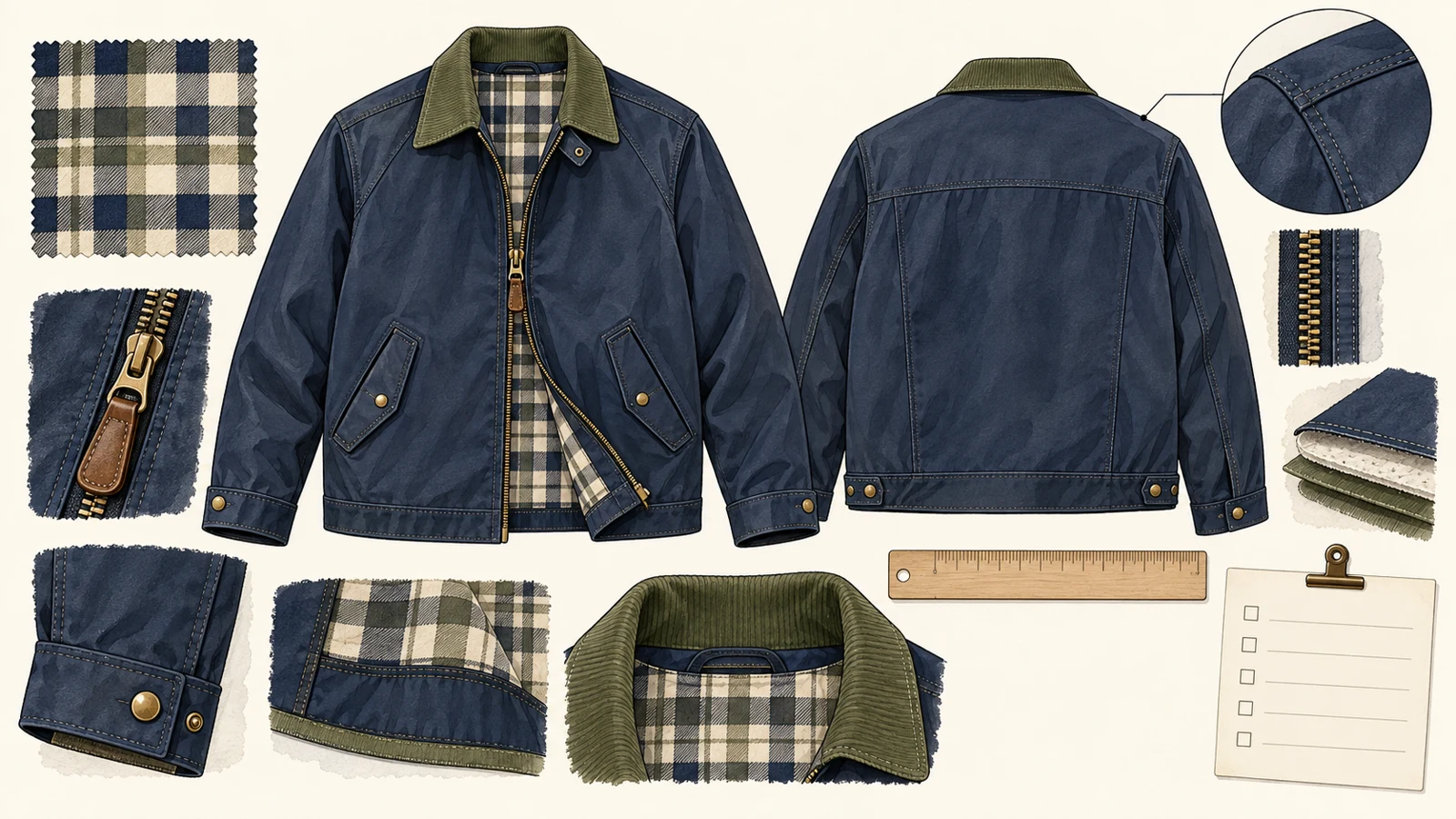
Check collar shape and support. A Harrington collar should sit as the approved design shows, while a utility jacket may use a contrast collar with a different hand feel. If interfacing or a support component is changed, review the resulting collar rather than approving the substitute by name.
For padded outerwear, document the agreed fill type, distribution and quilt layout. Do not transfer a lightweight shell-jacket approval to an insulated style. Different construction creates different review points.
Test zippers, pockets, cuffs and branding on the garment
Operate the zipper or front fastening repeatedly. Check whether it runs smoothly, whether the placket stays flat, and whether the top and bottom stops sit where the specification requires. Review the puller, tape color and hardware finish against the approved trim card. For an installed zipper test record, see our garment zipper inspection checklist.
Pocket inspection should include position, symmetry, opening size and usability. A four-pocket utility jacket needs an additional check of flap alignment and how the pocket openings work when the jacket is worn. For a Harrington, review hand-pocket access and any pocket-button or zipper details shown on the approved reference.
Check rib or cuff construction, hem finish, drawcords and toggles where applicable. For embroidered or printed branding, measure the artwork on the finished garment and check placement relative to seams, pockets and the front closure. A placement approved on a flat artwork file may look different on a three-dimensional jacket.
The current NOVITA Harrington jacket product page and utility jacket product page can help buyers identify the type of product they are specifying. Actual material, trim and decoration options still require confirmation for the order.
Apply the checks to two NOVITA jacket references
NOVITA’s published Harrington reference has a zip-front body and a check-lining direction. The utility reference has a button front, contrasting collar and a mix of patch and flap pockets. Use the differences below to prepare the review; the product pages are construction references, not evidence that your own sample has been approved.
| Published reference | Review on the selected sample | Keep open until confirmed |
|---|---|---|
| Harrington: zip front and check-lining direction | Fasten the zipper, check front balance and collar position, then assess body and sleeve lining over the intended layer. | Exact shell composition, selected lining, hardware and measurements. A linen direction needs its own material reference. |
| Utility: button front, contrast collar, patch and flap pockets | Fasten the front and review pocket spacing, flap alignment and access on the worn garment. | Pocket dimensions, closure details, collar material and lining. Appearance does not confirm shell composition or finish. |
Choose the next sample from the unresolved decision. If the zip-front fit is acceptable but the intended lining is absent, approve only the fit points represented by that version. If the utility pocket layout is still changing, keep the relevant front-panel and trim approvals open. Record the component change and recheck the affected fit or construction points.
Use a jacket sample approval record
The following record is an editorial template, not a completed NOVITA customer inspection or evidence of an actual order.
| CHECK | APPROVED REFERENCE | SAMPLE OBSERVATION | DECISION | REQUIRED ACTION | OWNER | RECHECK DATE |
|---|---|---|---|---|---|---|
| Sample identity | Current tech pack and version | To be entered | Pending | Confirm version | Buyer/supplier | To be agreed |
| Chest and hem | Measurement chart | To be measured | Pending | Record actual POM values | Reviewer | To be agreed |
| Sleeve and movement | Approved fit brief | To be assessed | Pending | Record fit comments | Reviewer | To be agreed |
| Shell | Swatch or reference garment | To be compared | Pending | Confirm material identity | Supplier/buyer | To be agreed |
| Body and sleeve lining | Lining references | To be checked | Pending | Check comfort and attachment | Reviewer | To be agreed |
| Collar and interfacing | Approved sample or drawing | To be compared | Pending | Photograph front and side | Reviewer | To be agreed |
| Zipper and placket | Trim card and drawing | To be operated | Pending | Confirm hardware and alignment | Reviewer | To be agreed |
| Pockets | Dimensioned drawing | To be measured | Pending | Check position and access | Reviewer | To be agreed |
| Cuffs and hem | Approved reference | To be checked | Pending | Review recovery and shape | Reviewer | To be agreed |
| Logo and labels | Final artwork files | To be compared | Pending | Check scale and position | Buyer | To be agreed |
| Packing | Packing specification | To be confirmed | Pending | Review pack sample | Buyer/supplier | To be agreed |
Choose a decision for each item: approved, revision required, or not represented by this sample. Do not mark an absent component as approved. Attach annotated photographs with the style code and version in each filename.
A written approval is only useful when the factory and buyer know which record controls production. Keep the latest accepted specification and the approved physical reference together.
Copyable jacket sample approval log
Copy the blank text below into an email, spreadsheet or tech-pack approval sheet. It is a blank buyer template, not an actual NOVITA inspection record. Keep the same style ID and sample revision on every photograph and comment.
Jacket sample approval log: select and copy the fields
PROJECT / BUYER: [enter]
STYLE ID / COLOUR: [enter]
SAMPLE STAGE: [proto / fit / pre-production]
SAMPLE ID + REVISION: [enter]
TECH PACK REVISION + DATE: [enter]
DATE RECEIVED / REVIEWED: [enter]
REVIEWER / APPROVAL AUTHORITY: [enter]
APPROVED SHELL / LINING REFERENCES: [enter]
APPROVED ZIPPER / TRIM REFERENCES: [enter]
FIT AND MEASUREMENTS: [pass / revise / hold + notes]
SHELL / LINING / COLLAR: [pass / revise / hold + notes]
ZIPPER / POCKETS / CUFFS: [pass / revise / hold + notes]
LABEL / ARTWORK / PACKING: [pass / revise / hold + notes]
PHOTO OR VIDEO EVIDENCE FILES: [enter links / filenames]
OPEN DEVIATIONS AND CORRECTIVE ACTIONS: [enter]
ACTION OWNER AND RECHECK DATE: [enter]
DECISION: [approve / revise and resubmit / hold]
BULK CUTTING RELEASED?: [yes / no]
AUTHORIZED APPROVER / DATE: [enter]
SUPPLIER ACKNOWLEDGMENT / DATE: [enter]
Release rule: if approved fabrics, lining, hardware or fit do not match the sample/specification, mark the affected item hold and do not authorize bulk cutting until the deviation is closed and the buyer signs the controlling version. For planned order quantity and lead time, consult MOQ conditions and the manufacturing process. For later production checks, use the separate QC checklist.
Write revision comments that can be checked
"Make the sleeve better" gives a sample team no measurable target. Write what is wrong, where it occurs and what would count as a successful correction.
For example, an illustrative comment might say: "The right pocket flap tilts upward when the jacket is fastened. Compare its position with the approved drawing and return a front photograph of the corrected sample." This is a writing example, not a report of a NOVITA order.
Where a measurement changes, record the previous specification, the new target and the method used to measure it. Where the issue is visual, attach the reference image and mark the exact area. Keep a revision log with a named reviewer and a decision date.
If the fabric, zipper, lining or construction changes after a sample has been approved, identify which earlier checks are no longer valid. Review the affected points again before treating the revised sample as the production reference.
Hand the approved sample over to bulk production
A final sign-off should identify the approved sample version, the latest tech pack, fabric and trim references, artwork files, color standards, size breakdown and packing instructions. It should also list any remaining approvals and the person authorized to resolve them.
The published NOVITA Harrington jacket specification lists 100 pieces per color with mixed sizes, sample development of 7–14 days, and bulk production 60 days after sample approval. These are product-page planning references. Ask the team to confirm the selected style, material availability, revision rounds and the start date for the quoted schedule. An unfinished fit approval is not a bulk-production release.
Use the clothing sample development process to understand the wider development sequence. This jacket-specific record is for the narrower decision of what has actually been approved.
Send a complete approval brief
Before asking a supplier to start bulk production, send the style code, current tech pack, annotated sample photographs, approved shell and lining references, trim and branding files, quantity by color and size, and a signed list of remaining actions. Ask the supplier to confirm which version will be used for production.
NOVITA works on men's casualwear OEM, ODM and private-label projects. To discuss a jacket specification, send your references and proposed order breakdown through the contact page. The team can review the details needed for sampling and quotation.