By NOVITA Editorial Team. Revised October 14, 2026.
A factory can make the right garment and still ship a difficult order to receive. The color on the size sticker may disagree with the hangtag. A mixed carton may contain the right total number of pieces but the wrong size assortment. A barcode may scan correctly while pointing to a different product variant.
These problems are easier to prevent when the brand provides a packaging specification before bulk packing. For private-label clothing, the specification should connect each finished garment to its product identity, retail presentation and shipping carton.
Our Factory Tour includes a short folded-garment handling clip. It gives process context, but does not establish barcode accuracy, carton assortment or packing approval. Those checks belong in the documented packaging sign-off.
This guide is for brand owners and sourcing teams preparing men's T-shirts, polos, hoodies, jackets or denim for wholesale and online sales. It includes a copyable approval structure and an illustrative variant-to-carton record.
Start with the sales channel and the sellable unit
Ask where the garments will be received. A wholesale distributor may want cartons grouped by style, color and size. A retail store may require hanging or ticketing rules. A fulfillment warehouse may need a barcode that can be scanned without opening the individual bag.
Obtain the current receiving instructions from the buyer, warehouse or marketplace. Put their document version and date in the packaging specification so the supplier can check the exact requirement being approved.
Define the sellable unit first. Is one folded T-shirt in a bag one sellable unit? Is a two-pack sold under a single SKU? Does a wholesale carton contain mixed sizes or only one size? These choices determine what should be printed on the individual unit, the inner pack and the master carton.
Keep product protection separate from retail presentation. A clean polybag may protect a folded garment during shipment; a branded mailer or gift box serves a different purpose. Quote and approve only the components the project needs.
Separate branding artwork from product information
The main brand label, size label, fiber and care information, hangtag and barcode sticker have different jobs. A logo file does not supply the data needed for all of them.
For each component, specify the artwork revision, material, finished size, color reference, attachment method and location on the garment or pack. If a neck label is sewn into a seam, show where it sits relative to the neckline. If a hangtag uses a string or pin, approve the attachment point on the actual garment.
A pocket tee with a custom woven label is one useful reference when documenting label artwork, finished dimensions and attachment placement. Confirm whether the label is on the pocket, neck or another location, then approve its position on the actual garment sample.
Product information needs a separate owner. The brand should verify the required fiber content, care wording, origin information, destination-market language and other applicable labeling rules against the actual product and selling market. The manufacturer should work from approved copy. Do not assume that a supplier's default care label is compliant in every country.
For a wider comparison of production routes and what "private label" may include, see NOVITA's guide to private label clothing manufacturers. This packaging checklist deals with the operational files after the branding scope has been chosen.
Build a SKU and barcode mapping file
A barcode is only useful if it identifies the correct variant in the buyer's product system. Create one row per sellable variant and keep the mapping under version control.
Here is an illustrative data structure. The codes are placeholders and are not real registered barcodes or NOVITA stock identifiers.
| STYLE | COLOR | SIZE | BUYER SKU | BARCODE DATA OWNER | UNIT LABEL FILE | UNIT BAG TYPE |
|---|---|---|---|---|---|---|
| TEE-A | Navy | S | TEE-A-NV-S | Buyer | Label-v3-NV-S | Clear self-seal |
| TEE-A | Navy | M | TEE-A-NV-M | Buyer | Label-v3-NV-M | Clear self-seal |
| TEE-A | Stone | S | TEE-A-ST-S | Buyer | Label-v3-ST-S | Clear self-seal |
| TEE-A | Stone | M | TEE-A-ST-M | Buyer | Label-v3-ST-M | Clear self-seal |
Keep the buyer SKU and barcode value in separate fields. A buyer SKU is an internal product code; a GS1 GTIN identifies a trade item in the applicable GS1 system. Use the identifiers supplied by the brand or its authorized provider. Print a proof, scan it through the intended receiving workflow and check the intended style, color and size in the product system. Check both a successful scan and the resulting product identity before packing.
If the brand uses separate retail SKUs and factory production codes, include both columns. Never ask a packing team to infer the relationship from similar product names.
Specify the fold, individual bag and placement
A packing instruction should be testable on a finished garment. "Fold neatly" is too vague if a retailer needs a particular folded width, logo visibility or sticker position.
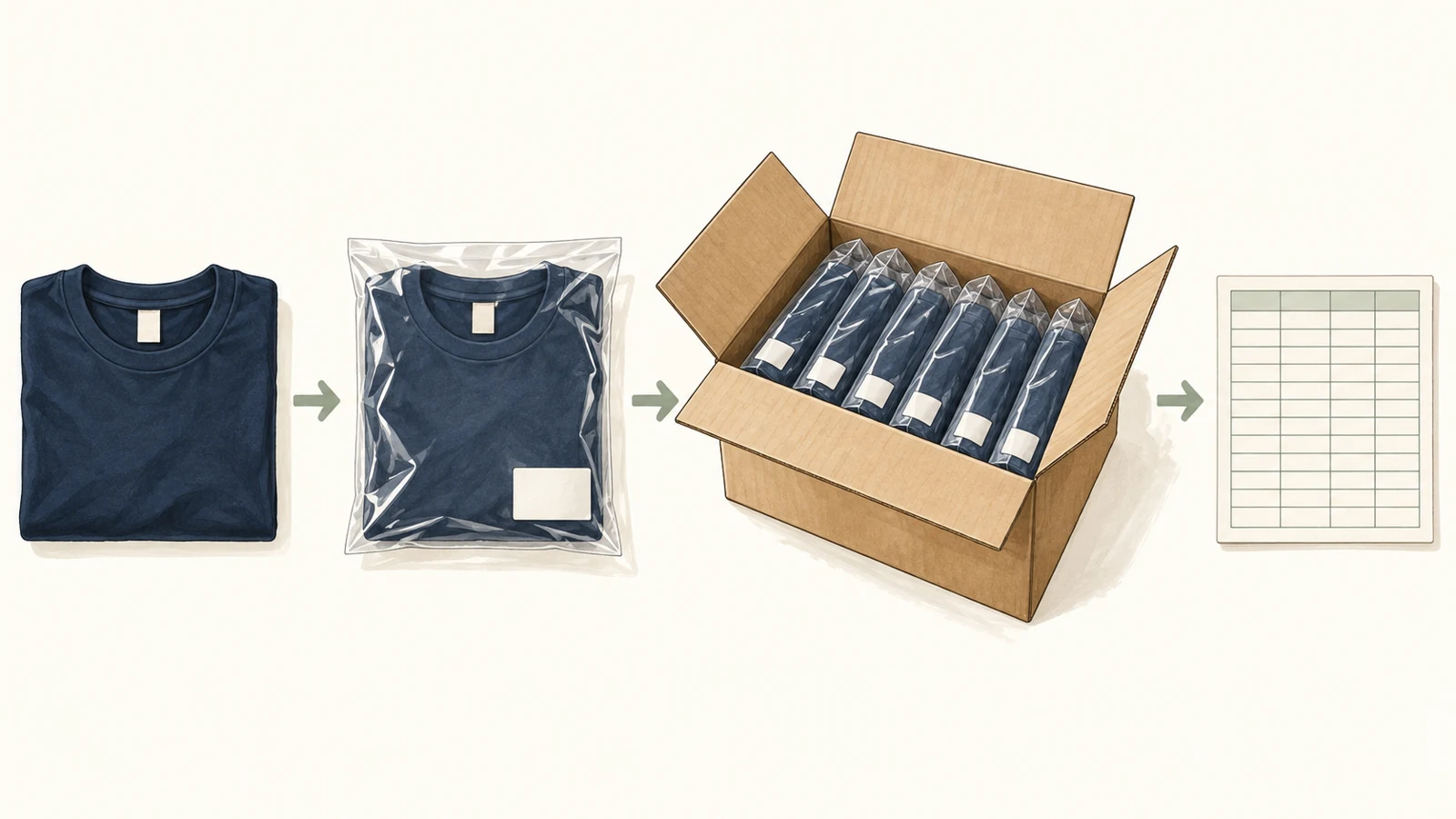
Record the approved folding sequence or photographs, final folded dimensions where necessary, bag type, bag closure, protective materials and any permitted alternatives. For jackets, review whether the fold compresses the collar or causes unwanted creasing. For polos, check whether the collar and placket remain presentable. For printed T-shirts, confirm whether protective tissue or another packing method is needed for the approved print and finish.
Identify where the size sticker, barcode label and hangtag should sit. If the bag needs a warning or specific marking for the destination channel, obtain the current requirement from the responsible retailer or compliance adviser. Requirements differ by market and receiving program, so a general blog should not substitute for those instructions.
Approve a packed sample in the same condition that the buyer expects to receive it. A garment sample approved without its final packaging does not prove the packed presentation.
Choose the packaging scope before ordering branded components
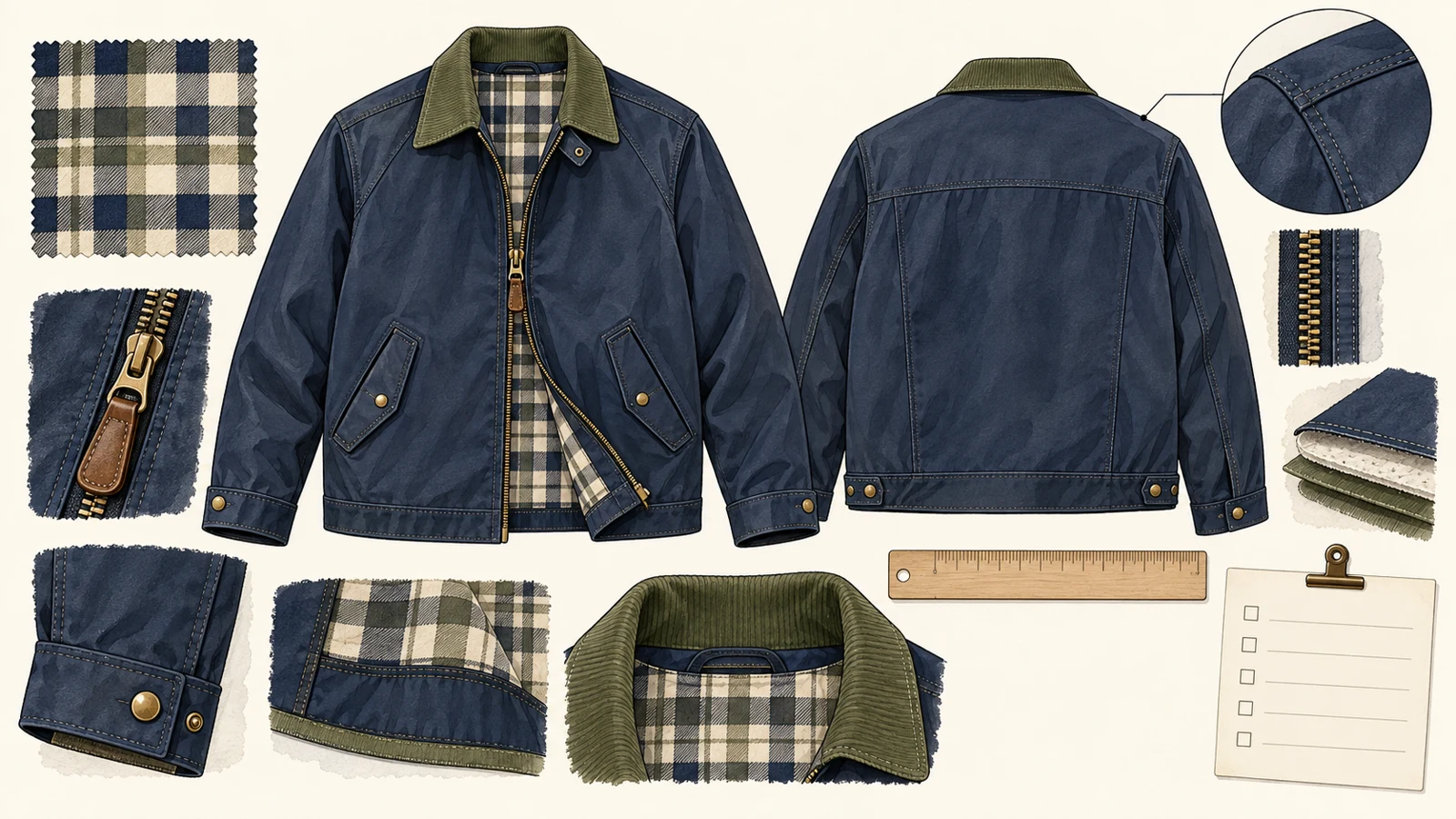
NOVITA’s published Harrington and utility specifications list a polybag with a brand sticker or a custom mailer box as packaging options. Treat these as options for a project discussion, not a claim that every size, material or receiving requirement is already included in the garment price.
| Option in the published product specification | Decision for the buyer | Evidence to request before approval |
|---|---|---|
| Polybag with brand sticker | Use it when the receiving channel accepts the agreed folded unit and label presentation. | Packed-garment fit, closure, sticker position, approved artwork and barcode mapping where required. |
| Custom mailer box | Choose it when the sales channel or approved presentation brief needs that format. | Dimensions tested with the garment, protection requirements, artwork proof and receiving compatibility. |
Keep the garment quantity and branded-component purchase quantity separate in the quotation. For the published custom-order baseline, mixed garment sizes are allowed within a style and color; that does not establish one packaging size for every garment. Test the actual packed sizes before purchasing the full packaging run, and agree who owns any remaining branded stock.
Turn the order breakdown into a carton plan
Carton planning starts with the confirmed order quantities. The carton plan must reconcile with the production size ratio, the individual-unit SKU file and the shipping packing list.
NOVITA's published private-label guide states a custom-order baseline of 100 pieces per style and color, with mixed sizes allowed. It also asks buyers to confirm label, hangtag and packaging minimums separately. For an illustrative order in two colors, that garment baseline would total 200 pieces. Build the carton plan from the confirmed size breakdown, and ask the supplier to identify any unused packaging stock, its ownership and the agreed storage or disposal arrangement. The example is not a customer order or a fixed carton quantity.
Use a carton table that can be checked against the physical contents:
| CARTON ID | STYLE | COLOR | SIZE | EXPECTED QTY | ACTUAL QTY | BARCODE / MARK | REVIEW STATUS |
|---|---|---|---|---|---|---|---|
| CTN-001 | TEE-A | Navy | S | Buyer to enter | Count at packing | Buyer to supply | Pending |
| CTN-001 | TEE-A | Navy | M | Buyer to enter | Count at packing | Buyer to supply | Pending |
| CTN-002 | TEE-A | Stone | S | Buyer to enter | Count at packing | Buyer to supply | Pending |
If cartons contain mixed variants, identify the mix explicitly. If a warehouse requires one SKU per carton, state that requirement before the packing plan is priced. Record the carton dimensions, gross weight, marking layout and any transport or warehouse restrictions once the actual pack has been tested.
A correct total piece count can hide an assortment error. Check totals by style, color and size, then reconcile those subtotals with the carton plan and final packing list.
Approve one complete packed sample
Packaging sign-off is more reliable when the buyer reviews one finished garment with its final labels, hangtag, unit bag, sticker and representative carton markings. Keep the approved physical sample or dated photographs alongside the specification. Keep this approval aligned with the garment’s sample development record.
Use an approval record with these fields:
| COMPONENT | FILE / REFERENCE VERSION | WHAT WAS CHECKED | DECISION | CORRECTION OWNER |
|---|---|---|---|---|
| Main label | Artwork revision | Size, position, attachment | Pending | Buyer/supplier |
| Care and content label | Approved legal copy | Wording and placement | Pending | Buyer |
| Hangtag | Print proof | Artwork and attachment | Pending | Buyer/supplier |
| Barcode / SKU | Buyer data file | Scan maps to correct variant | Pending | Buyer/warehouse |
| Individual bag | Pack sample | Fold, protection, sticker | Pending | Buyer/supplier |
| Carton | Packing plan | Assortment, marks, count | Pending | Buyer/supplier |
This is a blank working template, not a completed inspection record. Mark any component not represented by the sample as pending. Do not silently approve it.
When a label file changes after the pack is approved, update the controlled artwork and the pack record. The supplier should confirm whether the change affects lead time, minimum purchase quantities or the agreed quotation.
Check packing before shipment
Before cartons are closed, confirm that the latest specification is available to the packing team. During packing, verify the actual size and color labels against the garments and approved SKU file. Check the barcode data and carton markings on the packed units, not only on a design proof.
A useful final record identifies the lot or purchase order, carton IDs, expected and counted quantities, discrepancies, photographs and the person authorized to release or hold the shipment.
Packing checks are one part of a wider quality plan. For garment measurements, workmanship and inspection decisions, refer to the apparel quality control checklist. The clothing manufacturing RFQ checklist covers the broader quotation brief. This page is specifically about what the packing team needs to execute the approved order.
What to send your manufacturer
For a private-label packaging quote or approval, send the product style and quantity by color and size, target market, sales channel, label and hangtag artwork, approved product-information copy, SKU and barcode mapping, fold and bag requirements, carton assortment rules, shipping marks and the proposed approval process.
If an item is undecided, mark it as open and ask what options are feasible for that particular garment. The factory can review the proposed scope, but the brand should own its retail data and final destination-market requirements.
NOVITA supports OEM, ODM and private-label men's casualwear projects. For print and embroidery choices before labels and packing, see our apparel finishing overview. Review our private label apparel services, then share your garment reference, branding requirements and packing brief through the contact page so the team can review what is needed for a project-specific quotation.