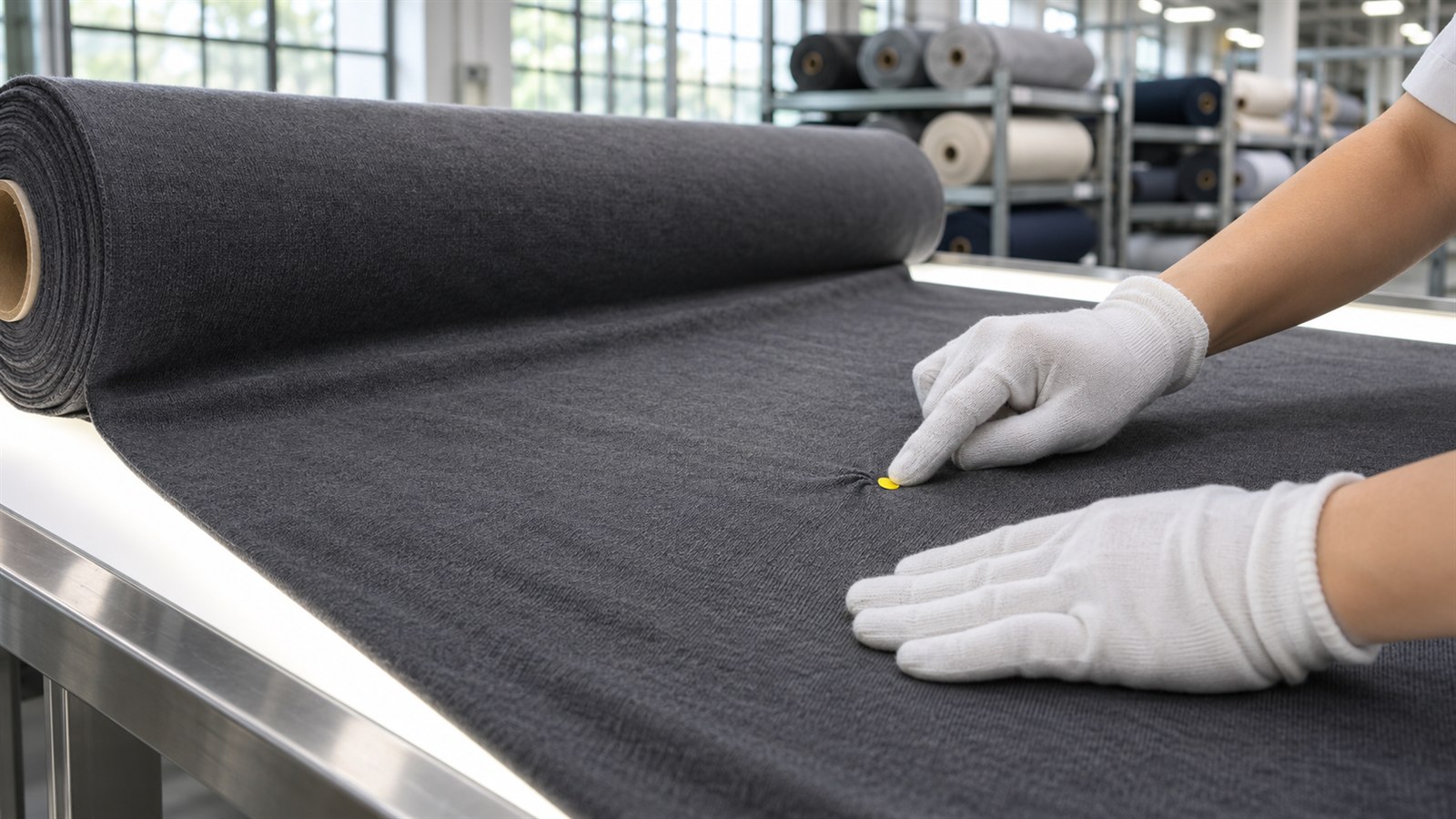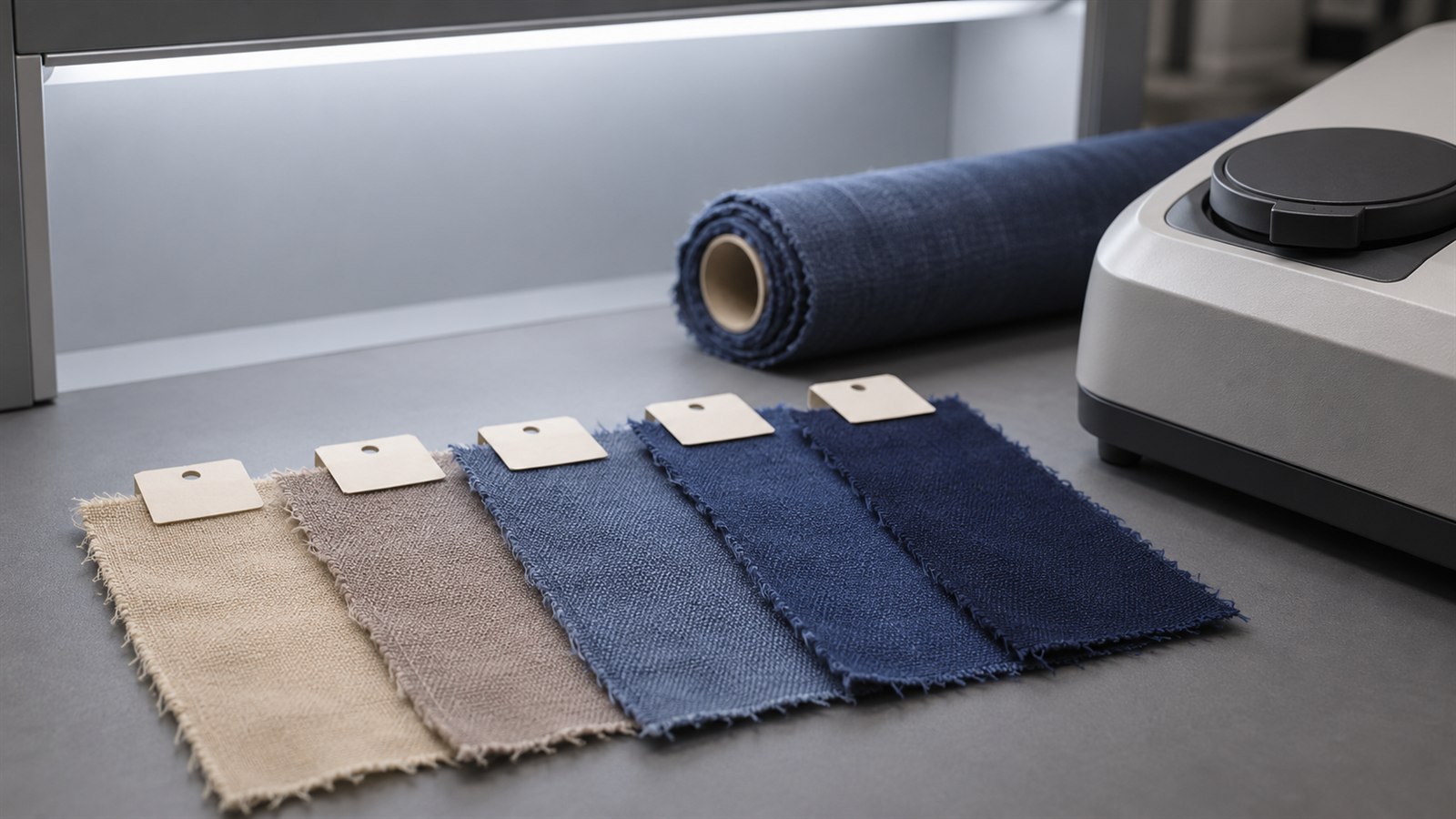
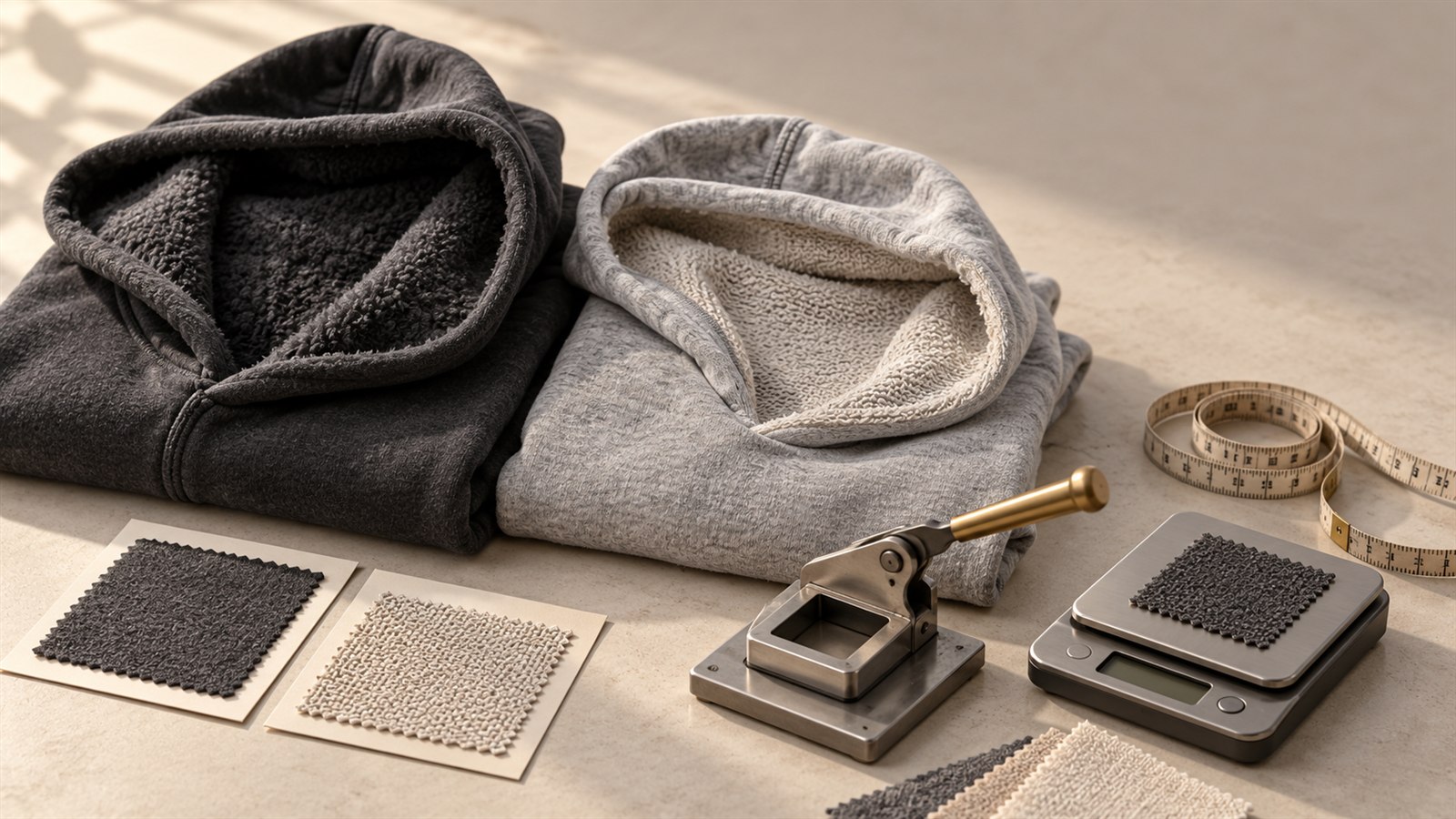
A heavyweight hoodie often starts around 340 to 400 GSM in supplier descriptions, but there is no shared commercial cutoff. GSM measures fabric mass per square metre, not thickness, warmth or finished garment weight. A dense loopback and a lofty brushed fleece can carry the same number and make noticeably different garments.
Published guides disagree: B2B Sportswear starts heavyweight at 340 GSM; Gracefiber uses 350+; Dechoreal lists 400 to 500+. Speech Clothing describes 350 GSM as an everyday heavyweight option. These labels leave buyers comparing different specifications.
When ordering a heavyweight hoodie, ask the mill to identify the finished fabric, test condition and acceptance limits in the quotation.
What GSM means and how it is checked
A mass measurement, not a thickness reading
A mill’s quoted GSM is a nominal target. To check it, cut a specimen of known area, weigh it on a suitable calibrated balance, and divide its mass in grams by its area in square metres. A caliper measures thickness; it cannot confirm GSM.
For example, a hypothetical 0.01 m² specimen weighing 4.00 g gives:
4.00 g ÷ 0.01 m² = 400 g/m² = 400 GSM.
Agree the conditioning procedure and measurement stage. Moisture and finishing can affect the result; a greige-fabric reading is not automatically comparable with a finished, washed-fabric reading.
ASTM D3776’s published abstract distinguishes full-width sampling from small-swatch testing. A small-swatch result applies to that specimen, not necessarily its whole lot. Ask for a documented bulk sampling plan: one development swatch cannot establish shipment conformity. The linked page is a historical edition’s public abstract; agree the applicable method and edition with the laboratory.
Converting GSM to oz/yd²
Using the NIST conversion factor, rounded for buying discussions:
1 oz/yd² ≈ 33.906 GSM oz/yd² = GSM ÷ 33.906 GSM = oz/yd² × 33.906
Thus 400 ÷ 33.906 ≈ 11.80 oz/yd². Confirm that an “oz” quotation means ounces per square yard, not total garment ounces. For the broader terminology, see the fabric-weight GSM explainer.
Weight bands buyers can use
Use these proposed quotation bands only after agreeing them with the mill for your order. They are not a grading standard. Always compare actual GSM because supplier labels overlap; ounce values below are calculated and rounded.
| Working band | GSM | Approx. oz/yd² | Typical end use | Commercial implication |
|---|---|---|---|---|
| Lightweight | Below 280 | Below 8.26 | Layering, lighter seasonal styles | Check opacity and hand feel; low mass does not prove low cost. |
| Midweight | 280 to below 340 | 8.26 to below 10.03 | Everyday custom hooded sweatshirts; 330 GSM is a comparison point | A practical starting sample when wearability matters more than maximum heft. |
| Heavyweight | 340 to below 450 | 10.03 to below 13.27 | Structured casualwear; 400 GSM is a comparison point | Reassess fit, seams and decoration rather than changing the cloth alone. |
| Ultra-heavyweight | 450+ | 13.27+ | Deliberately substantial, niche silhouettes | More material mass per area; handling and construction need sampling. |
At the reference points, 280 GSM ≈ 8.26 oz/yd²; 330 ≈ 9.73; 450 ≈ 13.27. Specify the number even when buying heavyweight blank hoodies: the category label alone leaves room for a materially different supply.
A search for a 700 gsm zip up hoodie describes an exceptionally heavy target: about 20.65 oz/yd², not a universal quality tier. Expect substantial garment mass; test drape and the stacked layers at the zip, pocket and hood seam. Needle penetration, feeding and seam bulk may constrain construction. Feasibility needs a fabric-and-sewing trial, not an assumption about NOVITA’s available range.
Same weight, different fabric
Specify the reverse-side construction and finish, not just “fleece.” NOVITA’s French terry hoodie page identifies a loopback reverse; its brushed fleece hoodie page provides the alternative product reference. Neither name guarantees a particular GSM.
“Terry fleece” is ambiguous buying language. Ask whether the offered cloth has intact loops, a brushed reverse, or another construction. Approve labelled face-and-back swatches before comparing quotes.
These are sampling expectations to investigate, not measured results for NOVITA fabrics:
| Construction | At 330 GSM | At 450 GSM | Shrinkage, surface and decoration checks |
|---|---|---|---|
| Brushed-back fleece | A raised back can feel soft and lofty without maximum mass. | More substantial mass with the brushed hand; actual stiffness depends on construction. | Check lint and back-face pilling; confirm whether the decoration face is smooth or raised. |
| Loopback French terry | Exposed reverse loops give a different contact feel from brushing. | Can offer a weighty, compact hand without a fluffy reverse. | Check loop snagging, recovery and wash change; test artwork on the actual face. |
| Fabric sold as “terry fleece” | No reliable prediction until the mill defines it. | The higher target does not resolve that ambiguity. | Rename it in the specification by construction and finish, then run the relevant trials. |
There is no defensible rule that either 330 or 450 GSM must shrink or pill more. Yarn, fibre blend, knitting and finishing matter. LOMERAQ’s construction comparison distinguishes raised-fibre pilling and lint from loop snagging; use those as inspection prompts, not guaranteed outcomes. A high GSM hoodie still needs its own wash and surface evaluation.
What heavy fabric does to pattern and fit
Develop the heavyweight hoodie block in the intended cloth with its actual trims, especially at the 400 to 450+ GSM targets discussed here. A lighter-fabric prototype may conceal how the heavier body hangs.
Check the drop shoulder from front, side and back. Shoulder drop, sleeve volume and armhole shape must work together; adding width alone can leave the sleeve hanging awkwardly. Judge an oversized block in movement, not only laid flat.
The hood also deserves a separate check. Its lining and seam allowances add mass, which can pull at the neckline or change how it sits down. Pocket depth affects hand access and how the pouch hangs; inspect the pocket opening for stretching and the attachment seams for bulk.
Treat cuffs and hem rib as engineered components. Approve their depth, circumference, stretch and recovery relative to the body. Tight rib can make a heavy body balloon; weak recovery can leave an unwanted open hem. Record the intended silhouette in fit photographs and measurement comments. The hoodie manufacturing guide covers the wider style and construction choices.
Shrinkage, recovery and surface durability
Require dimensional-stability evidence before bulk cutting. Agree the wash and drying procedure, number of cycles, conditioning and measurement points; do not import an unexplained shrinkage percentage from another fabric.
Measure body length and width, sleeve length, hood shape and rib openings before and after the agreed care procedure. Record growth as well as shrinkage. Compare shell, pocket and rib behaviour: mismatched dimensional change can distort an otherwise acceptable garment. For recording principles, use the pre-bulk shrinkage testing checklist, adapted to hoodie measurements.
For recovery, agree how cuffs and hem are extended, allowed to recover and measured. For surface durability, specify the pilling test method, exposure and acceptance grade with the mill or laboratory. Assess face and back where relevant; distinguish pills, shedding and loop snags. The fabric-pilling guide explains why these require separate observations.
Keep the approval record traceable: fabric code, colour and lot, care procedure, results, photographs, signed comments and a retained swatch. GSM cannot substitute for any of these results.
Decoration on thick fleece
Embroidery: support the stitches without making a board
For a custom embroidered heavyweight hoodie, approve a sew-out on production-representative cloth. Backing or stabiliser supports the knit; a suitable topping helps stop stitches disappearing into a raised surface. Plixa Labs’ fleece embroidery guide describes cut-away backing, topping and underlay as separate controls.
Do not simply increase stitch density to cover pile. Excessive density can stiffen the logo and contribute to distortion. Agree backing type, underlay, lettering size and coverage from a trial; judge the reverse against the intended next-to-skin use.
Hoop pressure compresses raised fibres and can leave a visible ring. Madeira’s hooping guidance stresses stabilisation without stretching the fabric. Judge hoop marks and pile crushing after the agreed recovery or care procedure, against a signed appearance reference. Do not promise every mark will disappear.
Printing: check the face, not the fleece label
A brushed back does not necessarily mean a brushed print face. On a raised face, verify coverage, edge definition and whether fibres interrupt fine detail. Heat and pressure can flatten pile or leave a contrasting surface patch. Approve print hand, adhesion and washed appearance on the selected finish, especially where a garment wash follows decoration.
Write weight into a testable tech pack
For a heavyweight hoodie order, write the selected fabric and acceptance basis into the tech pack. Assign the responsibilities below in the order agreement. See how a clothing factory reads a tech pack for version control and approval context.
| Property | How it is stated | How it is verified | Who signs off |
|---|---|---|---|
| Body fabric | Fabric code, composition, knit construction, face/back finish and approved swatch | Compare identified bulk material with retained reference | Buyer developer and mill |
| Nominal weight | Selected finished-fabric GSM; state whether before or after garment washing | Known-area specimen mass under agreed conditioning and test method | Mill QC; buyer quality approver |
| Weight tolerance | Agreed with the mill per order, written as acceptance limits before booking | Report individual readings and agreed summary; flag out-of-limit results | Buyer and mill |
| Bulk sampling | Lot/colour coverage, roll selection, across-width positions, specimen count and retest rules, all agreed | Trace readings to rolls and sample locations | Mill/factory QC and buyer |
| Shrinkage and recovery | Care procedure, measurement points and agreed limits | Before/after measurements and recovery record | Buyer technical approver |
| Surface and decoration | Pilling method/grade; approved sew-out or print; appearance criteria | Test record and comparison after agreed care | Buyer quality and decoration approvers |
| Fit and rib | Finished measurements, rib specification, hood and pocket details | Production-fabric fit sample and measurement report | Buyer technical approver |
Commercial consequences of heavier fabric
When quoting custom heavyweight sweatshirts, separate fabric mass from the other cost drivers. With pattern area unchanged, higher GSM means more mass. The final price also depends on yarn, usable width, cutting yield, finishing, rib, decoration and sewing difficulty. Do not convert a GSM increase directly into the same percentage increase in garment price.
NOVITA’s hoodie and sweatshirt manufacturing page lists brushed fleece and French terry, in-house printing, embroidery and washing, and a Foshan, China manufacturing base. Its standard custom MOQ is 100 pcs per style/colour; confirm the breakdown in the quotation. Sample development is typically 7 to 15 days after materials and construction are confirmed; bulk production is 60 days after sample approval, depending on quantity and fabric availability.
Those terms are not a guarantee for every heavyweight hoodie project. Confirm fabric availability and any special mill minimum before committing. Use the sample-development process to plan fit, wash and decoration approvals rather than treating an attractive first sample as production clearance.
Buyer pre-production checklist
| Gate | Evidence to require before release |
|---|---|
| Material identity | Labelled swatch, composition, construction, finish and fabric code |
| Weight agreement | Nominal GSM, conditioning, method and mill-agreed tolerance |
| Lot verification | Traceable roll sampling plan and recorded weight results |
| Fit | Actual-fabric approval covering shoulder, hood, pocket and rib |
| Care and durability | Agreed wash, recovery and surface-test results |
| Decoration | Approved artwork trial, backing/print process and after-care appearance |
| Release | Signed sample version, resolved deviations and retained references |
Add these checks to the apparel quality-control checklist. If a lot misses the agreement, hold release and document the decision; do not average away an out-of-limit result without the agreed acceptance rule.
FAQ
What GSM is a heavyweight hoodie?
Published definitions differ: the guides compared here start at 340, 350 or 400 GSM. State the actual finished-fabric target and construction instead of relying on the weight category.
How different are 400 and 450 GSM?
For equal fabric area, 450 GSM has 12.5% more mass: (450 − 400) ÷ 400 × 100. That does not prove it is 12.5% thicker or warmer; compare matched constructions and finished samples.
How do I convert hoodie GSM to ounces?
Divide GSM by approximately 33.906 for oz/yd²: 400 GSM is about 11.80 oz/yd². This describes fabric mass per area, not the weight of an assembled hoodie.
Is heavier fabric always warmer?
No. Loft, trapped air, knit structure, fibre composition and garment fit also affect insulation. Compare fabrics under the intended wearing conditions rather than promising warmth from GSM alone.
Does heavyweight fleece suit embroidery?
It can, but stability and surface structure matter more than mass alone. Approve backing, topping where needed, digitising and hoop pressure on the chosen cloth, then check distortion, comfort and appearance after care.
How can a buyer verify the bulk lot’s weight?
Agree representative roll and colour sampling, conditioning, specimen area, weighing method and acceptance limits before production. Require traceable results against that agreement; one sample or a finished garment weighed on a scale cannot establish the entire lot’s GSM.
Sources and further reading
Industry sources and standards
- Speech Clothing: Heavyweight hoodie GSM and fit
- B2B Sportswear: Sweatshirt weight and GSM guide
- Gracefiber: GSM recommendations for hoodies
- Dechoreal: Heavyweight hoodie fabric guide
- ASTM D3776/D3776M: Fabric mass per unit area
- NIST: SI unit conversion factors
- LOMERAQ: Fleece vs French terry
- Plixa Labs: Embroidery on fleece
- Madeira: Correct embroidery hooping
Related NOVITA guides
- NOVITA: Custom hoodies and sweatshirts
- NOVITA: French terry hoodie
- NOVITA: Brushed fleece hoodie
- NOVITA: T-shirt fabric weight (GSM) guide
- NOVITA: Hoodie manufacturer guide
- NOVITA: Fabric pilling guide
- NOVITA: T-shirt shrinkage testing
- NOVITA: How a factory reads a tech pack
- NOVITA: Sample development process
- NOVITA: Apparel quality control checklist