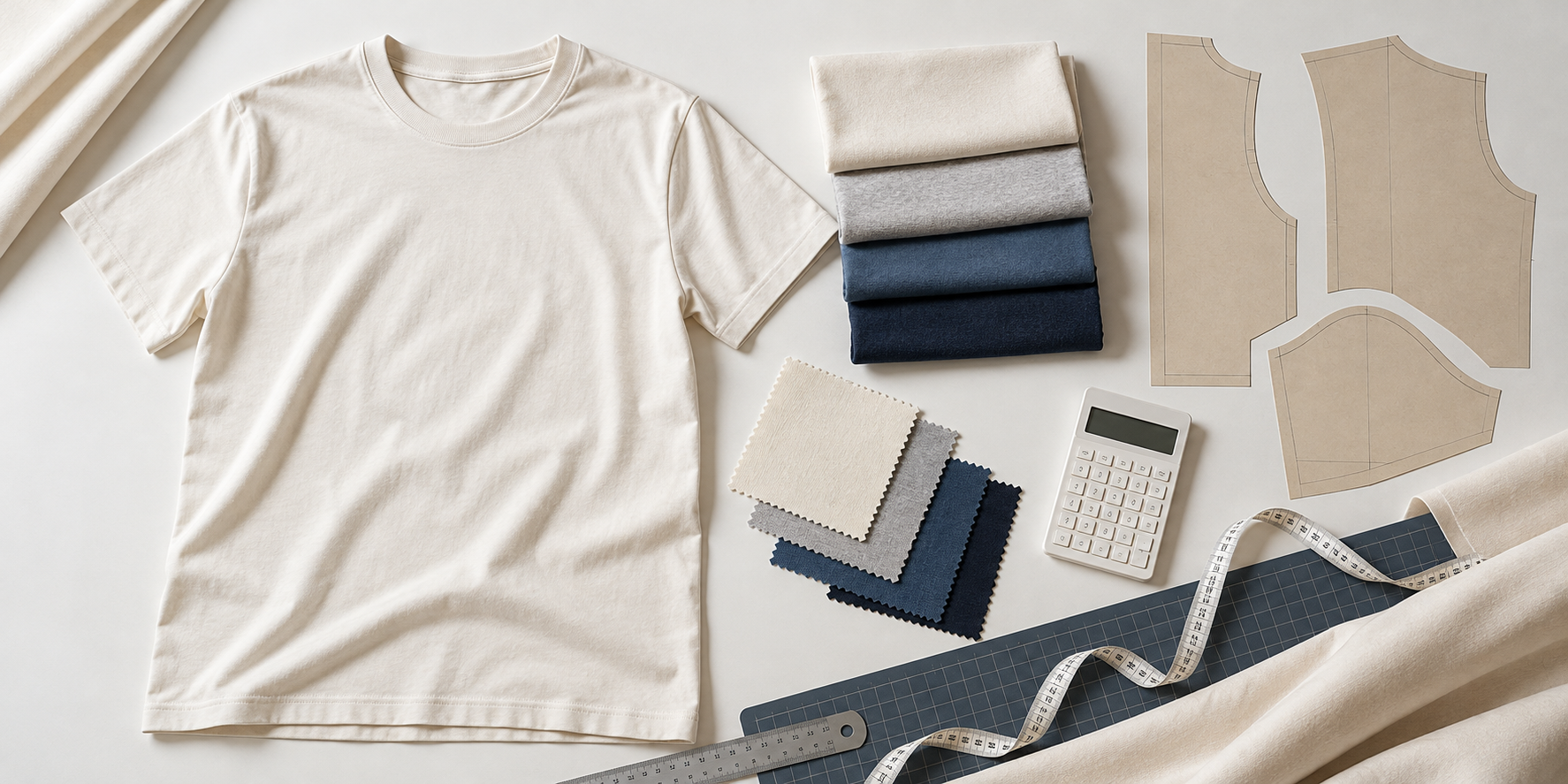
To estimate how much jersey a T-shirt uses, start with the area of its approved pattern pieces. Divide that area by the expected marker efficiency, then multiply by the fabric weight in grams per square metre (GSM). This gives an estimated fabric weight per garment before any separately justified cutting-room allowances. Once the graded patterns are ready, use the actual CAD marker and order size mix to replace the estimate.
Ask the supplier for the pattern area or CAD marker, the width used in the layout, the marker length, the garment count and size ratio, plus an explanation of any extra allowance. These are the figures you need to check a consumption claim before booking fabric.
What does “fabric consumption per T-shirt” mean?
A factory may quote kilograms per piece, kilograms per dozen, metres per piece or the total needed for an order. Converting between these units requires the same usable width and GSM. A metres-per-piece figure cannot be compared with kilograms-per-piece until those inputs are known.
For a crewneck jersey T-shirt, the front, back and sleeves may come from the main fabric while the neckband uses a separate rib. Confirm how the factory groups those materials. If the rib is booked separately, give it its own line instead of hiding it inside a combined kilograms-per-piece figure.
GSM measures fabric mass per square metre, not the quantity a garment consumes. Two styles cut from the same 190 GSM jersey can require different fabric lengths because their pieces and size ratios differ. NOVITA lists a 260 GSM oversized boxy T-shirt; that published product specification establishes its nominal fabric weight, but it cannot tell a buyer the style’s consumption without the graded patterns and cuttable width. The T-shirt GSM guide explains how to select the weight itself.
Which fabric consumption formula should you use?
Method 1: approved CAD marker. If the marker contains complete garments in the order’s actual size ratio:
Fabric length per garment (m) = marker length (m) / number of complete garments in the marker
Fabric weight per garment (kg) = length per garment (m) × marker width (m) × GSM (g/m²) / 1,000
Use the width stated in the marker report and the GSM of the fabric at its cutting stage. The marker can contain several sizes; divide its length by the number of complete garments represented, rather than the number of distinct sizes. If a mill invoices by roll width or by weight at a different finishing stage, reconcile that separately.
Method 2: pattern-area estimate. If the CAD marker is not ready but you have the pattern-piece areas:
Estimated marker fabric area per garment (m²) = total pattern-piece area per garment (m²) / marker efficiency (decimal)
Estimated fabric kg per garment = estimated marker fabric area (m²) × GSM / 1,000
Estimated running metres per garment = estimated marker fabric area (m²) / planned marker width (m)
Marker efficiency compares the combined pattern-piece area with the area of the complete marker rectangle. At 80% efficiency, 20% of that rectangle is space outside the nested pieces. Dividing the pattern area by 0.80 already accounts for it; applying another 20% waste charge would count that loss twice. Layout efficiency depends on fabric width, piece shape, size ratio and directional restrictions. CottonWorks’ garment-construction guidance describes how marker planning seeks to reduce unused fabric.
Worked example: estimate jersey needed for 500 T-shirts
This example is a calculation exercise. Its inputs are assumed, not measured at NOVITA or taken from a real customer order. Suppose the main jersey pattern pieces, with seam allowances, total 1.00 m² per T-shirt. Neck rib will be purchased separately.
| Input | Illustrative value | What a buyer should verify |
|---|---|---|
| Order quantity | 500 pieces | Actual size ratio, not just total quantity |
| Main-fabric pattern area | 1.00 m² per garment | CAD area report for all included pieces |
| Cut-ready jersey GSM | 190 g/m² | Bulk fabric test and agreed conditioning |
| Planned marker width | 1.60 m | Verify against the cutting marker and usable fabric width |
| Assumed marker efficiency | 80% | Replace with actual marker efficiency |
| Extra spreading/end allowance | 3% of marker consumption | Confirm it is not already in the quoted yield |
Dividing the pattern area by efficiency gives 1.00 ÷ 0.80 = 1.25 m² of main jersey per piece in the theoretical marker. At 190 GSM, that is 1.25 × 190 ÷ 1,000 = 0.2375 kg, or 237.5 grams, before separate allowances.
At a 1.60 m marker width, the length is 1.25 ÷ 1.60 = 0.78125 m per garment. Assume, for this exercise only, an additional 3% purchase allowance that is not present in the marker. The estimated requirement becomes 0.2375 × 1.03 = 0.244625 kg per garment. Three percent is an example input, not a recommended industry default.
For 500 pieces, the planning figure is approximately 122.3 kg, or 402.3 running metres at the assumed width and GSM. The fabric order would then need to respect actual roll quantities and any documented reserve. Neck rib, threads, labels and losses from rejected finished garments are outside this example.
Check the result in the opposite direction. One running metre at 1.60 m width and 190 GSM weighs 1.60 × 190 ÷ 1,000 = 0.304 kg. Multiplying the unrounded length (402.34375 m) by 0.304 kg/m returns 122.3125 kg. Use unrounded figures when reconciling a quote. A mismatch usually points to a different width, fabric stage, unit or allowance.
How to check the fabric consumption on a supplier quote
Suppose a supplier quotes 0.26 kg per piece while your preliminary estimate is about 0.245 kg. That difference deserves a question, not an accusation. Compare the size breakdown, cuttable width, fabric GSM and any separately booked reserves first. If the supplier cannot explain the basis for 0.26 kg, request a marker report before signing off on the costing.
| Quote field | Evidence to request | Why it matters |
|---|---|---|
| Fabric specification | Composition, structure, approved GSM and finishing stage | Weight must correspond to the material being costed |
| Width | Actual usable width after any required preparation | Roll-label width can overstate cuttable width |
| Pattern pieces | CAD area report, with included/excluded pieces | Prevents omission or double counting |
| Marker report | Marker width, length, garments and size mix | Allows an independent yield calculation |
| Separate material | Rib, contrast panels, pocketing or other fabric | These may be costed in another unit |
| Additional allowance | Rate, definition and calculation base | Avoids charging marker waste twice |
| Commercial unit | Per kg, per metre, per dozen or per finished piece | Converts yield to comparable fabric cost |
The material calculation belongs next to the other quoted items. NOVITA’s custom T-shirt quote comparison guide covers setup charges, decoration and other terms. Fabric yield can verify part of a supplier’s cost explanation; it cannot establish the full finished-garment price on its own.
Where do fabric waste and shrinkage belong?
When a supplier lists a single wastage percentage, find out which losses it includes:
- Marker loss: fabric area between pattern pieces. It is already captured when pattern area is divided by marker efficiency.
- Cutting-room loss: spreading ends, splices and unusable sections arising outside the marker. Account for these only if they are not already present in the supplier’s booked consumption.
- Process change: width or length change after relaxing, laundering or finishing. Whether this needs an extra allowance depends on when the pattern was measured and when the fabric will be cut.
The percentage base also changes the result. Three percent extra on 100 kg of marker consumption gives 100 × 1.03 = 103 kg. If 3% of the delivered total is expected to be unusable, the purchase requirement is 100 ÷ 0.97 = approximately 103.09 kg. Those approaches answer slightly different questions. Specify the denominator before comparing allowances.
For knitted jerseys, confirm whether the GSM and width are measured before or after relaxation and any shrinkage-control treatment. Applying a shrinkage adjustment to an already compensated, cut-ready marker can overstate requirements. Our T-shirt shrinkage testing checklist explains which sample measurements buyers should approve before bulk production.
Why a shortcut based on chest width and body length can mislead
A quick formula based on chest width and body length may help at the earliest estimating stage. It simplifies a pattern into rectangles, though, and its output depends heavily on which allowances the author included. Once an actual pattern and marker exist, use those instead.
A finished chest measurement is not the same as the area of a front or back pattern piece. Sleeve curvature, neck openings, seam allowances, grainline restrictions and the size mix all affect the layout. Tubular knitted fabric adds another complication: a nominal tube width may be measured flat while an open-width marker uses the full available fabric width. Treating the two widths as interchangeable can double or halve a length estimate.
For an unfamiliar style, a shortcut may flag a quote worth questioning. The decision to buy fabric should rest on the pattern and marker evidence, with its revision date recorded.
What should buyers send before asking for a consumption calculation?
Send the current tech pack, graded size chart and size ratio, jersey specification, reference sample or construction drawing, and a list of any separate rib or contrast fabrics. Include a sample revision number so the supplier knows which measurements to cost.
In return, request the cuttable and marker widths, marker length or pattern area, size ratio, each allowance and the final quantity expressed in both kilograms and metres when appropriate. If a pattern changes after sampling, ask for a fresh calculation tied to the revised tech pack. The same worksheet can accompany your RFQ and bulk-fabric approval.
Buyer FAQ
Can I calculate fabric consumption from GSM alone?
No. GSM measures grams per square metre. You also need the area required by the patterns and a way to account for marker utilization or actual marker length. Check the weight and unit assumptions against our T-shirt GSM reference.
Should I compare a factory’s metres with another factory’s kilograms?
First convert both to the same basis using the same usable width, GSM and material stage. Otherwise, the quoted units are hiding differences rather than explaining them. Compare the full quotation scope with our T-shirt manufacturing cost guide.
Does a higher marker efficiency always mean a lower purchase quantity?
For an otherwise identical pattern, width and size mix, a more efficient marker generally reduces fabric needed in the cutting layout. It does not establish the total purchase requirement if the factories use different defect or processing allowances.
Before you approve the quotation
Attach the marker or area worksheet to the supplier quotation. Note the fabric components included, the pattern version, the measurement units and the agreed allowance rules. A purchasing colleague should be able to reproduce the estimate without calling the original merchandiser.
For a custom T-shirt manufacturing enquiry, send NOVITA the tech pack, material specification and intended size mix. Our team can review the requested manufacturing specifications and clarify the information needed for a style-specific quotation. A fabric-consumption figure still needs confirmation against approved patterns and production-stage fabric data.
Technical references
- ASTM D3776/D3776M-20(2025): official standard page covering test methods for mass per unit area of fabric.
- CottonWorks: Garment Construction: explains marker planning, cutting and pattern yield.
- Gerber AccuPlan reports: documents marker length, utilization, fabric consumption and cutting-room end loss in production planning reports.