Knitted tops are the category where buyers most often specify the wrong variable first. A tech pack that reads “7GG cotton crewneck, relaxed fit” looks complete, but the three things that actually decide the garment — gauge, yarn and knit structure — are still open.
This guide covers what to settle before you brief a knitwear supplier, and in what order.
Gauge, Yarn and Knit Structure Are Three Different Decisions
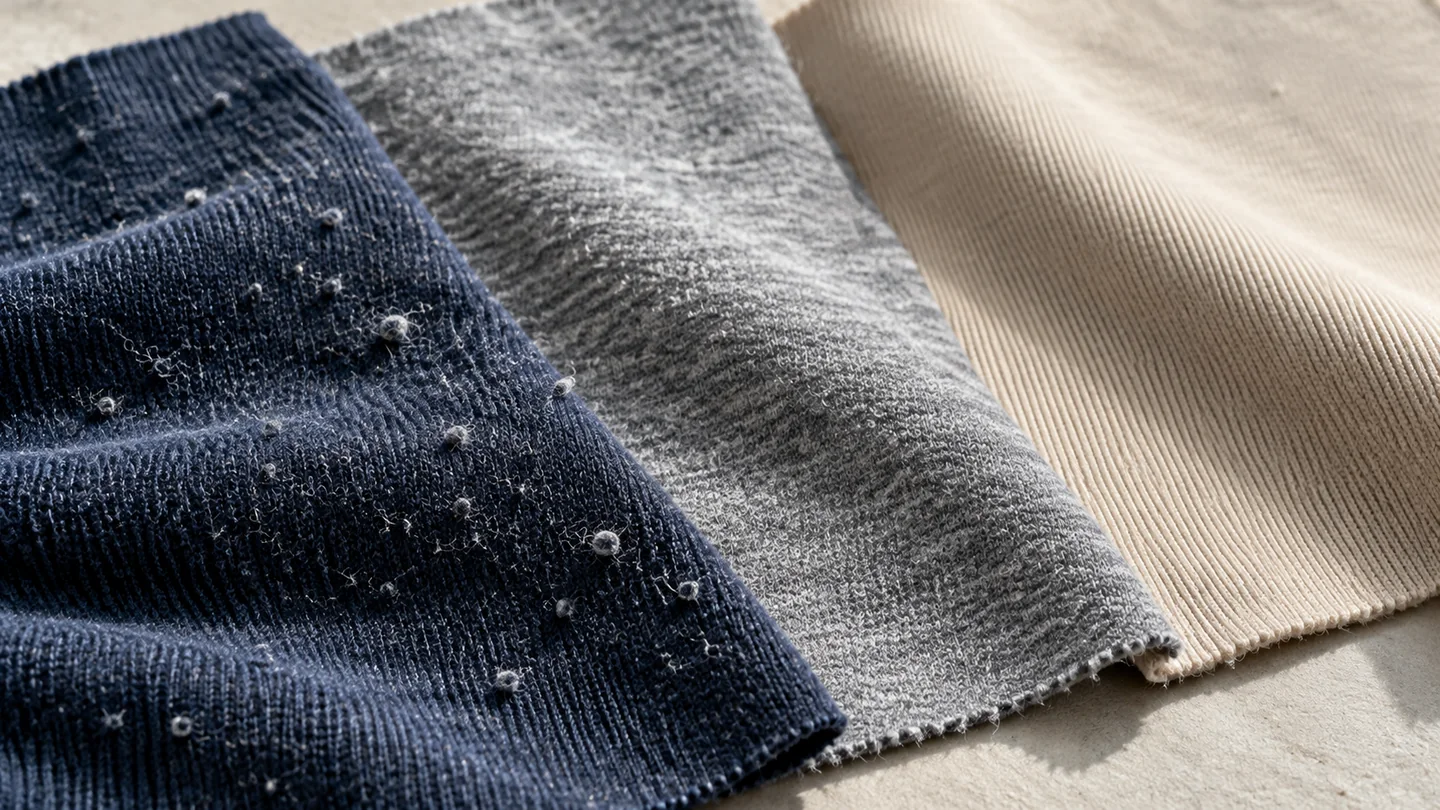
GG (gauge) describes the needle density of the knitting machine. A higher number means finer needles and a finer yarn the machine can take. It is a machine setting, not a weight.
Yarn is what you actually feel in the hand — the fibre, the count and the twist. It sets the weight far more than the gauge does.
Structure sits on top of both. Plain, rib, cable, intarsia and jacquard are all knitted on the same machines and produce completely different garments.
The practical consequence: the same 7GG can produce a light layering piece or a heavy winter sweater depending on the yarn it runs. Buyers who treat gauge as the specification end up approving a sample that feels nothing like the reference.
Settle the end use and the target hand feel first. Gauge and yarn follow from those.
Sweater or Sweatshirt? Settle This Before You Brief Anyone
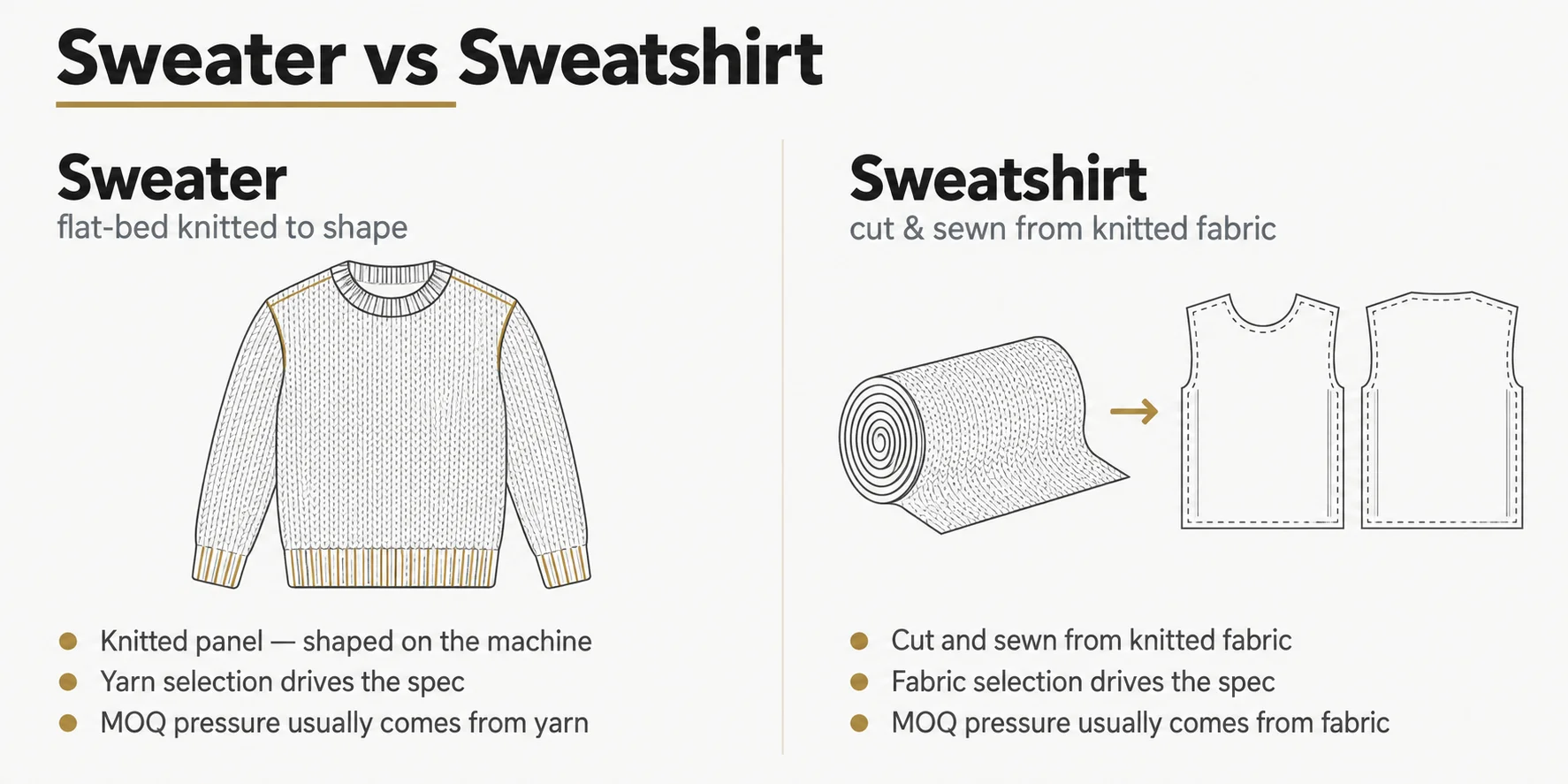
Before developing a knitwear collection, buyers should first clarify whether they need a sweater or a sweatshirt, because they follow different production processes from the yarn stage onward.
| Sweater | Sweatshirt | |
|---|---|---|
| Machine | Flat knitting | Circular knitting |
| Structure | Knitted panel, shaped on the machine | Cut and sewn from knitted fabric |
| What drives the spec | Yarn selection is critical | Fabric selection is critical |
| MOQ pressure | Often affected by yarn minimums | Often affected by fabric minimums |
| Hand feel | Real knitwear: drier, more structured | Soft, brushed, closer to a t-shirt |
A sweatshirt is a circular-knit fleece fabric cut and sewn like a t-shirt — wider sourcing options, lower unit cost. A sweater is flat-bed knitted to shape — higher unit cost, a genuine knitwear hand, different drape, and a different set of minimums.
Switching between the two late in a programme means going back to sample stage, because the machinery, the yarn and the costing are all different.
Decoration behaves differently too. Print sits well on fleece and poorly on knitwear; embroidery works on both but needs different stabilisation on each. If your range contains both, the artwork should be planned per construction rather than reused across the line.
What Each Gauge Is Actually For
| Gauge | Typical use | Buyer consideration |
|---|---|---|
| 3GG | chunky knit / heavy sweaters | more yarn consumption, heavier structure |
| 5GG | mid-heavy knitwear | balance between warmth and production efficiency |
| 7GG | everyday sweaters, knit polos, cardigans | one of the most versatile gauges |
| 12GG | fine knit tops, lightweight sweaters | requires finer yarn and more precise control |
These are direction markers, not fixed rules.
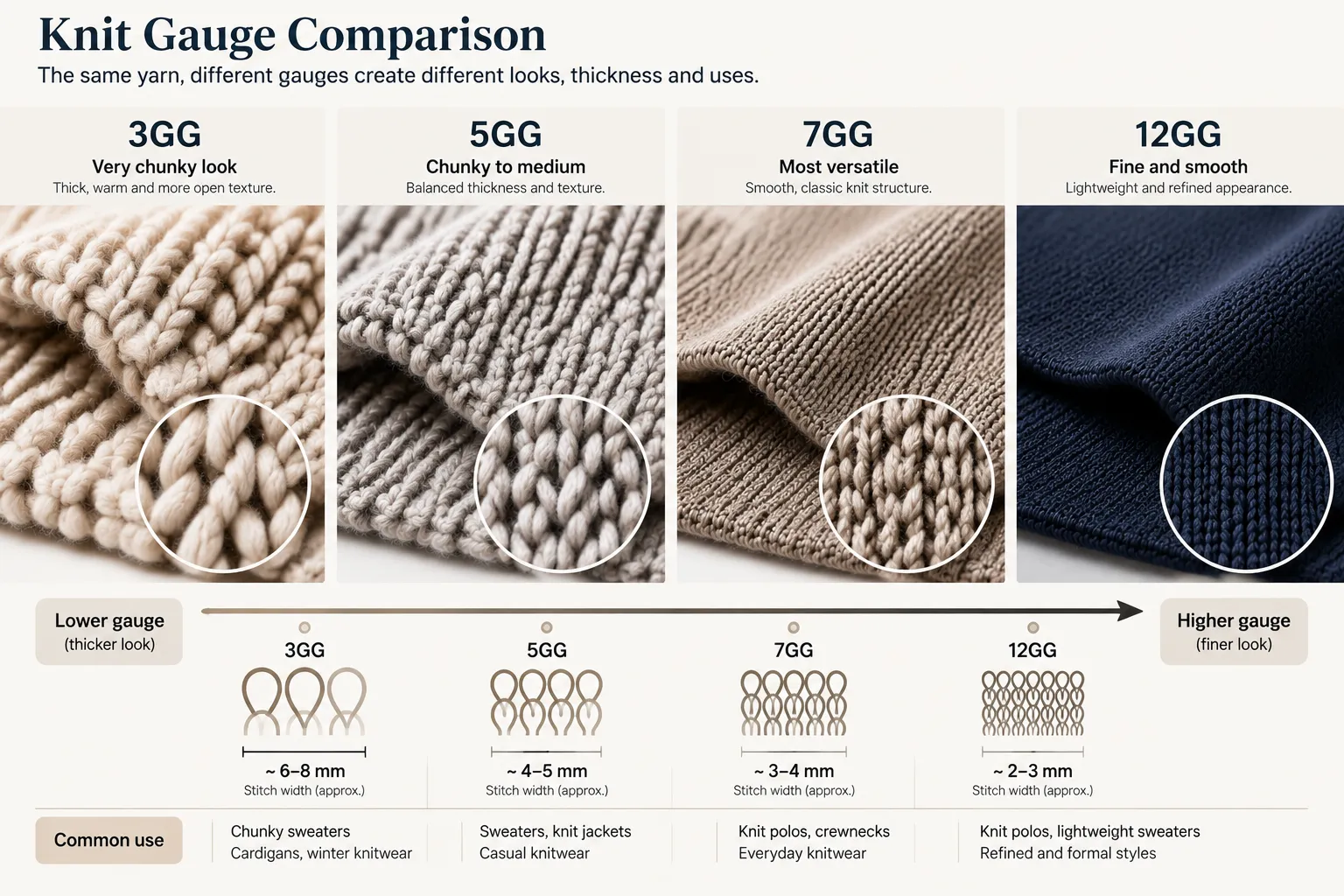
Gauge is not thickness. A 12GG usually allows a finer appearance, but final weight also depends on the yarn, the stitch structure and the finishing. A 7GG run in a heavy yarn is not light, and a 12GG run in a specialised yarn is not automatically thin. This is why the gauge number on its own cannot be the specification — it has to be read together with the yarn.
Yarn Choice Is the Hand-Feel Decision
Yarn is what the customer feels and what the garment ages into.
The honest position is that there is no single correct composition here. Fibre blend and yarn count are agreed against your target hand feel, season and end use, and then confirmed on the approved sample — the same style is regularly developed in more than one yarn for different markets.
What is worth deciding up front:
- What should it feel like in the hand? Clean and dry reads cotton. Warm and slightly fuzzy reads wool or a wool blend. A softer, more uniform hand often points to a synthetic blend, which also changes how the garment wears over time.
- What season is it for? This decides the yarn weight more reliably than any gauge target.
- Does it need to survive frequent washing? That drives the blend and the finishing, not the structure.
Knit Structures and What Each One Actually Does
| Structure | Best for | Watch out for |
|---|---|---|
| Plain / jersey knit | the base surface; clean, low-decoration styles | very little visual interest — the design has to come from the fit or the colour |
| Rib | all-over texture, or trims and plackets | all-over rib reads heavier and more traditional; a fine rib reads sharper |
| Cable / textured panels | surface interest without a print | uses more yarn and adds weight |
| Intarsia | colour blocks and motifs knitted in, clean reverse | practical colour count is limited; heavier than jacquard for the same area |
| Jacquard | multi-colour patterns and finer detail | carries floats on the reverse side, which some markets dislike |
| Chenille | soft, fuzzy letters and appliqué-style effects | a pile yarn — it sheds and behaves differently under embroidery |
| Open weave / pointelle | breathability and a summer read | shows what is worn underneath; not suited to a structured look |
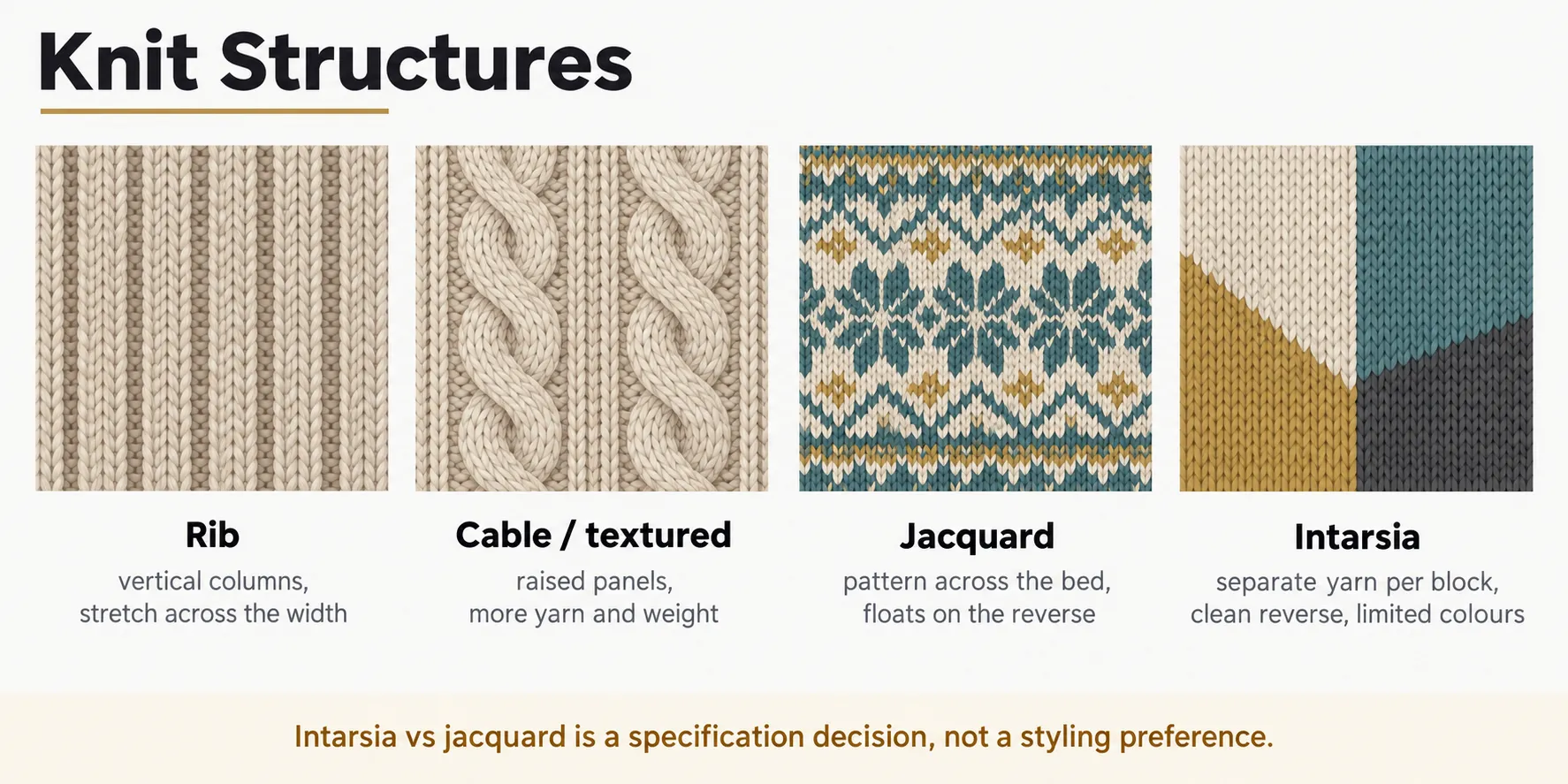
Intarsia and jacquard are not interchangeable. Intarsia knits a separate yarn for each colour block, so the back is clean but the colour count is limited in practice. Jacquard carries the pattern across the bed with floats on the reverse, which handles more colours and finer detail but leaves a backed surface. Choosing the wrong one is a specification decision, not a styling preference.
Four working examples, each built on a different one of these structures: a 5GG colour-block chunky pullover (structure as the design), a 7GG cotton-blend intarsia crewneck (intarsia), an argyle jacquard sweater vest (jacquard), and an open-weave summer knit tee (engineered openness).
Collar, Neckline and Sleeve Construction
The collar is the first thing a buyer touches and the hardest part to repeat consistently — the same is true on knitwear as on polos.
Neckline options run from crew and V through mock neck, stand collar with a zip, polo-style placket and a full cardigan placket. Each one changes how much the collar needs to hold its shape, and therefore how the yarn has to behave. A horn-button ribbed placket cardigan is a useful reference for how much structure a full placket demands from the yarn.
Sleeve construction is a real difference, not a trim choice. A set-in sleeve sits at the natural shoulder and reads cleaner. A raglan sleeve runs diagonally from the underarm to the neck and reads sportier, with more room through the shoulder. Both are produced here — compare a half-zip mock neck with raglan sleeves against a set-in textured knit crewneck sweater before you commit a range to one.
Rib height at the cuff and hem changes the silhouette more than most buyers expect. Deeper rib reads heavier and holds shape longer; a narrow rib looks cleaner but relaxes faster. Specify it rather than leaving it to a factory default.
On half-zips specifically, the zip length and the collar stand height decide whether the collar holds its shape when worn open. A stand collar that collapses looks unfinished, and it is a yarn-and-structure consequence rather than a trim one. An all-over rib build such as our ribbed quarter-zip knitted pullover behaves differently here from a smooth-body version.
Decoration on Knitwear
Embroidery works well on knitwear. A stable knit surface holds stitches cleanly, and finer or more open structures simply need additional backing — decided at sampling rather than assumed.
Printing and embroidery can both work for some applications, but knitted-in designs usually give better integration for certain knitwear styles. When the design is intrinsic to the garment — a colour block, a motif, a stripe sequence — intarsia or jacquard carries it in the fabric rather than on top of it. That is a structurally different product, not a decoration choice.
Chenille letters, woven patches and badges are all common on knitwear and all behave differently from embroidery thread on the same surface. A chenille letter varsity jacket knit is the clearest example of a knit where the decoration is the product.
Where the artwork depends on fine detail or gradients, it is worth discussing the construction before committing to a decoration method — some knitwear surfaces simply will not hold that level of precision.
Sampling: What a Knitted Top Sample Has to Prove
A knit cannot be judged from an image. Gauge, yarn and structure only become real in the hand.
One point that is regularly missed: the sample has to be washed and finished before you review it. Knitwear changes dimension and hand after finishing, so a raw off-machine sample will not tell you what the bulk will feel or measure like.
What to check on the sample:
- Gauge and hand feel against the reference
- Collar stand and roll
- Sleeve join and shoulder line
- Rib recovery after stretching
- Shade against the approved colour standard
- Measured shrinkage after the agreed wash
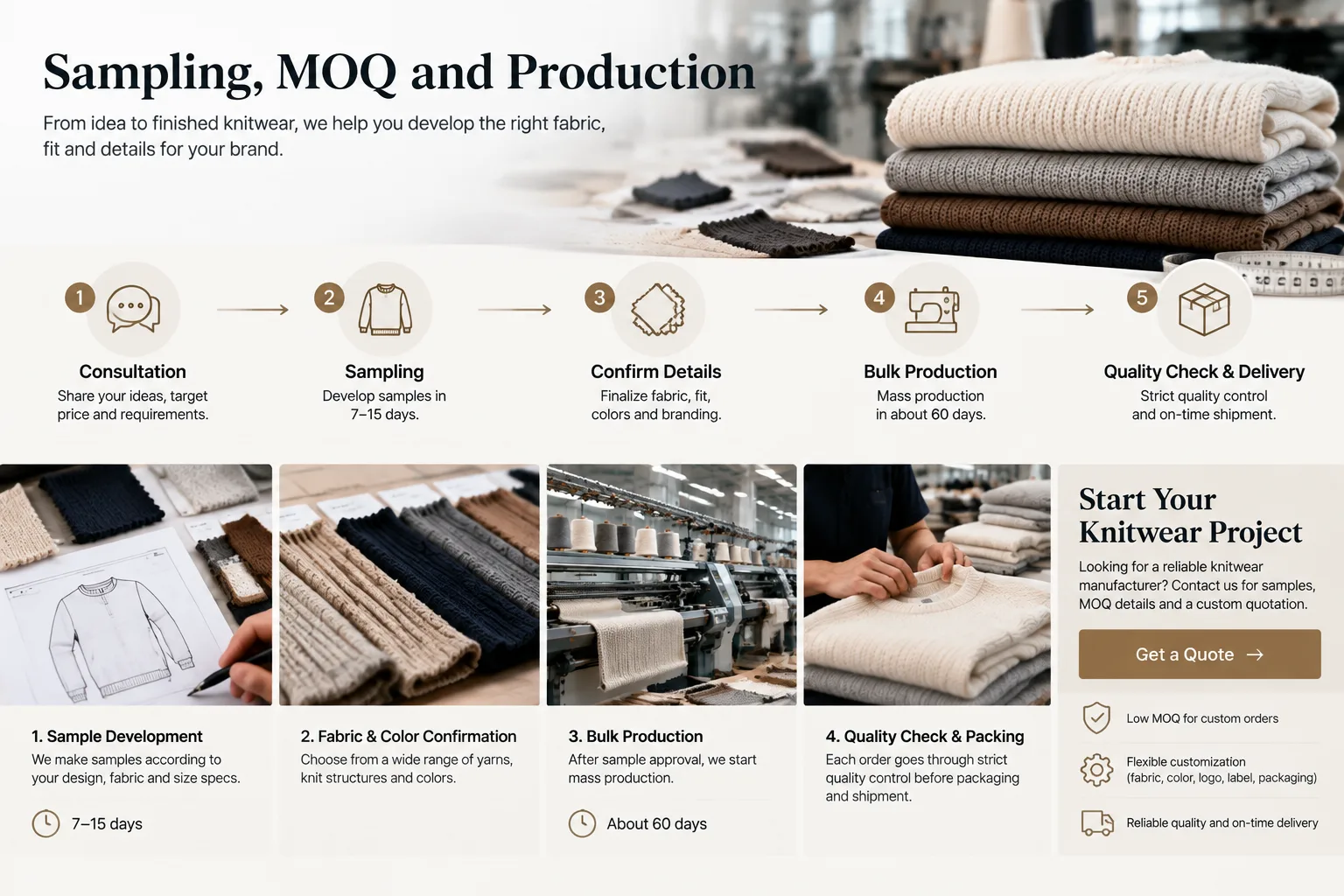
Sampling typically runs 7–15 days depending on the structure and the yarn.
MOQ, Lead Time and What Actually Moves Them
Our standard minimum is 100 pieces per style per colour, with mixed sizes allowed. Bulk production generally runs around 60 days after sample approval.
In knitwear production, yarn availability often becomes a bigger constraint than sewing materials. A special yarn, a Pantone-matched shade, a specific blend or a recycled yarn has its own minimum order — often expressed in kilograms — and its own dyeing and spinning lead time. That sits upstream of everything else on the schedule.
Colour-heavy intarsia or jacquard patterns add time as well, because each colour is a separate yarn position on the machine.
Planning consequence: confirm yarn availability before you commit to a launch date, not after.
Buyer Specification Checklist
Use this when briefing a knitwear supplier. Two quotes are only comparable when they describe the same garment.
- End use and season
- Target hand feel, with a physical reference where possible
- Sweater construction or sweatshirt construction — stated explicitly
- Gauge and yarn, or a reference garment that defines them
- Knit structure: plain, rib, cable, intarsia, jacquard, chenille, open weave
- Neckline and collar type
- Sleeve construction: set-in or raglan
- Rib height at cuff and hem
- Decoration method and placement
- Colour standard, not just a colour name
- Wash and finishing requirement
- Labels, hangtags and packaging
Frequently Asked Questions
What is the difference between 7GG and 12GG knitwear?
Gauge describes needle density on the knitting machine, so 12GG uses finer needles and finer yarn than 7GG. In practice 12GG usually gives a finer, closer appearance, but the final weight still depends on the yarn, the stitch structure and the finishing — a 7GG in a heavy yarn can weigh more than a 12GG in a fine one.
What is the MOQ for custom knitted tops?
100 pieces per style per colour, with mixed sizes allowed within that quantity.
How long does knitwear sampling take?
Typically 7–15 days depending on the structure and the yarn, followed by bulk production of around 60 days after approval.
Can I customise yarn composition?
Yes. Fibre blend and yarn count are developed against your target hand feel, season and end use, then confirmed on the approved sample. Because the same style is often developed in more than one yarn for different markets, we agree the composition with you rather than fixing a single standard.
What is the difference between jacquard and intarsia?
Intarsia knits a separate yarn for each colour block, giving a clean reverse but a practical limit on colour count. Jacquard carries the pattern across the knitting bed with floats on the reverse, which allows more colours and finer detail.
Do knitted garments shrink after washing?
Knitwear does change dimension through finishing and washing, which is why the sample should be washed and measured before bulk approval. The agreed finishing process and the measured shrinkage are recorded so that bulk matches the approved sample.
Can you produce custom knit polos and sweaters?
Yes. Our knitwear range covers sweaters, cardigans, sweater vests, half-zips and knit polos, in gauges from 3GG through 12GG, including intarsia, jacquard and chenille programmes.
Develop Your Custom Knitwear Collection With NOVITA
Develop your custom knitwear collection with NOVITA’s OEM/ODM production team. Share your design, yarn preference or target market, and we can suggest a suitable knitting solution — gauge, knit structure, decoration method and finishing.
Explore our knitted tops manufacturing capabilities or contact us with your specification to start a sample.