Why fabric defects need a written acceptance specification
A fabric inspection report can tell a buyer what was found and how it was scored. Whether the material is acceptable depends on the purchase specification: the agreed method, scoring basis, acceptance limits and requirements for the intended garment.
That distinction matters before a roll reaches the cutting table. Buyers often encounter the four-point table first and treat the resulting score as a complete quality decision. But a number without its method and acceptance basis leaves the mill, garment factory and buyer with different ways to interpret the same material.
ASTM D5430-26, Standard Test Methods for Visually Inspecting and Grading Fabrics, describes visual examination and grading. Its public significance-and-use statement warns that different point-assignment options can produce considerably different penalty totals for the same rolls. It says the same option should be used when resolving disagreements about reported values. Its scope also allows the methods to be used for acceptance of individual rolls and shipments when purchaser and seller agree.
For a sourcing team, the implication is practical: confirm the inspection rules before comparing scores. If a supplier and an inspector used different options, their disagreement may begin with the method rather than the condition of the fabric.
Acceptance needs its own instruction. A roll-level limit, a shipment-level limit and a performance requirement answer different questions. Writing them down gives the parties a reference for approval, correction or further investigation. It also helps the cutting room distinguish material that may be used from material awaiting a decision.
This article covers fabric and material-stage defects, their grading and their consequences for garment production. It does not diagnose faults created during sewing or provide a finished-garment sampling plan. Those belong to separate checks.
The buyer’s starting brief should identify the fabric and approved reference, the inspection and scoring method, the reporting basis, the acceptance line and the action required when material fails. The sections below explain what each decision needs to contain.
Common fabric defects at the mill and finishing stage
Fabric defects, also described as cloth defects, can originate in yarn production, weaving, knitting, dyeing, finishing or handling. Grouping them by production stage helps buyers ask where the problem arose and whether it is local, repeated or spread across the roll.
The following is a practical grouping used in inspection guidance. It is not a universal grading list or a statement that every named condition receives the same penalty.
| Family | Common names | Where to investigate | Buyer consideration |
|---|---|---|---|
| Woven | Broken end, broken pick, double pick, tight or slack picks, reed mark, float, starting mark | Weaving | Record the location and extent. Some local faults may be avoided during cutting, depending on the marker. |
| Knitted | Ladder or run, hole, needle line, sinker line, drop stitch, barre, spirality | Knitting and subsequent processing | Distinguish a local structural fault from a broader appearance or dimensional condition. Some problems become apparent after washing. |
| Dyeing and finishing | Shade variation, head-to-tail shading, dye or oil stains, crease marks, bowing, skewing, excessive shrinkage | Dyeing and finishing | Local stains and whole-roll conditions need different assessment. A visual point total may not capture the complete problem. |
| Yarn and handling | Slub, nep, thick and thin places, foreign fiber, contamination, knots, width variation | Yarn production and material handling | Agree which characteristics are defects for the intended use and which require separate measurement. |
Use the list to establish the vocabulary for the order. A description such as “fabric fault” is insufficient when the next decision is whether to cut around it, test the roll or hold related material. The report should identify the observed condition and its location without assuming the cause has already been established.
A local float and a head-to-tail shade change illustrate the difference. The float can be mapped to a position on the roll. A shade change may affect the relationship between panels cut from different parts of that roll. Their commercial consequences depend on how the fabric is used, and the same point-counting approach may not explain both adequately.
Discovery stage also needs to be separated from origin. A&E’s needle-cutting guidance notes that some damage attributed to sewing is created earlier, including staple holes introduced before cutting and contact with rough surfaces. Finding a hole at a sewing machine does not establish that the needle caused it.
Ask the factory to distinguish material faults from cutting or sewing damage before assigning a reason code. The purpose is to direct the investigation to the relevant process and preserve an accurate record of affected material.
The agreed defect list should also state how the fabric is viewed. Earlier accessible editions of ASTM D5430 describe one-side inspection, examination of both sides by agreement, and treatment of defects not visible on the face. These earlier-edition provisions explain why inspection-side and visibility rules belong in the order; they should not be assumed from a report headed only “fabric inspection.”
Fabric inspection scores: method, option and normalization
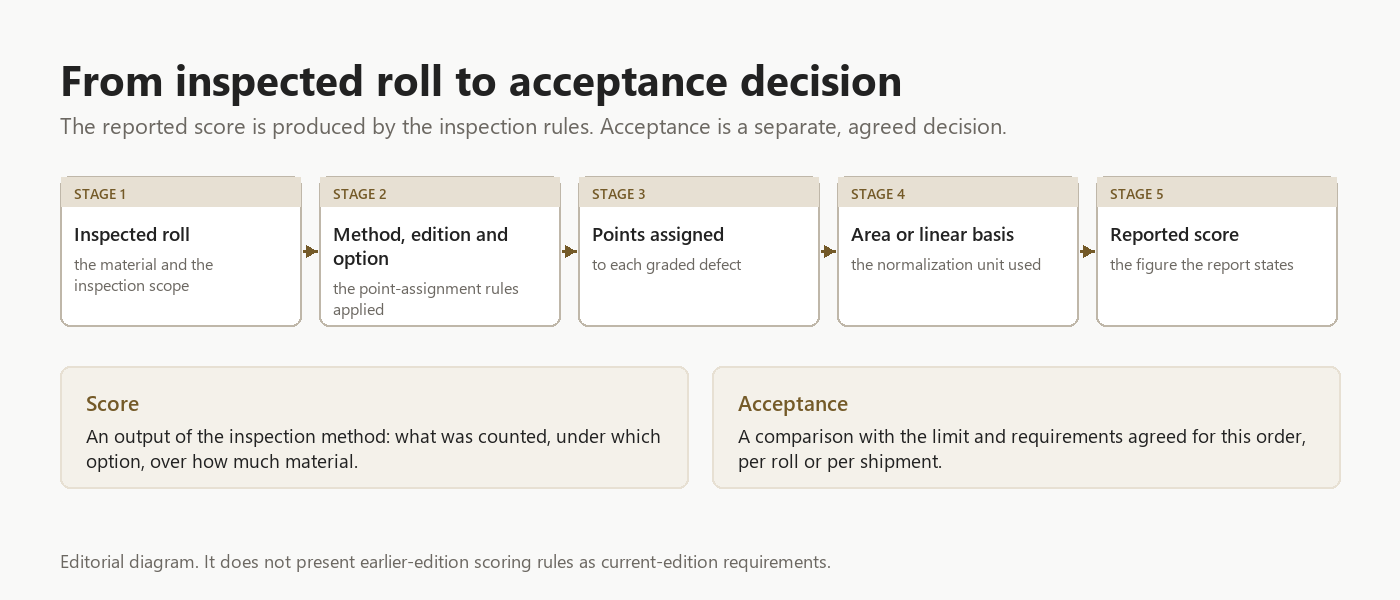
Before comparing fabric scores, establish what was counted, under which rules and over how much material. The total is the output of the inspection method, not a stand-alone property of the roll.
| Item to compare | What the buyer needs to know | Why it matters |
|---|---|---|
| Point-assignment option | The option used and its defect bands and caps | Different options can produce materially different totals on the same roll. |
| Normalization basis | Area or linear length, and the unit used | Points per square area and points per linear length are different measures. |
| Inspection scope and setup | Rolls and quantity examined, inspection side and viewing conditions | These determine the coverage and conditions of the reported observations. |
| Acceptance criteria | The limit and whether it applies to rolls, the shipment or both | A score needs the agreed criterion before it supports an acceptance decision. |
The four-point system is not the whole ASTM method
ASTM D5430 provides more than one point-assignment option. The commonly called four-point system should therefore not be used as a synonym for the entire method.
In an earlier accessible edition of ASTM D5430, the option identified as Option A assigns one point to defects of 75 mm (3 inches) or less, increasing to four points for defects longer than 230 mm (9 inches). That edition caps the total at four points within any one linear meter or yard.
Other options in the same earlier accessible text differ in their length bands and ceilings. One separates warp and weft bands and allows up to ten points within a linear meter or yard. The difference is substantial enough to change the roll’s reported total even though the fabric is unchanged.
These scoring details describe the earlier accessible edition. They are not presented as confirmed wording from D5430-26. The current publicly verified material supports the conclusion that options can yield different scores; it does not establish their exact number. The order and report should identify the chosen method, edition and option explicitly.
Earlier accessible reporting provisions also call for the option to be named. For buyers, carrying that identifier into the report is a useful way to make the mill’s inspection and a later reinspection comparable.
A total needs a denominator
In an earlier accessible edition of ASTM D5430, normalization is expressed on area or linear-length bases: points per 100 square meters, per 100 square yards, per 100 linear meters or per 100 linear yards.
Area-based grading takes inspected width into account; linear grading does not. A report of points per 100 linear yards cannot be compared directly with a limit per 100 square yards. Ask for the total points and inspected dimensions so the reported basis can be followed.
Metric and imperial area figures also need conversion before comparison. Eurofins’ published figure of 24 points per 100 m² converts to approximately 20 points per 100 yd². This is an arithmetic conversion, not a new acceptance recommendation. It illustrates why the unit must travel with the number.
Use the same basis for the score and its acceptance limit. If a report switches units, retain the original data and show the conversion rather than comparing the printed figures alone.
Match the inspection conditions
Record which side was inspected, how much of the shipment was examined and the agreed viewing conditions. Differences in illumination, viewing distance or line speed can affect what is detected. A report describing only “four-point inspection” leaves these conditions unclear.
A low average also needs context. Defects concentrated in one section can affect cutting even when the roll’s overall point total is low. Keep location records alongside the score so production teams can assess the usable material.
When a report arrives, check the calculation inputs before accepting its conclusion. Confirm that the roll identities, inspected length and width where relevant, total penalties and reporting unit are present. Then compare the normalized result with the criterion for that same roll or shipment. If an input is missing, request clarification rather than treating the stated grade as independently reproducible.
Why 40 points is not a universal pass/fail rule
Forty points per 100 square yards appears frequently in fabric inspection guidance. It is used in some commercial contexts, but the figure needs a source, a scope and an agreed place in the purchase specification.
Current evidence does not establish 40 points as a universal ASTM D5430 pass/fail requirement.
The practical distinction is:
The scoring method tells you how defects are counted. The purchase specification tells you how many points you will accept.
Earlier accessible rejection provisions in ASTM D5430 refer to maximum acceptable levels agreed between purchaser and supplier for rolls and shipments. Those provisions support separating the scoring method from the order’s acceptance line. They do not justify treating a familiar trade figure as a universal requirement.
The examples below show how different types of document use acceptance figures. They are evidence of differing practice, not recommended limits for a NOVITA order.
| Source type and example | Published threshold or practice | Scope and limitation |
|---|---|---|
| Historical government purchase specification: CCC-C-428G, 1987 | A lot limit of 40 points/100 yd²; the lot is unacceptable if two or more individual rolls exceed 60 points/100 yd². | A historical US specification for cotton duck, not a general fabric rule. |
| Distributor purchasing requirement: alphabroder Fabric Approval Guidebook | Points/100 yd²: first quality, 25 for an individual roll and 15 for a shipment; second quality, 40 and 20. | Requirements for goods supplied to that distributor. The quality category matters. |
| Machinery-supplier guidance: Serkon | Points/100 yd²: 40 per roll and 20 for the lot average; buyers may tighten the roll limit to 20–28. | Supplier guidance distinguishing individual-roll and lot-average limits. |
| Inspection-company commentary: V-Trust | Describes some factories using up to 40 points/100 yd². | Attributes the figure to factory practice; it does not establish a universal standard requirement. |
| Testing-company practice: Eurofins | 24 points per 100 m². | A published passing score on a metric area basis. |
Read the document type and scope before adopting any number. A purchasing requirement binds the relevant supply arrangement when agreed. A supplier guide or inspection-company article describes practice. A historical government specification concerns its stated product and context. These categories should not be treated as interchangeable authority.
The alphabroder example is particularly useful: citing its second-quality figure as a general first-quality limit would reverse the distinction the guide makes. Likewise, an individual-roll limit cannot be substituted for a shipment-average limit. The aggregation level is part of the rule.
A buyer brief should state whether each inspected roll must meet its own limit, whether the shipment is assessed separately, and what happens when those results differ. Do not let an acceptable average silently resolve an individual roll that fails the agreed roll criterion.
Choose the line for the intended fabric and end use, then confirm it with the supplier before inspection. This article supplies no default threshold and makes no claim about a NOVITA inspection limit. The useful outcome is a written decision rule that the parties can apply to the same reported score.
Defect severity depends on end use and garment location
A defect name identifies a condition. Its severity depends on what that condition does to the intended product, including whether it remains visible or is removed during fabrication.
Cotton Incorporated’s fabric-defect classification material is a teaching resource, not a substitute for an order-specific standard or specification. It describes a major defect in terms of an exposed condition severe enough to put the finished item into seconds. Its minor category considers the location in the finished item and the possibility that the imperfection will be lost in fabrication.
The same material explains that an imperfection considered minor for one end use may be major for another. Garment-quality teaching references also identify visibility, saleability and garment location as classification factors. Together, these support a buyer-facing conclusion: defect severity is not determined by the defect name alone.
Size and frequency still matter. They need to be considered with end use, exposure and agreed criteria. A small condition in a prominent area may be unacceptable, while a condition removed in cutting may never reach the finished garment. Neither outcome should be assumed without checking the actual construction.
| Where the defect lands | What the factory and buyer need to assess | What to agree |
|---|---|---|
| Visible front panel, placket or collar | Exposure when the garment is worn | Visible zones and the criteria applied to them |
| Closed within a side seam | Whether construction fully conceals the condition | Treatment of closed-in areas, without assuming concealment resolves every concern |
| Hem fold or material trimmed away | Whether the condition remains in the finished garment | What qualifies as lost in fabrication |
| Beneath a pocket, waistband or facing | Coverage in the completed product | Whether the location receives a different grading treatment |
| A repeated condition across an unavoidable panel | Whether the marker can avoid it and whether it affects appearance or use | Agreed size, frequency and acceptance criteria |
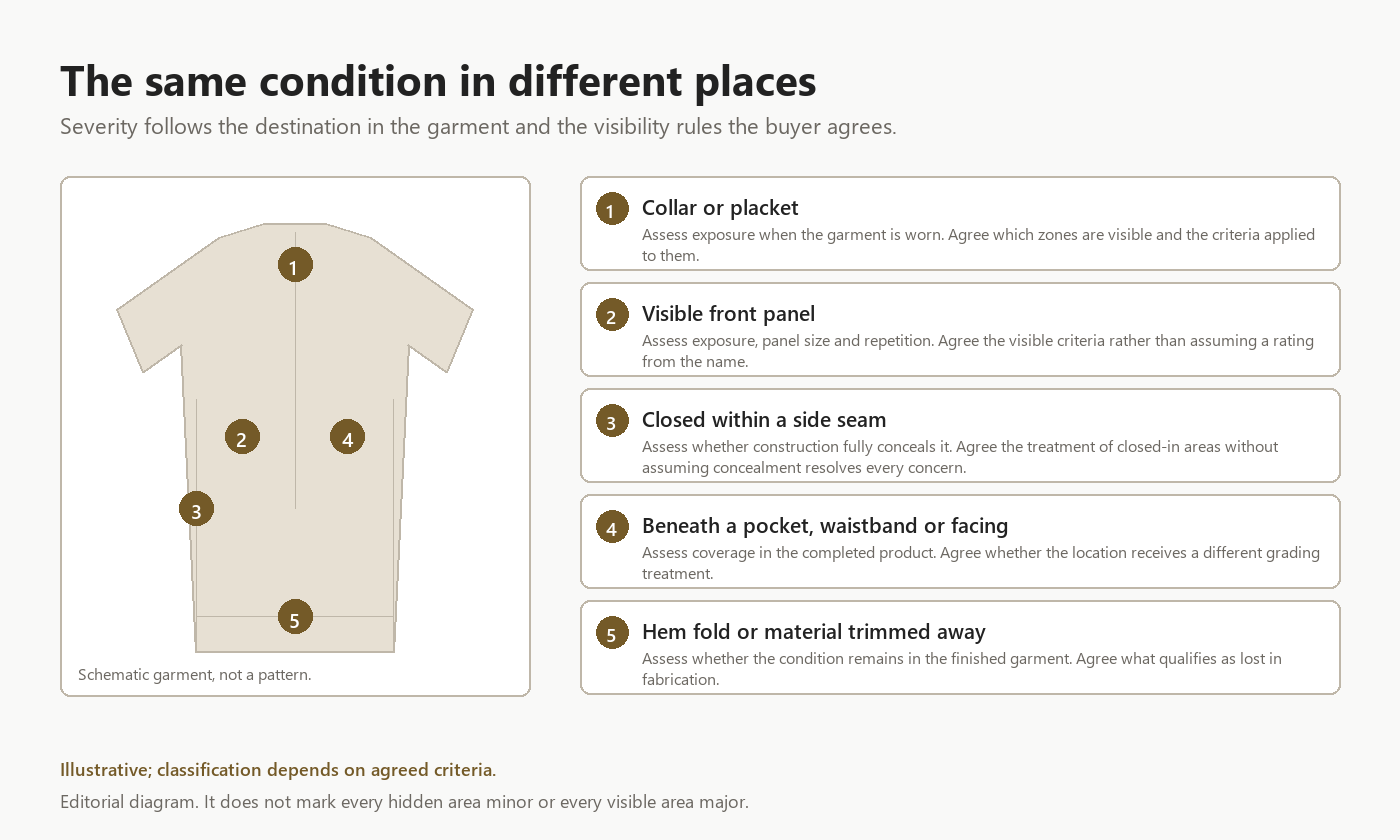
These are assessment questions rather than automatic classifications. A location map should not simply mark every hidden area “minor” or every visible area “major.” It should identify the areas the buyer treats differently and connect them to the agreed defect list.
For repeat orders, check that the map still matches the garment. A change in panel layout, pocket coverage or hem construction can change where a fabric condition lands without changing the roll itself. The specification needs to describe the current product.
Where a fabric agreement uses a critical category, define its consequence explicitly. Cotton Incorporated’s material notes that some agreements use the term for a condition sufficient to downgrade an entire roll. That agreement-specific use should not be presented as a universal definition for every fabric or finished garment.
Finished-garment defect classification and AQL sampling are a separate stage. Do not transfer their categories or acceptance decisions to a fabric roll without defining how they apply.
A workable buyer record names the defect, its size and repetition, its roll position and its likely destination in the garment. That allows the parties to assess both the fabric condition and the production consequence.
Separate checks a four-point score cannot replace
A visual point score is one inspection result. It does not by itself establish whether the fabric meets every dimensional, color or performance requirement after processing and use.
Some clothing defects originate in material behavior that is not reliably captured by a local defect count. A fabric can score well visually and still show unacceptable shrinkage, shade differences, bow, skew, spirality or colorfastness under the buyer’s agreed requirements.
Textile technical guidance identifies the following separate checks. Their methods and limits must be selected for the order; the table does not prescribe a testing program or acceptance values.
| Check | What to assess separately | What the buyer should specify |
|---|---|---|
| Dimensional stability | Shrinkage or growth after the relevant care or finishing process | Method and care cycle (for example ISO 6330 washing procedures, ISO 3759 marking and ISO 5077 dimensional change), measurement stage and limit |
| Shade consistency | Variation within a roll, between rolls or between lots | Approved reference, comparison conditions (for example visual rating to AATCC EP9), grouping and approval rules |
| Bow and skew | The geometry of the fabric across its width | Method (for example ASTM D3882), measuring position and limit |
| Spirality | Twist that becomes apparent after laundering, particularly in relevant knits | Method (for example ISO 16322 or AATCC TM179), laundering conditions and limit |
| Colorfastness | Color change or staining under the relevant exposure | Test method and conditions (for example ISO 105-C06 or AATCC TM150) and required result |
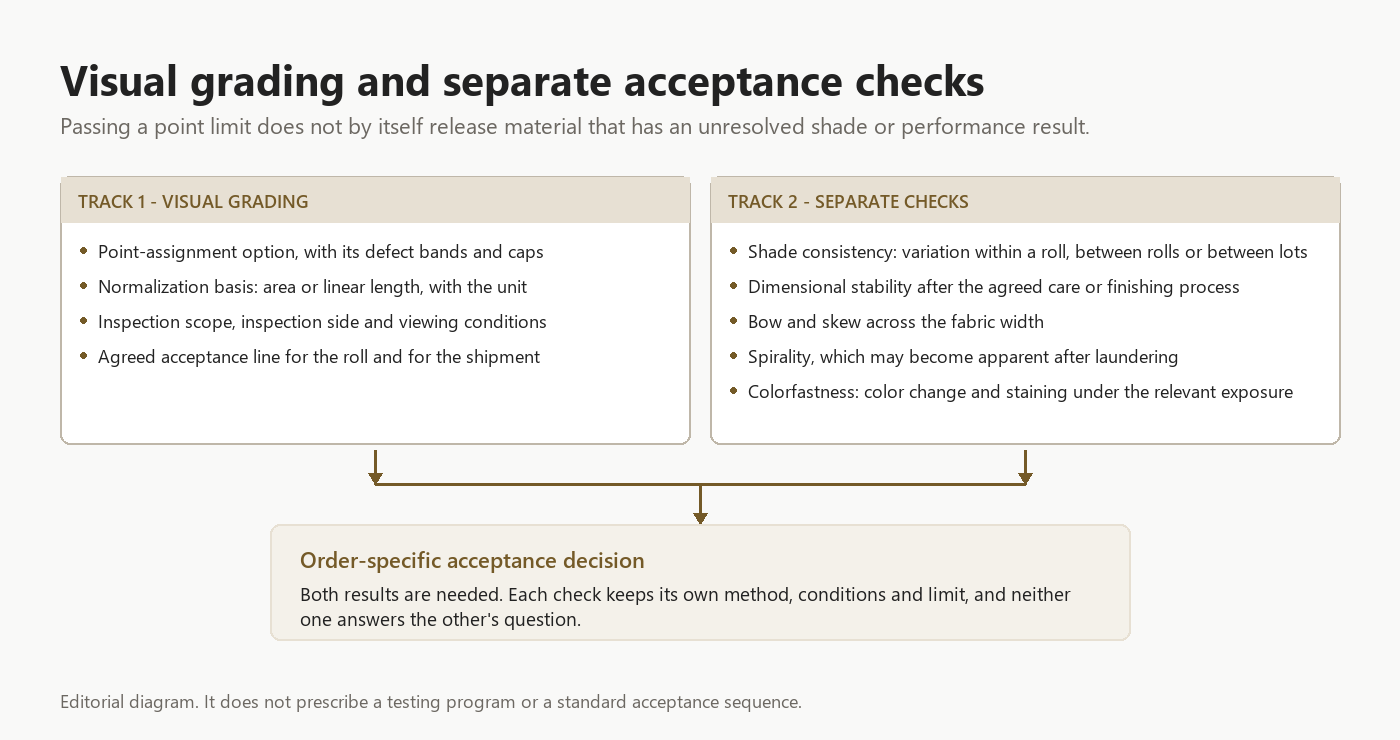
Keep the approved color reference and shade-group records connected to the roll identities. Grading each roll individually does not establish that panels cut from different rolls will match. Where shade grouping applies, the cutting plan needs to preserve those groups.
Dimensional checks likewise need the intended care or finishing conditions. Comparing an unwashed measurement with a post-wash limit, or reports produced under different conditions, leaves the result open to interpretation. Record the method and condition with the value.
Bowing, skewing and spirality should remain distinct assessment items rather than being hidden under “fabric appearance.” The source guidance notes that rolls can relax during storage and transport, and that measuring positions and methods can differ. Agree the relevant measuring points so mill and factory records can be reconciled.
Testing conditions and any required conditioning are part of the method. Keep them with the reported result so a later comparison uses the same basis.
Also review the distribution of visible defects. A low point average can conceal a cluster in material required for a large panel. A defect map helps the cutting room make that distinction without treating the average as proof that every section is equally usable.
Give visual grading and these separate requirements their own acceptance decisions. Passing the point limit should not automatically release material that has an unresolved shade or dimensional result.
Finding fabric defects at cutting: recovery, records and next steps
When a defect appears during spreading or cutting, establish which material is affected and preserve its identity before deciding how to recover production. An earlier inspection result represents its agreed scope; it does not settle every condition revealed when the roll is laid out or cut.
Decide whether the material can be recovered
Cutting-room guidance describes practical responses: mark defects so spreaders can identify them, avoid defects where the marker permits, replace affected panels, keep shade groups separate and report newly found conditions to the supplier.
Avoidance depends on the marker and defect position. A fault beneath a large body panel may be impossible to bypass without losing the piece. A local fault elsewhere may be removable through the cutting arrangement. Ask the factory to show the affected pieces and material loss rather than assuming that every defect could have been cut around.
Replacement panels also need shade and lot control. Recutting can restore quantity while introducing a mismatch if the replacement comes from unsuitable material. Record the source of the replacement and the reason for the recut.
Separate material faults from cutting faults
A high recut rate shows a production problem, but does not identify its cause. Practitioner guidance lists fabric faults, cutting errors, shade control and later damage among possible contributors. Use reason codes tied to the investigated cause rather than labeling every recut “fabric defect.”
Compare the observed condition with the approved fabric and the agreed defect criteria. Where origin remains uncertain, keep that uncertainty in the record. The investigation should establish what happened before the commercial discussion assigns responsibility.
Preserve a traceable evidence set
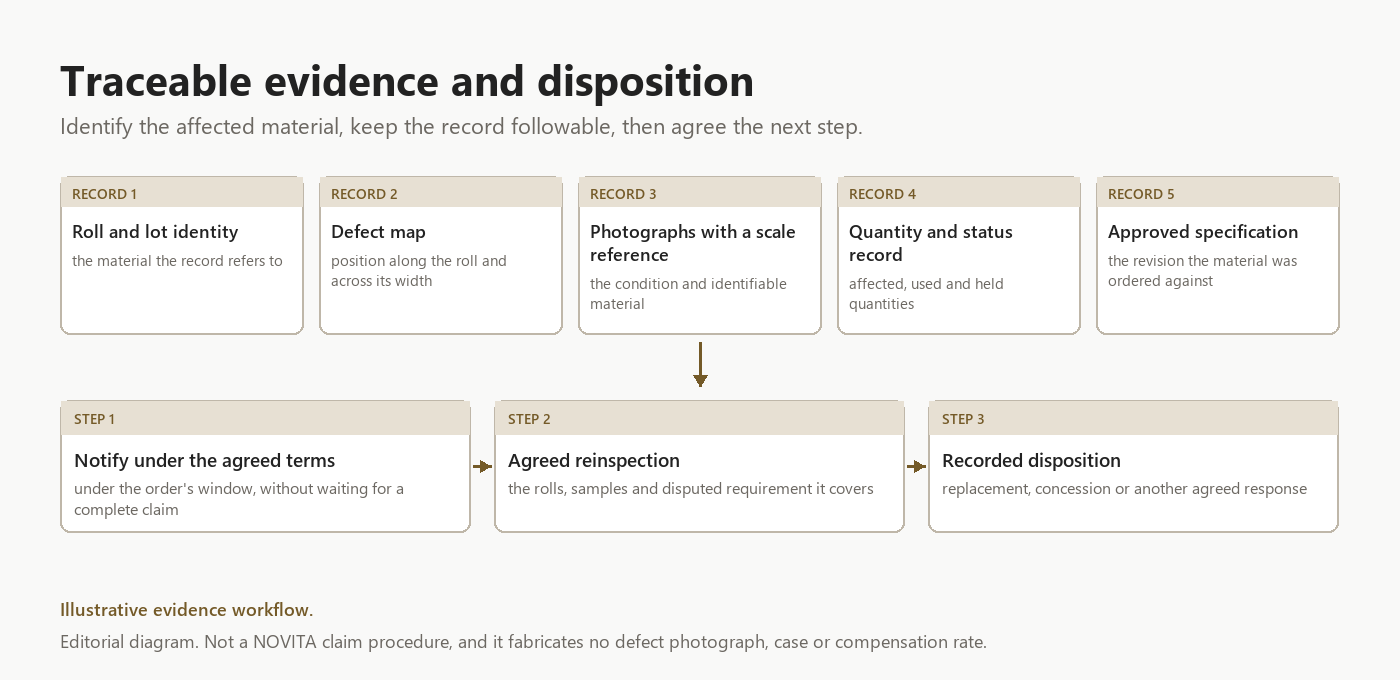
For suspect material, identify and hold the affected rolls while the parties agree the next step. Supplier-side claim guidance recommends preserving evidence and separating technical findings from commercial disposition. This is practical guidance, not a NOVITA claim procedure or a universal contractual rule.
Keep the record focused on information someone outside the cutting room can follow:
- The purchase order, current specification and approved reference identity.
- Roll and lot numbers, including affected, used and held quantities.
- Photographs showing the condition, scale and identifiable material.
- A defect map locating the issue along the roll and across its width.
- Measurements, checking conditions and retained samples where needed.
- The recorded production impact and the action requested.
Use consistent identifiers across photographs, measurements and the written notice. Preserve relevant packaging and shipment records. Keep subsequent findings linked to this record so the supplier can distinguish additional affected material from a repeat report of the same condition.
Notify and agree the next step
Notify the supplier promptly under the order’s agreed window. The initial notice can identify the issue, suspected quantity and next action while the investigation continues. Avoid postponing notification until the complete claim is assembled if the contract requires earlier notice.
Agree the scope of reinspection or testing. A supplier retest does not automatically represent the whole shipment; the parties need to define the rolls, samples and disputed requirement it addresses. Where independent testing is needed, use an agreed laboratory with the relevant capability.
Keep two decisions separate. The technical finding establishes the condition, likely cause and affected extent. Commercial disposition addresses whether the material is replaced, accepted under concession or handled through another agreed response. Costs and responsibility depend on the supply arrangement; the article supplies no compensation rate or default outcome.
Do not continue using disputed material without a documented decision. If controlled use is agreed, record its scope and retain enough evidence for the remaining investigation. Otherwise, preserve and hold the material pending disposition.
The factory can sometimes avoid local faults or replace panels. It cannot make a whole-roll condition disappear through recutting, or resolve contractual responsibility from a point score alone. The buyer’s instruction should connect the recovery plan, material status and remaining approval requirements.
After correction or replacement, record what was checked again and which material is now approved. Keep remaining suspect quantities separate in the status record. A photograph of a replacement panel documents that panel; it does not establish the condition of every related roll. Close the affected-material decision against the agreed reinspection scope, not merely against the completion of a repair.
Writing the fabric acceptance specification before ordering
Replace “four-point inspection, standard quality” with a specification the supplier can apply and the buyer can check. The following fields turn the article’s decisions into an order brief. They are an editorial checklist, not a prescribed NOVITA SOP.
| Field | What to state |
|---|---|
| Inspection and scoring method | Method and edition or revision |
| Point-assignment option | The selected option where more than one is available |
| Normalization basis | Area or linear-length basis, including units |
| Inspection scope and sampling basis | Rolls and quantity examined, selection basis and responsibilities |
| Acceptance line | Agreed limits and whether they apply to individual rolls, the shipment or both |
| Defect severity, visibility and location rules | Defect list, grading criteria, zones and treatment of material lost in fabrication |
| Shade requirements | Approved reference, comparison, grouping and approval rules |
| Dimensional stability | Method, care conditions and acceptance limit |
| Bow, skew and spirality | Applicable methods, measuring positions and limits |
| Colorfastness | Required methods, exposure conditions and result |
| Reporting requirements | Traceable roll identities, inspection coverage, option, raw points and normalized scores |
| Failed-material disposition and reinspection | Hold, notification, reinspection, controlled-use and disposition arrangements |
Add inspection-side and viewing conditions to the method instructions. Where the purchase specification includes separate roll and shipment criteria, give each its own field; do not assume one limit serves both.
Illustrative buyer specification
Illustrative buyer specification example — not a NOVITA customer document or internal SOP.
Fabric and approved reference: ____.
Inspection and scoring method, edition and point-assignment option: ____.
Normalization basis: points per 100 ____.
Inspection scope, selection basis, inspection side and setup: ____.
Individual-roll acceptance limit: ____ points per 100 ____. Shipment acceptance limit and decision rule: ____.
Agreed defect list, severity and location rules, including characteristics not counted as defects: ____.
Shade reference, grouping and approval requirements: ____.
Dimensional stability: method and care conditions ____, limit ____.
Bow and skew: method and measuring positions ____, limit ____. Spirality, where applicable: method and conditions ____, limit ____.
Colorfastness: method and exposure conditions ____, required result ____.
Report: identify inspected rolls and quantities, option used, total points, normalized scores and separate check results.
Failed material: hold pending agreed disposition. Notification window and evidence requirements: ____. Joint reinspection or independent testing arrangements: ____. Controlled use, where permitted, requires documented agreement.
Specification revision and approval reference: ____.
The blanks are intentional. Select the values and methods for the actual order, obtain supplier agreement and connect the completed specification to the approved references. None of the threshold examples earlier in the article should be copied in as an unapproved default.
Review each blank before releasing the brief. If a check is not applicable, record that decision; if it is required but unresolved, identify who will confirm it. Leaving a necessary field empty passes the decision to the inspection stage, where the parties may already be working from different expectations.
Connect acceptance to disposition
The technical brief should identify who receives the report, who can approve an exception and how failed material remains traceable. Agree notification requirements for visible and later-discovered issues, the reinspection procedure and the records to retain.
Where costs for verified reinspection, transport, replacement or rework need allocation, address them in the commercial terms. A technical acceptance table does not establish those responsibilities by itself. Likewise, it does not replace payment, remedy or other contractual provisions.
Keep revision control explicit. If requirements change after the order is placed, record which version applies and which material or approval it affects. An inspector should not have to choose between an old order attachment and a newer informal message.
Before inspection begins, check that the supplier and inspection team are working from the same completed brief. Before cutting begins, check that the material status reflects both visual grading and the separate acceptance requirements. That gives the point score a defined role in the buyer’s decision without asking it to answer questions it does not measure.
Discuss Your Fabric Acceptance Requirements
Send NOVITA your fabric details, target garment and the inspection requirements you want to apply. Tell us which fabric conditions, shade requirements and test results matter for your order.