A lower factory quotation does not always produce a lower-cost clothing order. A manufacturer closer to your market does not automatically deliver faster. Both statements depend on what you are making, which materials are available and how much development remains before production can begin.
For a clothing brand deciding between manufacturing in the USA and China, the useful comparison is not a country ranking. It is the cost and risk of delivering the same approved garment to the same destination by the date your business needs it.
This guide uses a US delivery destination. Brands selling into other markets should recalculate the logistics and compliance requirements for their destination.
Start with requirements that price cannot solve
Some conditions should be checked before comparing quotations.
If your product positioning or customer contract requires US manufacturing, establish exactly which origin claim the product must support. If a collection needs a particular washed fabric or construction, confirm that each supplier can source and produce it. If a fixed launch date is essential, ask whether the full development-to-delivery schedule is feasible—not simply whether the factory can sew quickly.
A useful brief contains:
- The garment specification and intended quality level.
- The material, finish and decoration requirements.
- Quantities by style, color and size.
- The delivery destination and date.
- Any mandatory origin, testing or labeling requirements.
- The development work that is included or still needed.
Send the same brief to both suppliers. Otherwise, a “USA vs China” comparison may actually compare different fabrics, different quantities or different services.
Compare landed cost, not just the sewing price
For this decision, calculate the cost of usable units arriving at your agreed receiving point. Define that point consistently—for example, your US warehouse.
A practical comparison includes:
Garment order value + development and setup + freight and insurance + applicable import duties and taxes + brokerage and clearance + inland delivery + expected rework or unusable-unit costs.
Avoid double-counting. A supplier’s quotation may already include some freight or delivery charges; another may stop at the factory. Record the named delivery term and place, and ask what is excluded.
Also separate one-time development expenditure from recurring order costs. Charging all initial pattern and sampling work to the first order is useful for launch budgeting, but it is not the same calculation as comparing a later reorder.
An illustrative comparison
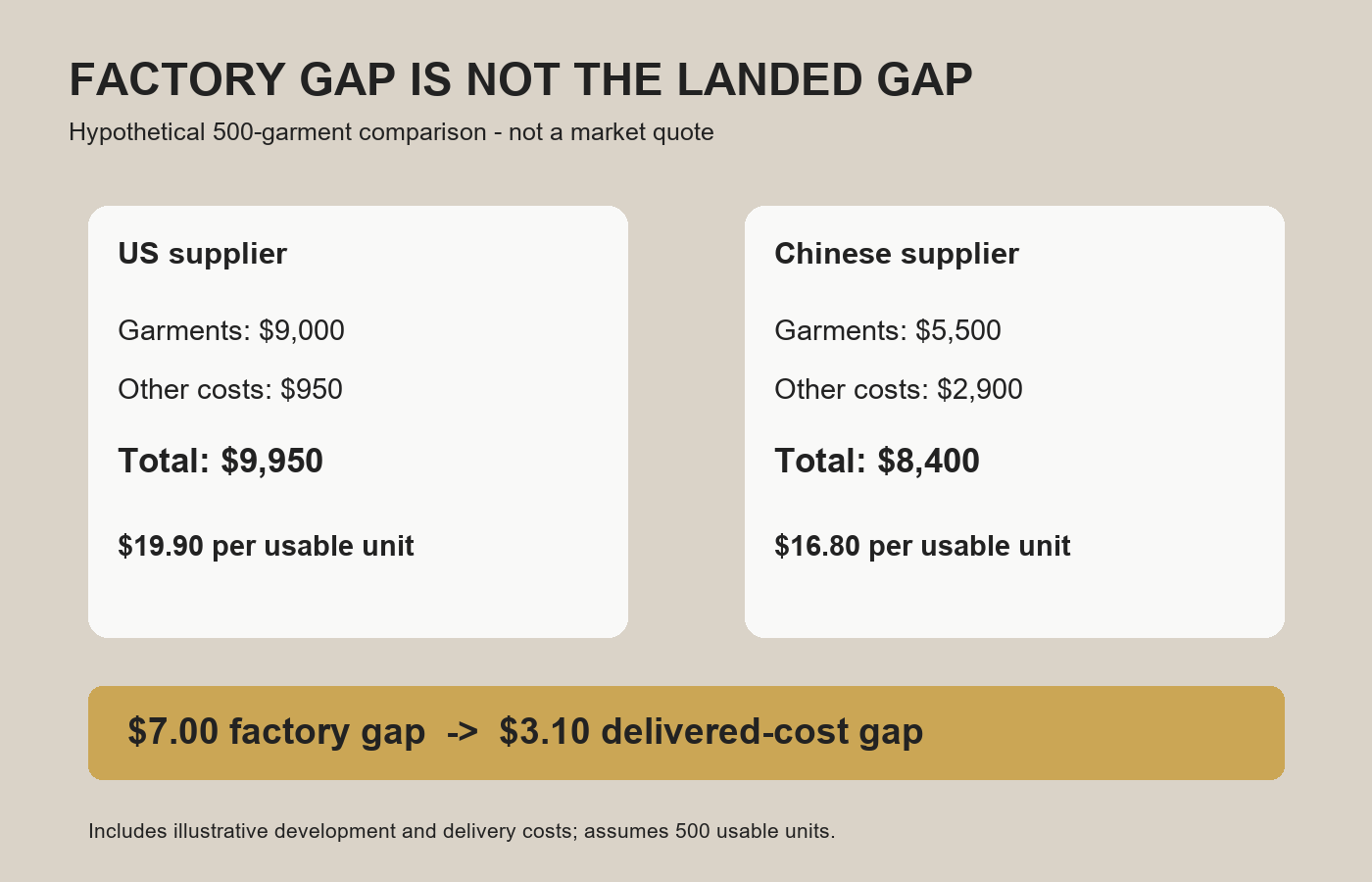
The following numbers are invented to explain the calculation. They are not market averages, current freight prices, duty rates or a NOVITA quotation.
| Cost item for 500 garments | US supplier | Chinese supplier |
|---|---|---|
| Garment order value | $9,000 | $5,500 |
| Development and setup | $700 | $900 |
| Freight, clearance, applicable duties and delivery combined | $250 | $2,000 |
| Total before rework or unusable units | $9,950 | $8,400 |
| Cost per unit if all 500 are usable | $19.90 | $16.80 |
The factory-price difference is $7 per garment, but the example’s delivered-cost difference is $3.10. If expedited shipping becomes necessary, the gap may narrow further. A different fabric, order size, shipping mode or destination could produce a different result.
If some garments cannot be sold, use the number of usable units as the denominator. This applies to either supplier; it is not a prediction about a country’s quality.
Before committing, have the import calculation checked using the actual garment classification, fiber composition, origin, shipment value and applicable rules. US import charges can change, so a blanket percentage copied from an old article is not a reliable budget.
Separate development time from production and transit
Ask for a schedule with distinct stages:
- Resolving the specification and sourcing materials.
- Pattern development and sampling.
- Buyer review and any revision rounds.
- Bulk material readiness and production scheduling.
- Manufacturing, finishing and inspection.
- Dispatch, transport, clearance and final delivery.
For a US buyer, local development can make in-person reviews and sample movement easier. However, a domestic factory waiting for imported fabric may still have a long material lead time.
A Chinese manufacturer may have suitable materials and trims available through its sourcing network. That is a supplier-specific advantage to verify, not a guarantee attached to every Chinese factory. International sample movement, time-zone differences and bulk transit must still be included.
The most important timing question is often: What has to be approved before the schedule becomes firm? A quotation based on readily available fabric is not a confirmed timeline for a custom-dyed replacement.
For a fixed launch, work backward from warehouse receipt. Identify the latest material approval, sample approval and dispatch dates. Keep a realistic allowance for revisions and delivery uncertainty rather than assigning all available time to sewing.
Check minimums at the material level
Neither country has one standard minimum order quantity.
Minimums depend on the supplier’s operating model, the garment and the materials. An available fabric in a standard color may work at a quantity that is impractical for a custom dye lot, specially developed rib, branded zipper or new wash.
Ask both manufacturers to explain:
- The minimum for each style and color.
- Whether sizes can be combined within that quantity.
- Any separate fabric, trim or decoration minimum.
- Charges for unused material or setup.
- Whether a reorder must meet the same minimum.
A low sewing minimum is not necessarily a low total commitment. Conversely, a larger first order may leave material available for a later run—but storage, ownership and reorder availability must be agreed rather than assumed. Our guide to minimum order quantity in clothing explains how separate material and style minimums affect the actual order.
Evaluate quality against the same product standard
A national label is not an inspection result. Compare the suppliers using the same finished-garment requirements.
Start with fabric identity and behavior, fit, key measurements, construction, decoration and finishing. For a washed product, review the finished result rather than only the unwashed base garment. Define the washing conditions and acceptance criteria that matter to your product.
The approved sample should correspond to the current specification and intended bulk materials. If a substitute is used during development, identify what remains unapproved before production.
Ask who is responsible for inspection and how deviations are handled. Photographs are helpful for visible details, but they do not replace measurement checks or agreed testing when those are necessary.
This creates a fairer comparison than assuming domestic production is always premium or overseas production is always inconsistent. Use a shared apparel quality control checklist to make the agreed requirements concrete.
Treat communication as a process
For a US brand, working across Chinese and US time zones can lengthen an unanswered question into another day. A domestic supplier may allow easier real-time contact, although that does not guarantee clear decisions.
Whichever location you choose, establish:
- One owner for buyer approvals and one supplier contact.
- A current specification with version control.
- A consolidated sample-comment sheet.
- Written approval for material or construction substitutions.
- A record of decisions that affect price or timing.
If a supplier recommends an alternative, request its effect on fit, appearance, durability, cost and schedule. A quick “OK” in a chat should not become approval for an unspecified change.
Do not assume domestic sewing permits an unqualified origin claim
For clothing sold in the United States, origin labeling deserves its own review. The FTC’s textile-labeling guidance explains requirements for imported products, US-made products using imported materials and products processed in more than one country.
For example, that guidance discusses qualified statements such as “Made in U.S.A. of imported fabric.” Domestic assembly and the origin of the materials both matter. Textile products have specific rules, so the general Made in USA advertising standard should not be used as the only test for a clothing label.
The FTC and US Customs and Border Protection have separate requirements, and manufacturers and importers must comply with both where applicable. The CBP guidance for importers also makes clear that using a broker does not remove the importer’s ultimate responsibility for correct entry documentation and applicable charges.
Confirm the appropriate claim and requirements for the actual product with qualified advisers. This section is general purchasing guidance, not a legal determination of origin or a tariff quotation.
Which route fits your order?
US production may be the stronger fit when a verified domestic-origin requirement is essential, local development access materially reduces risk, or proximity improves replenishment for your particular supply chain.
Chinese production may be the stronger fit when a qualified supplier’s material access, garment specialization and delivered quotation meet your requirements, and the schedule allows for international logistics. If you are evaluating that route, the China manufacturer selection guide covers supplier checks separately from this location comparison.
Some brands use both routes. However, a garment approved with one supplier does not automatically transfer unchanged to another. Patterns, materials and finishing may differ, so a second source needs its own validation.
For a project involving NOVITA in Foshan, evaluate the actual men’s casualwear specification, quantities and delivery terms alongside the US supplier’s offer. There is no need to assume China is always cheaper—or to assume a domestic quotation is always the safer choice.
Choose the manufacturing route that meets your non-negotiable requirements and delivers the approved product at an acceptable total cost and risk. The country is part of that decision, not a substitute for making it.