Choosing the right denim fabric is one of the most important decisions in jeans production.
Two denim fabrics may look similar before production but behave very differently after cutting, sewing, washing and finishing. Fabric weight affects structure and comfort. Fiber composition influences stretch and recovery. Dyeing and finishing affect how the surface develops after washing.
For clothing brands, wholesalers and private label buyers, selecting denim should therefore start with the final product rather than with a fabric swatch alone.
This guide explains the main types of denim fabric, how denim weight works, the difference between rigid and stretch denim, and what buyers should confirm before bulk production.
At NOVITA, we support OEM, ODM and private label men’s apparel production in China, including custom denim jeans. Fabric composition, weight, wash and fit can be selected according to the requirements of each project.
What Is Denim Fabric?
Denim is a durable woven fabric traditionally constructed with a twill weave.
In classic denim, the warp yarns are usually dyed while the weft yarns remain lighter. This creates the familiar contrast between the outside and inside of the fabric and is one of the reasons denim develops distinctive fading patterns over time.
However, modern denim is no longer limited to one construction.
Depending on the product, manufacturers may use rigid denim, stretch denim, lightweight denim, heavier denim, garment-dyed fabrics or different fiber blends (see our garment-dyed vs vintage-wash guide).
The best option depends on the intended fit, comfort level, wash effect and target market.
For buyers, the key question is not simply:
“What denim fabric is best?”
A better question is:
“What denim fabric is best for this specific product?”
Main Types of Denim Fabric
Rigid Denim
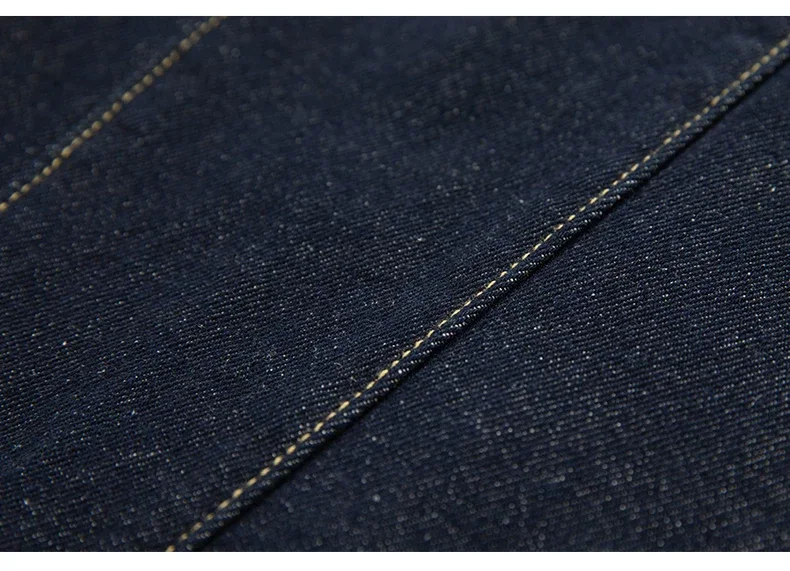
Rigid denim contains little or no stretch and is commonly chosen when the goal is a more structured, traditional denim appearance.
It works particularly well for classic jeans, workwear-inspired products and styles where the buyer wants the fabric to hold its shape.
Rigid fabrics also respond well to many traditional washing and fading techniques.
The trade-off is comfort. A rigid fabric normally feels less flexible than stretch denim, especially in slim-fitting products.
For this reason, fit and pattern development become especially important.
Stretch Denim
Stretch denim is designed to provide more flexibility and comfort.
It is often used for slim jeans, fitted silhouettes and products where movement is an important selling point.
When evaluating stretch denim, buyers should look beyond the initial stretch of the fabric.
Recovery is equally important.
A fabric may stretch easily but lose shape after repeated wear if recovery is poor. This can lead to loose knees, seat deformation or an inconsistent fit.
For production, the required stretch level should therefore be evaluated together with the garment pattern and final fit.
Lightweight Denim
Lightweight denim is softer and easier to wear in warmer climates or for relaxed products.
It can be suitable for lightweight jeans, denim shirts, summer garments and fashion styles that require more movement.
Because lighter fabrics generally provide less structure, the garment pattern and construction should be developed accordingly.
Midweight Denim
Midweight denim is commonly used because it offers a balance between structure, durability and comfort.
It can work across many men’s jeans programs, from standard five-pocket jeans to washed casual styles.
For brands developing their first denim collection, a midweight construction is often easier to work with than very light or very heavy denim.
Heavyweight Denim
Heavyweight denim produces a more substantial hand feel and stronger structure.
It is often associated with heritage denim, workwear and premium vintage-inspired jeans.
However, heavier does not automatically mean better.
A heavy fabric can increase sewing difficulty, affect comfort and require different choices in needles, seams, trims and washing.
The fabric should match the intended product rather than simply being selected because a higher weight sounds more premium.
Understanding Denim Weight: oz vs GSM
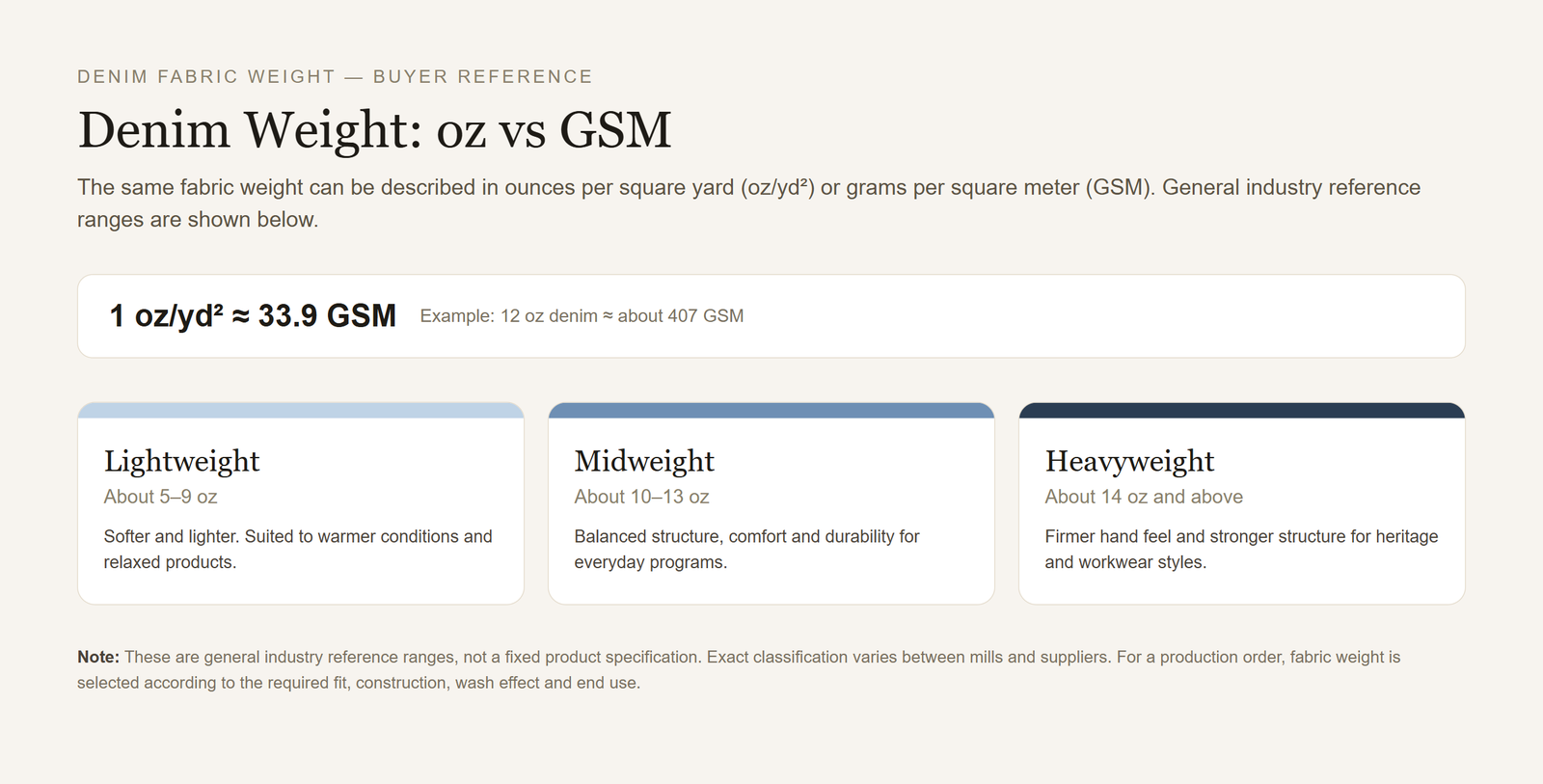
Denim weight is commonly expressed in either ounces per square yard (oz/yd²) or grams per square meter (GSM).
These are simply two different ways of describing fabric weight.
A useful approximate conversion is:
1 oz/yd² ≈ 33.9 GSM
For example, a 12 oz denim is roughly equivalent to about 407 GSM.
Exact classification varies between mills and suppliers, but buyers will often see denim grouped approximately like this:
| Denim Category | Typical Reference Range | General Characteristics |
|---|---|---|
| Lightweight | About 5–9 oz | Softer, lighter, suitable for warmer conditions and relaxed products |
| Midweight | About 10–13 oz | Balanced structure, comfort and durability |
| Heavyweight | About 14 oz and above | Firmer hand feel, stronger structure and heritage/workwear character |
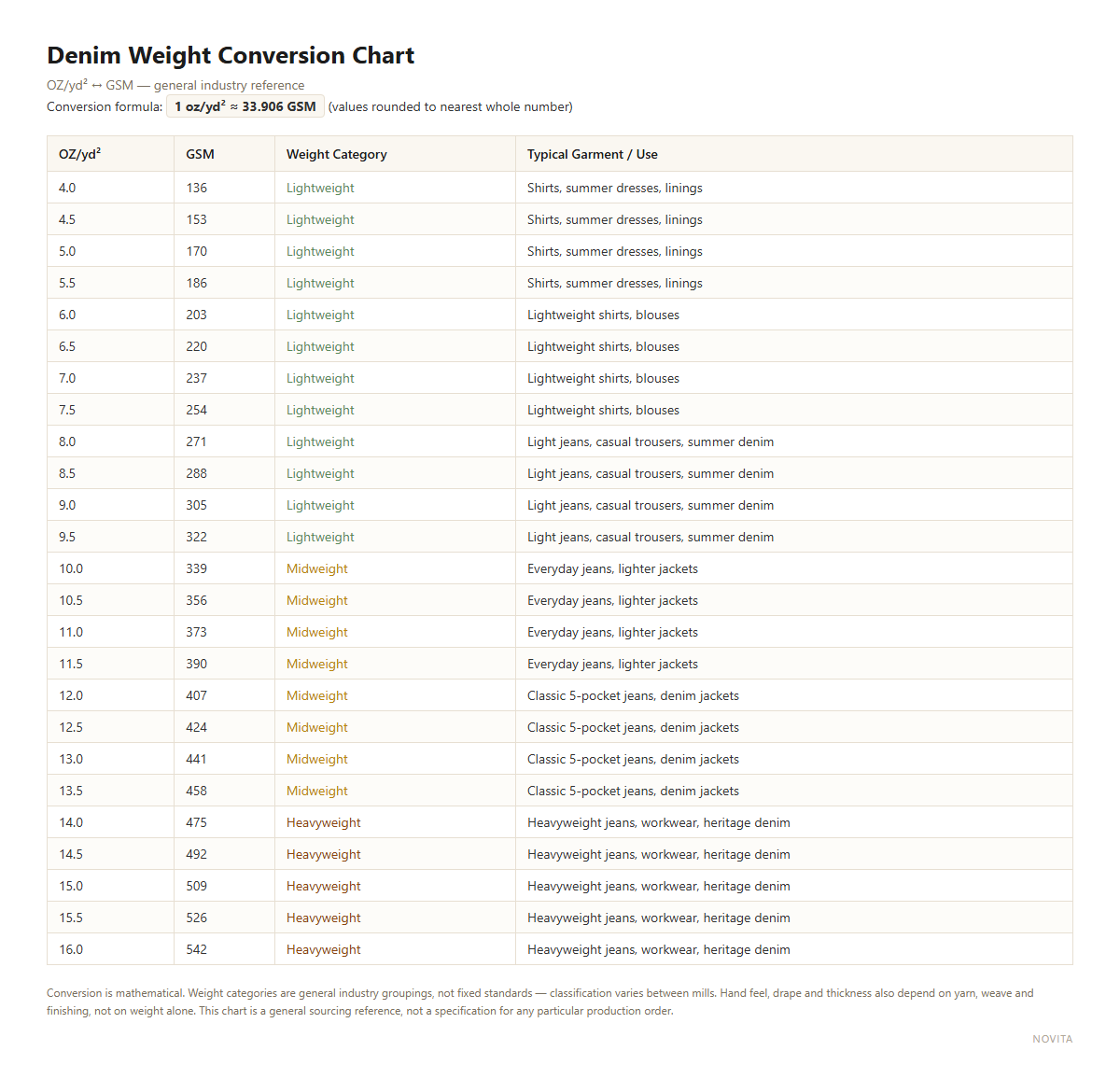
Denim Weight Conversion Chart: OZ/yd² to GSM
The chart below converts ounces per square yard to grams per square meter using the fixed formula 1 oz/yd² ≈ 33.9 GSM. Values are rounded to the nearest whole number.
| OZ/yd² | GSM | Weight Category | Typical Garment / Use |
|---|---|---|---|
| 4.0 | 136 | Lightweight | Shirts, summer dresses, linings |
| 4.5 | 153 | Lightweight | Shirts, summer dresses, linings |
| 5.0 | 170 | Lightweight | Shirts, summer dresses, linings |
| 5.5 | 186 | Lightweight | Shirts, summer dresses, linings |
| 6.0 | 203 | Lightweight | Lightweight shirts, blouses |
| 6.5 | 220 | Lightweight | Lightweight shirts, blouses |
| 7.0 | 237 | Lightweight | Lightweight shirts, blouses |
| 7.5 | 254 | Lightweight | Lightweight shirts, blouses |
| 8.0 | 271 | Lightweight | Light jeans, casual trousers, summer denim |
| 8.5 | 288 | Lightweight | Light jeans, casual trousers, summer denim |
| 9.0 | 305 | Lightweight | Light jeans, casual trousers, summer denim |
| 9.5 | 322 | Lightweight | Light jeans, casual trousers, summer denim |
| 10.0 | 339 | Midweight | Everyday jeans, lighter jackets |
| 10.5 | 356 | Midweight | Everyday jeans, lighter jackets |
| 11.0 | 373 | Midweight | Everyday jeans, lighter jackets |
| 11.5 | 390 | Midweight | Everyday jeans, lighter jackets |
| 12.0 | 407 | Midweight | Classic 5-pocket jeans, denim jackets |
| 12.5 | 424 | Midweight | Classic 5-pocket jeans, denim jackets |
| 13.0 | 441 | Midweight | Classic 5-pocket jeans, denim jackets |
| 13.5 | 458 | Midweight | Classic 5-pocket jeans, denim jackets |
| 14.0 | 475 | Heavyweight | Heavyweight jeans, workwear, heritage denim |
| 14.5 | 492 | Heavyweight | Heavyweight jeans, workwear, heritage denim |
| 15.0 | 509 | Heavyweight | Heavyweight jeans, workwear, heritage denim |
| 15.5 | 526 | Heavyweight | Heavyweight jeans, workwear, heritage denim |
| 16.0 | 542 | Heavyweight | Heavyweight jeans, workwear, heritage denim |
Conversion is mathematical (1 oz/yd² ≈ 33.906 GSM, rounded). Weight categories are general industry groupings, not fixed standards — classification varies between mills. Hand feel, drape and thickness also depend on yarn, weave and finishing, not on weight alone. This chart is a general sourcing reference, not a specification for any particular production order.
These numbers should be treated as general industry references rather than fixed rules.
For an actual NOVITA production order, fabric weight should be selected according to the required fit, construction, wash effect and end use.
Rigid Denim vs Stretch Denim: Which Should You Choose?
The choice between rigid and stretch denim depends mainly on the intended silhouette and customer experience.
Rigid denim is usually more suitable when a brand wants a traditional appearance, strong structure and more visible wear development.
Stretch denim is more appropriate when comfort, mobility or a slimmer fit is important.
Neither option is automatically superior.
For example, a relaxed straight-leg jean may benefit from rigid denim because the pattern already provides enough movement.
A fitted jean may perform better with some stretch because the fabric needs to follow the body.
The best decision is therefore made by considering fabric + pattern + fit together.
Selecting fabric independently from garment construction often creates problems later in sampling.
Cotton Denim and Denim Blends
Traditional denim is closely associated with cotton, but modern denim can also use blended fiber systems.
Different blends are used to change stretch, softness, weight, recovery, durability or hand feel.
For buyers, fiber composition should be treated as a product-development decision rather than a marketing number.
A higher cotton percentage does not automatically make one denim better than another.
The correct composition depends on the required performance.
A rigid vintage jean and a flexible slim jean are solving different problems, so they may require different fabric constructions.
If a project has no fixed composition yet, buyers can begin with the desired fit, hand feel and wash appearance and then select fabric accordingly.
How Denim Washes Affect Fabric
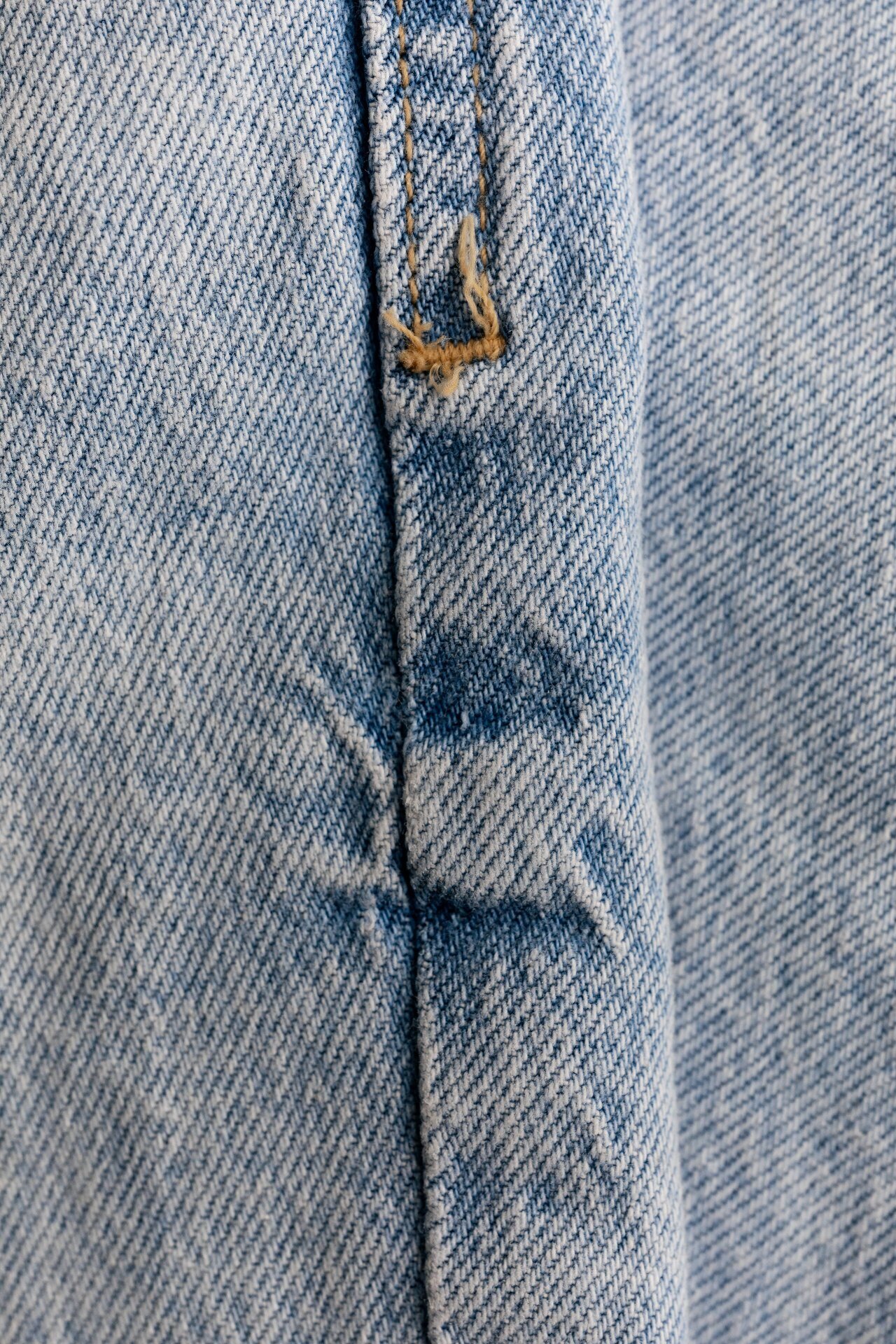
Denim fabric should never be evaluated only in its unwashed state.
The base fabric decides how much of the effect survives: on a heavy rigid denim an acid splash and bleach wash lands sharp, while the same recipe on a soft stretch base reads far softer.
Washing and finishing can significantly change:
- color
- surface texture
- softness
- shrinkage behavior
- contrast
- fading
- overall hand feel
A dark rigid denim and a heavily washed vintage denim may begin with similar raw materials but end up looking and feeling completely different.
Common finishing directions include stone wash, enzyme wash, acid wash, fading and localized effects.
If you are comparing wash options, see our guide to types of denim washes.
For localized fading around the upper thigh and hip area, you can also read our guide to whiskering jeans.
The important point for buyers is that fabric selection and wash development should happen together.
Some fabrics react more strongly to washing, while others may not produce the desired contrast or texture.
How to Choose Denim Fabric for Jeans Production
The correct denim fabric depends on what the finished garment is supposed to achieve.
Fabric also has to serve the construction: a double-knee carpenter jean needs a weight that holds its shape at the reinforcement panels, not only a hand feel that photographs well.
A classic rigid jean needs structure and durability.
A slim comfort jean needs flexibility and recovery.
A vintage-washed jean needs a fabric that responds well to finishing.
A product intended for a warm market may require a lighter hand feel than a heavy workwear style.
Buyers should therefore evaluate several factors together.
| Product Direction | Main Fabric Considerations |
|---|---|
| Classic rigid jeans | Structure, durability, wash development |
| Stretch jeans | Flexibility, recovery, comfort |
| Relaxed jeans | Drape, structure, hand feel |
| Vintage washed jeans | Fabric reaction to washing and fading |
| Heavy workwear denim | Weight, seam construction, durability |
| Lightweight denim products | Comfort, drape, climate suitability |
This is also why copying another brand’s fabric specification is not always a good idea.
The same specification may perform differently when the fit, sewing construction or wash process changes.
What Buyers Should Confirm Before Bulk Production
Before approving bulk production, buyers should confirm the relationship between the fabric and the finished garment.
The key areas are fabric composition, fabric weight, color, stretch and recovery, wash reference, finished hand feel, fit, shrinkage behavior, stitching construction, trims and packaging.
These points are best confirmed during sample development rather than after bulk fabric has already been ordered.
At NOVITA, sample development generally takes 7–15 days, depending on the project.
For custom production, our standard MOQ is 100 pcs per color, with mixed sizes allowed.
Bulk production is generally around 60 days after sample approval, depending on order quantity, fabric availability and customization requirements.
You can learn more about our clothing sample development process.
Fabric Selection and Denim Wash Development Should Be Done Together
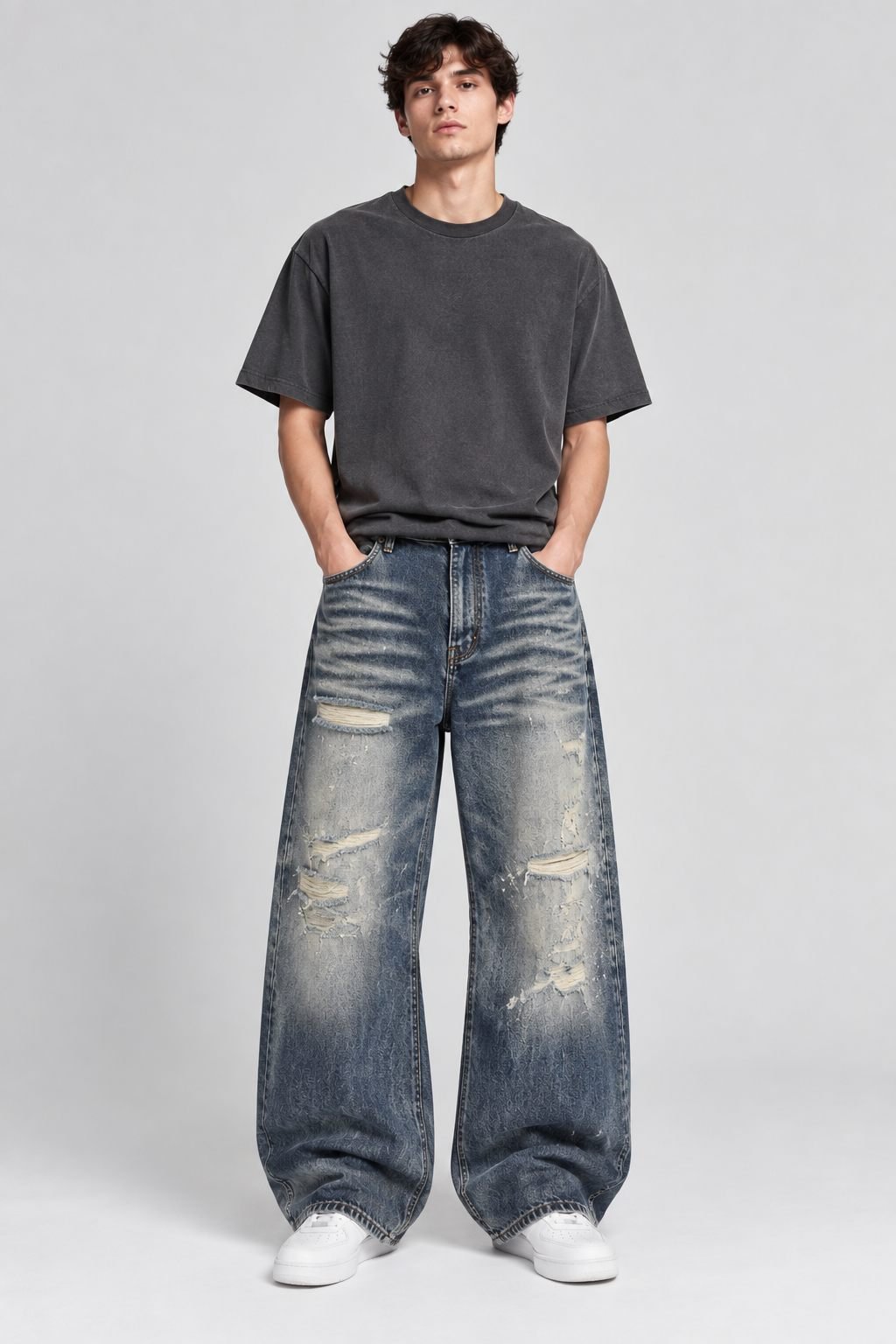
One of the most common sourcing mistakes is approving a fabric first and discussing the wash later.
For basic products, this may work.
For heavily washed or vintage-style denim, it can create unnecessary sampling rounds.
If the target garment needs strong fading, whiskering, a worn surface or a specific hand feel, the fabric should be selected with that finishing direction in mind.
A useful development sequence is:
Target product → fit → fabric → wash → sample → adjustment → approval
This approach is more reliable than choosing fabric based only on price or GSM.
Why Fabric Weight Alone Does Not Define Quality
Buyers sometimes assume that heavier denim automatically means better denim.
That is not necessarily true.
Quality depends on the entire construction of the garment.
A well-made lighter denim jean can perform better than a poorly developed heavy jean.
Important factors include yarn quality, weave consistency, dyeing, stretch recovery, cutting, sewing, seam construction, wash control and final inspection.
Fabric weight is therefore one specification within a much larger production system.
The most useful question is not:
“How heavy is the denim?”
It is:
“Is this denim suitable for the product we are trying to make?”
Denim Fabric Sourcing for Private Label Brands
For private label projects, buyers do not always need to arrive with a complete fabric specification.
A project can begin with a tech pack, reference sample, product image or target description.
From there, the fabric can be selected based on the desired fit, weight, hand feel and finishing direction.
For a broader overview of denim production, see our custom denim jeans manufacturing guide.
You can also browse our custom denim jeans category for NOVITA’s denim production capabilities.
FAQ
What is the best denim fabric for jeans?
There is no single best denim fabric for every type of jeans. The correct choice depends on fit, weight, comfort, stretch requirements, wash effect and target market.
What weight of denim is commonly used for jeans?
Many jeans use midweight denim, although lighter and heavier constructions are also common. The correct weight should be selected according to the intended product rather than following one fixed number.
Is rigid denim better than stretch denim?
Rigid denim offers more traditional structure, while stretch denim provides greater flexibility and comfort. The better option depends on the fit and intended customer experience.
What is the difference between oz and GSM?
Both measure fabric weight. Denim is often described in ounces per square yard, while GSM means grams per square meter. Approximately, 1 oz/yd² equals 33.9 GSM.
Can denim fabric weight and composition be customized?
Yes. Fabric construction, weight and composition can be selected according to project requirements, subject to fabric availability and production feasibility.
What is NOVITA’s MOQ for custom denim jeans?
NOVITA’s custom production MOQ is 100 pieces per color, with mixed sizes allowed.
How long does denim sampling take?
Sample development generally takes 7–15 days, depending on the fabric, wash, construction and customization requirements.
Start Your Denim Project
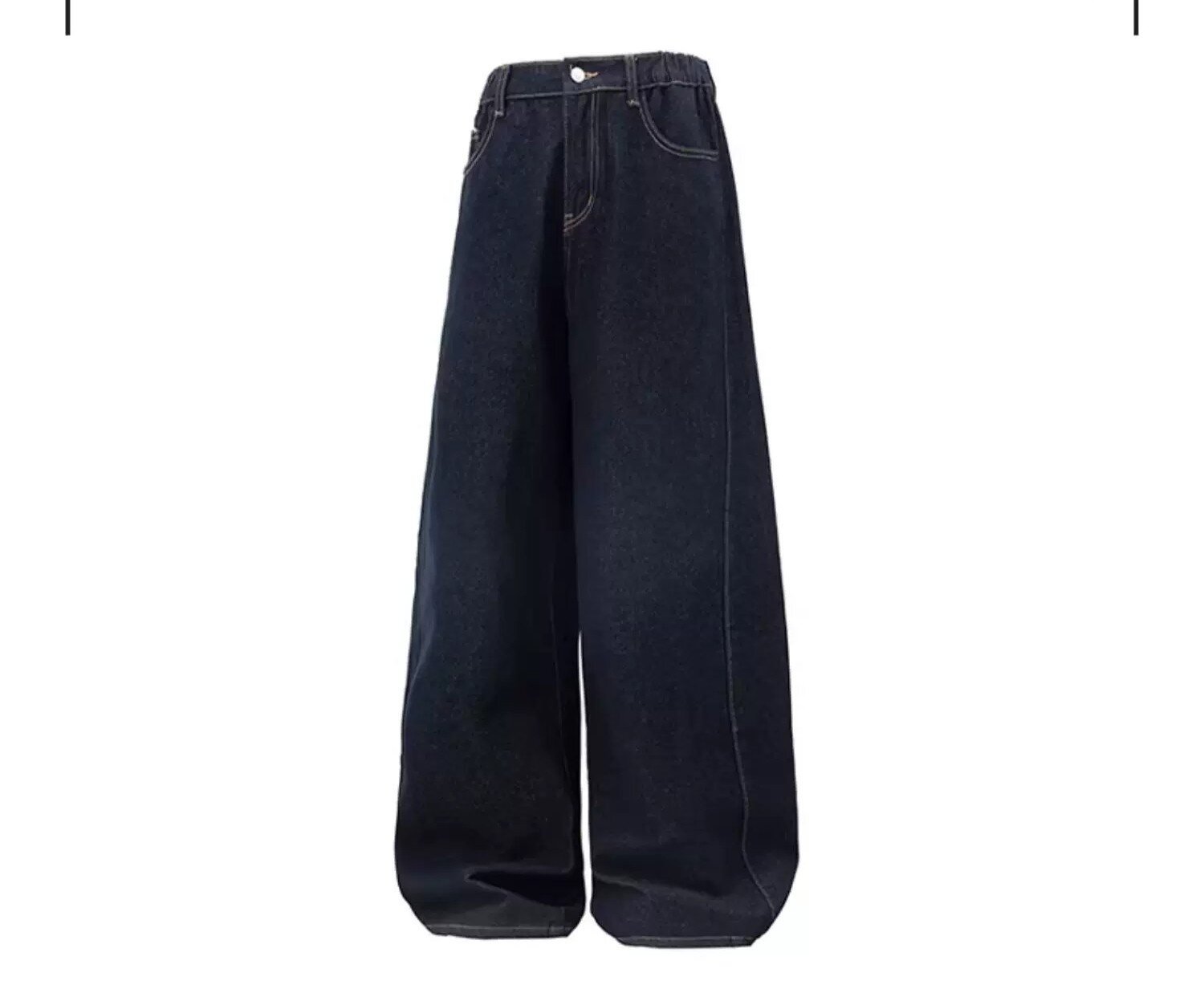
Choosing denim fabric is not only about selecting a weight or composition.
The fabric needs to work together with the fit, wash, construction and final market position of the garment.
If you are developing a new denim collection, NOVITA can support fabric selection, sample development, private label customization and bulk production.
Explore our custom denim jeans or contact us to discuss your project.