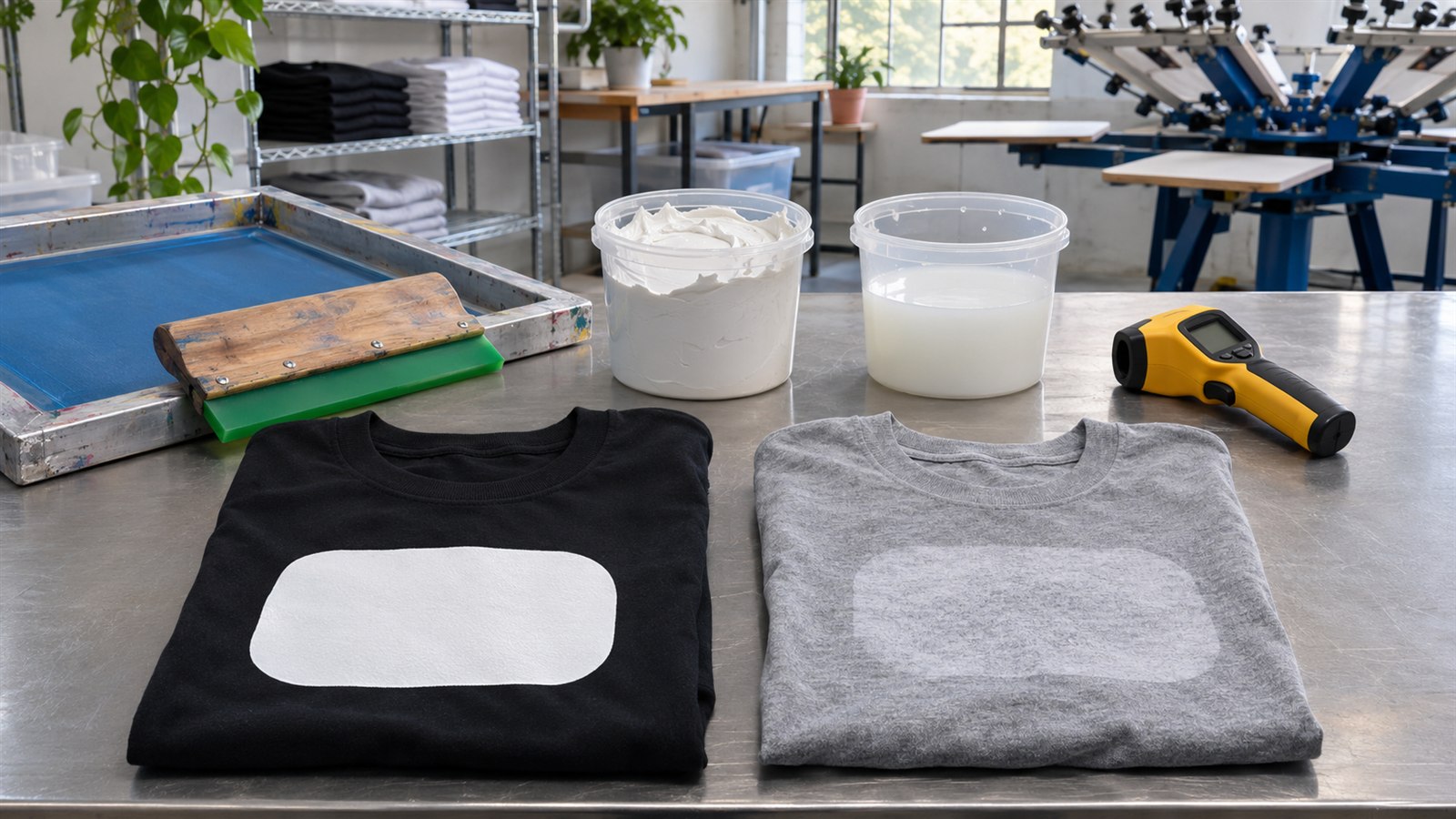
Plastisol vs water-based ink is a choice between a PVC-based ink that sits on top of the fabric and needs heat to cure, and a water-based ink that soaks into the fibers and cures once its water has gone. Plastisol gives opaque color on dark garments. Water-based ink gives a softer hand on light cotton. Both fail if under-cured.
This guide is for brands and sourcing teams ordering screen-printed T-shirts, hoodies or sweatshirts from a factory. It covers the decision in buyer terms: which ink to test first for your fabric and garment color, what to write in the print spec, and how to approve the strike-off so the bulk order matches it.
Plastisol vs water-based ink at a glance
Plastisol and water-based ink differ in what carries the pigment, how the print sets and where the ink sits on the fabric. Those three differences explain most of what a buyer sees on a sample: hand feel, opacity on dark colors, and how the print behaves after washing.
| Point to compare | Plastisol ink | Water-based ink |
|---|---|---|
| Base | PVC resin and plasticizer, essentially no solvent | Pigment in a water-based binder |
| How it sets | Must be heated to cure; it does not air-dry | Water must evaporate, then the print is heat cured |
| Where it sits | Forms an ink film on top of the fabric that you can feel | Soaks into the fibers; little or no film on light fabric |
| Dark garments | Opaque color is straightforward | Needs an opaque range or an underbase to cover dark fabric |
| Typical cure guidance | Most textile plastisols cure at 300–330°F (149–166°C) | One supplier lists 2–3 minutes at 320°F (160°C), measured at the ink |
| Main production risk | Under-cure, or dye bleed on polyester | Under-cure, or ink drying in the screen during long runs |
| What the buyer checks | Opacity, edge sharpness, stretch and wash behavior | Hand feel, color on the actual fabric, wash behavior |
Cure figures differ by ink series, so the numbers above show the range, not a rule. The ink supplier’s technical data sheet for the exact series is what the factory should follow.
How each ink cures, and why under-cure is the buyer’s problem
Plastisol cures by heat alone. ScreenPrinting.com states that most plastisol for textile printing cures in the range of 300°F to 330°F. Below that range the ink film can look finished but still crack or wash out. Plastisol does not dry in the screen, which makes long runs easier to control.
Water-based ink cures in two steps. The water has to leave the print first, and the binder then needs heat to set. The PERMASET AQUA technical data sheet gives 2–3 minutes at 320°F (160°C), 5–6 minutes at 285°F (140°C) or 8–9 minutes at 250°F (120°C). It also says those figures are ink-deposit temperatures, not dryer settings, and should be checked with temperature strips or an IR gun.
The dryer display is not proof of cure, and that matters to you as the buyer. A print that left the dryer under temperature can pass a visual check at the factory and then fail after a few washes at your customer’s home. Two simple controls reduce that risk:
- Ask the factory to name the ink series and follow its data sheet, with ink temperature checked rather than dryer temperature assumed.
- Wash test the strike-off and the first bulk pieces before you release the order. The same data sheet recommends a test wash to confirm the cure regime.
Which ink suits your fabric and garment color
Fabric content and garment color decide where to start. Plastisol is usually the first test on dark garments and polyester blends, because it covers well. Water-based ink is usually the first test on light 100% cotton, where a soft print is the goal. Use the table as a starting point, then confirm on the actual fabric.
| Garment | Start testing with | What to watch on the sample |
|---|---|---|
| Light-colored 100% cotton jersey | Water-based ink | Color strength on the real fabric; print feel after one wash |
| Dark 100% cotton (reactive dyed) | Plastisol, opaque water-based ink, or discharge | Opacity of white and light colors; hand feel of the underbase |
| Cotton/polyester blend or 100% polyester | Plastisol formulated for polyester | Dye migration (the garment color bleeding into a white print) |
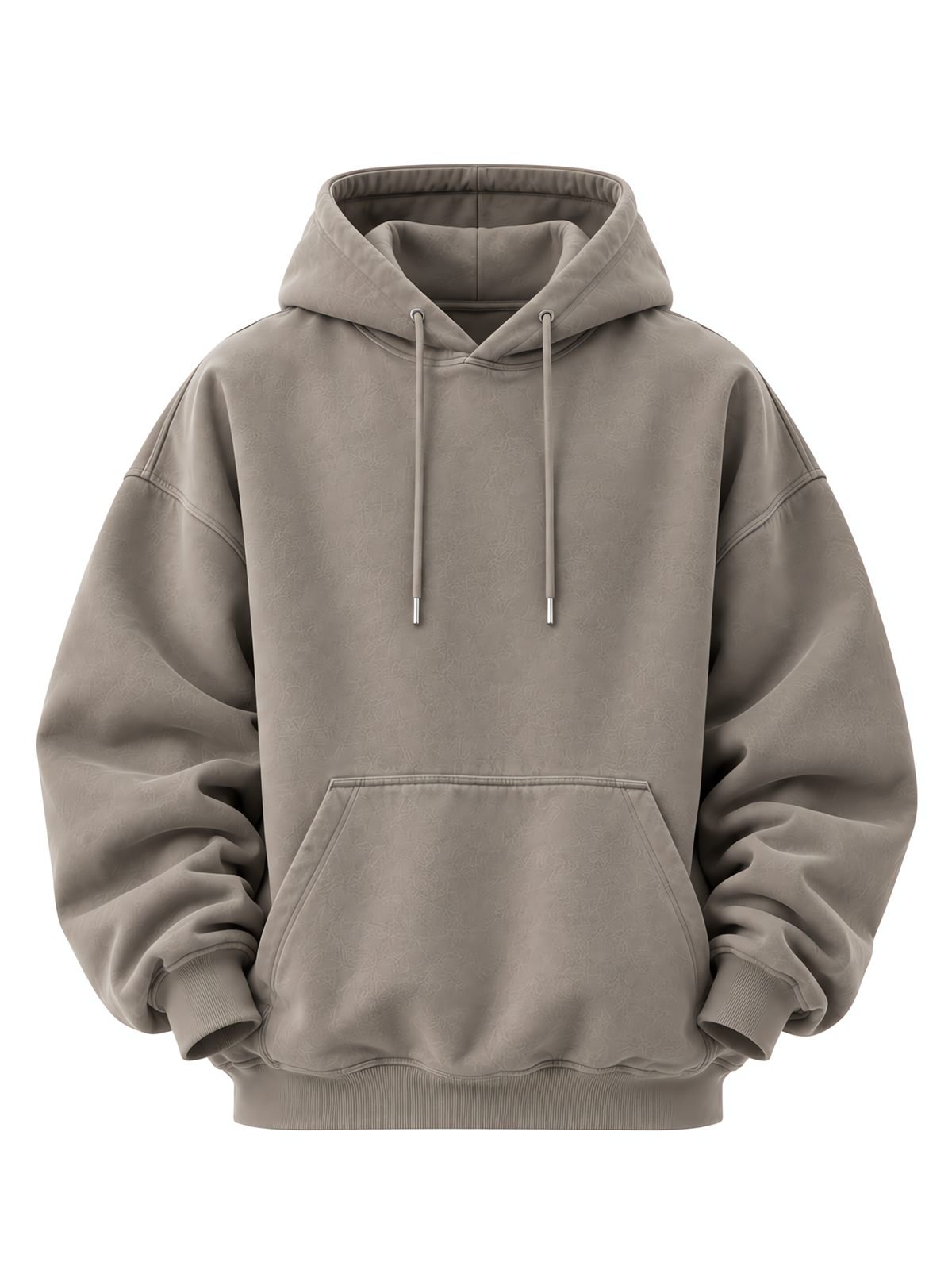
| Heavyweight fleece hoodie or sweatshirt | Either, tested on the brushed fabric | Ink coverage on the fleece surface; cracking when stretched |
| Garment-dyed or washed styles | Test after the dye or wash process | Print color and adhesion after the wash, not before |
Discharge ink is a third option for dark cotton. Discharge removes the garment’s dye in the print area instead of covering it, so the print feels close to the fabric. It works on 100% cotton or high-cotton fabric dyed with reactive dyes. Polyester and rayon do not discharge evenly, if at all, so the factory should swab test each new fabric before bulk.
Fabric choice affects the print as much as the ink does. If you are still deciding on the body fabric, compare cotton, CVC and polyester options in our guide to T-shirt fabric types before you lock the decoration method. If you are still choosing between print methods, our DTF vs screen printing comparison covers cost and durability by order size.
EU phthalate rules: what applies to a plastisol print
Plastisol prints sold in the EU fall under REACH Annex XVII entry 51 (rules checked November 2026). Under Commission Regulation (EU) 2018/2005, articles placed on the market after 7 July 2020 must not contain DEHP, DBP, BBP or DIBP at or above 0.1% by weight of the plasticized material, individually or combined. The regulation’s definition of plasticized material includes printed designs and inks.
For a buyer, that means the print is assessed as its own material, not diluted by the weight of the whole garment. Three practical points follow:
- Ask the factory which ink series it will use, and request the supplier’s technical data sheet and safety data sheet for that series.
- If your market or customer requires proof, agree before sampling on who commissions a lab test on the printed area and which lab and method are acceptable.
- Phthalate-free and PVC-free inks exist. The PERMASET range, for example, states that it contains no PVC resin and no phthalate plasticizers. A water-based ink is not automatically compliant with every rule, so the same document request applies.
Children’s products and some retailer programs carry extra requirements beyond this entry. Confirm the rules for your market with your compliance team or test lab. If your customers also ask for product certificates, our guide to OEKO-TEX STANDARD 100, GOTS and GRS explains what each certificate covers.
What to write in the print spec
The print spec should name the ink system and the acceptance tests, not only the artwork. A spec that only says “screen print, Pantone 186 C” leaves the factory to choose the ink, underbase and cure, and you lose the basis for rejecting a print that feels or washes differently from the sample.
| Spec field | What to write | Why it matters |
|---|---|---|
| Ink system | Plastisol, water-based or discharge, plus the ink series once the factory confirms it | Changing the ink changes hand feel, opacity and compliance documents |
| Colors | Pantone references per color, and the garment color each is printed on | The same Pantone reads differently on white and black bodies |
| Underbase | Required or not; which colors print over it | Affects hand feel and cost on dark garments |
| Print size and placement | Artwork size per size range, and the reference point (for example, below the collar seam) | Prevents one print size being used across the whole size run without agreement |
| Hand feel | “Match the approved strike-off”, with the strike-off retained by both sides | Gives a physical reference instead of a description |
| Cure control | Follow the ink data sheet; ink temperature checked with strips or an IR gun | Reduces the risk of prints that crack or fade after washing |
| Wash test | Number of home-wash cycles and the check you will apply (cracking, peeling, fading) | Turns “durable” into something you can accept or reject |
| Documents | Ink technical data sheet, safety data sheet, and any test report your market needs | Supports compliance questions after shipment |
For color performance of the garment itself, set separate requirements. Our colorfastness testing guide lists the test methods buyers usually specify for wash, rub and light fastness.
How to approve the strike-off and the bulk print
Print approval works best as a short sequence on the actual production fabric. Each step locks one variable, so the bulk order can be compared against something physical.
- Strike-off on the real fabric and color. Print each colorway on the body fabric you will use in bulk, not on a spare blank.
- Wash test the strike-off. Run the cycles you wrote in the spec and check for cracking, peeling and fading against an unwashed piece.
- Stretch check. Stretch the print area by hand. A plastisol print that cracks or shows fine lines when stretched may be under-cured.
- Approve and retain. Sign off one washed and one unwashed piece per colorway, and keep a matching set at the factory.
- Repeat on the pre-production sample. Approve the print on the full sample made with bulk fabric. Our sample development guide explains where this fits in the approval sequence.
- Check early bulk. Compare the first printed bulk pieces with the retained set before most of the order is printed. A during-production inspection is the usual point to do this.
An approval only holds while the inputs stay the same. A new fabric lot or dye color, a different ink series or a change of printing contractor can each change the result. When any of these change, ask for a new strike-off.
How NOVITA handles screen-printed orders
NOVITA offers screen printing with water-based, plastisol and puff inks for bulk graphics, coordinated with cut and sew production at NOVITA’s own garment factory and long-term partner factories in Foshan. Screen printing, embroidery and garment washing can be combined in one order.
The custom MOQ of 100 pieces per style and per color applies to decorated orders too. Sampling normally takes 7–15 days after fabric, measurements, construction and workmanship requirements are confirmed, excluding extra revisions and shipping. Bulk production is 60 days after sample approval. The ink choice and print are confirmed on the physical sample before bulk. See apparel solutions for the full service scope.
If you have artwork, a garment reference and a target quantity, send them to our team and ask for a strike-off plan with the ink system named for each colorway.
Frequently asked questions
Is plastisol ink water-based?
No. Plastisol is a PVC-based ink with essentially no solvent, and it cures only when heated. Water-based ink uses water as its carrier, which must evaporate before the print is heat cured. The two inks need different handling in the screen and in the dryer, so a factory treats them as separate print systems.
How can you tell if a print is plastisol or water-based?
On light fabric, a plastisol print usually has an ink film you can feel on the surface, while a water-based print sits in the fibers with little texture. Opaque water-based inks on dark fabric can also leave some film, so touch alone is not proof. The reliable check is to ask the factory to name the ink series on the strike-off record.
Can you mix plastisol and water-based inks?
Not as one ink. They are different chemistries and should not be blended in the same container. Some printers combine separate ink systems in layered prints, but that is a process the printer must test on your fabric and cure conditions before bulk. Write the agreed ink system for each color into the print spec.
Which ink lasts longer in the wash?
Both can hold up through repeated washing when the print is fully cured on a suitable fabric. Most print failures after washing come from under-cure, the wrong ink for the fabric, or dye bleeding on polyester. Agree on the number of wash cycles and the pass criteria in the spec, then test the strike-off and early bulk pieces.
Sources
- ScreenPrinting.com, “Plastisol Ink vs Water Based ink” (accessed November 2026).
- Colormaker Industries, PERMASET AQUA & SUPERCOVER technical data sheet, v2005 (2020).
- Commission Regulation (EU) 2018/2005 amending Annex XVII to Regulation (EC) No 1907/2006 (REACH) as regards bis(2-ethylhexyl) phthalate (DEHP), dibutyl phthalate (DBP), benzyl butyl phthalate (BBP) and diisobutyl phthalate (DIBP).