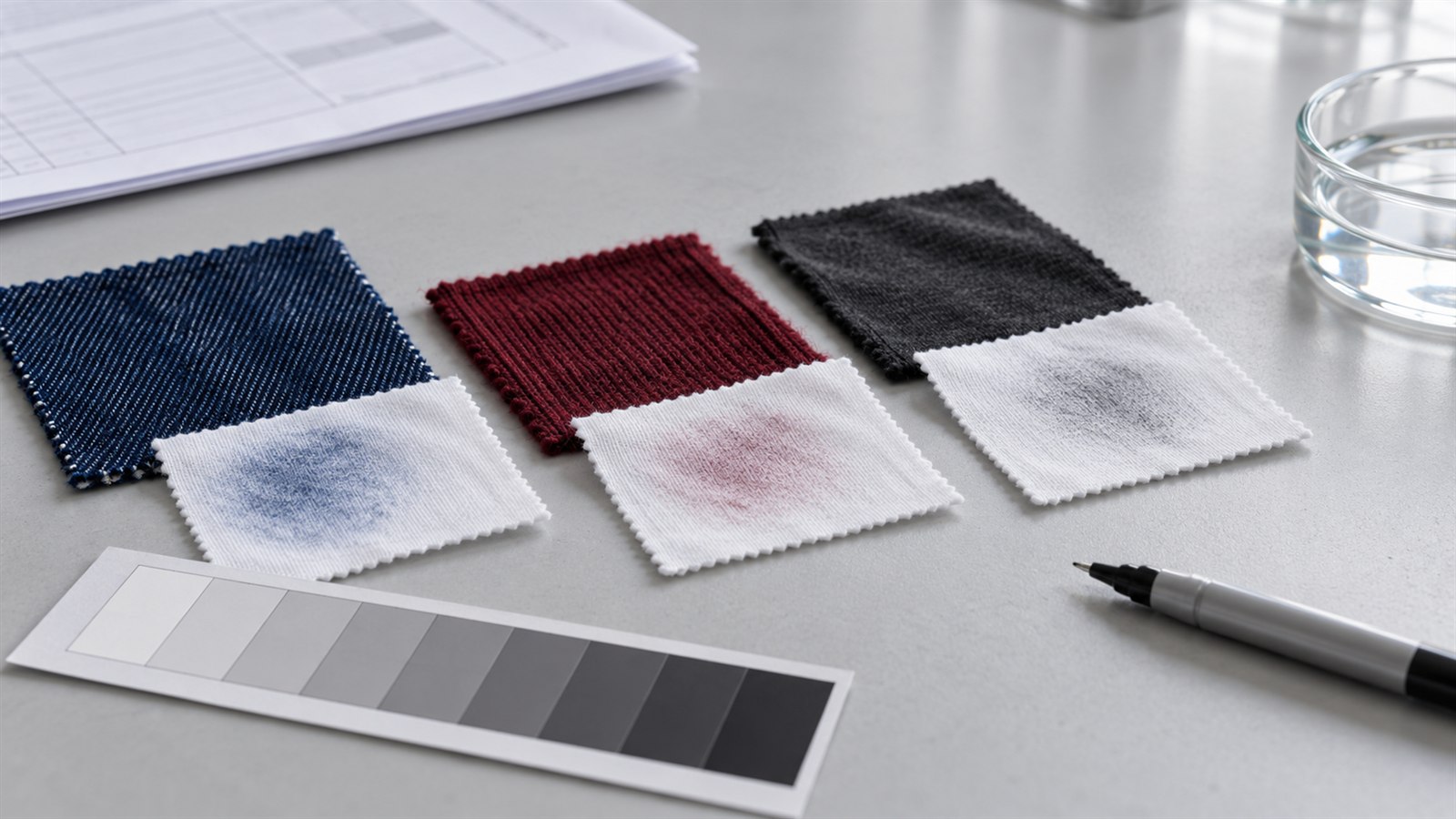
A colorfastness failure can become a customer claim, a re-dye and a late shipment. For apparel buyers, the term means a material’s resistance to changing color or transferring color onto other materials under a specified exposure. Replace vague instructions such as “must not fade” with the exposure, test method and agreed acceptance grade.
What color fastness is and is not
An approved navy shade can still stain a white collar. Matching the original color and retaining it during use are separate approvals. Keep fabric shade-band approval separate from durability testing.
Standards often use the spelling “colour fastness” for the same property. “Colorfast fabric” still needs qualification: light stability says nothing conclusive about sweat or laundering. Crocking measures transfer through rubbing; it is one fastness property, not the whole subject. A bulk approval must address the exposures relevant to the garment.
The five fastness types buyers should specify
Build the colorfastness test plan around intended care, skin contact and exposure. These verified methods are options, not interchangeable equivalents.
| Fastness type | What it simulates | Verified test method | Grading scale | Specimen notes |
|---|---|---|---|---|
| Washing | Laundering-related color loss and transfer | ISO 105-C06:2010 | Gray scales for color change and staining | State procedure, detergent, temperature and treatment history; include adjacent fabric. |
| Rubbing/crocking | Surface color transfer through friction | ISO 105-X12:2016 or AATCC TM8 | Staining assessment; TM8 also permits the Chromatic Transference Scale | Report dry and wet separately; assess the white rubbing cloth. |
| Light | Fading under an artificial daylight source | ISO 105-B02:2014 | Blue-wool-reference assessment under the selected procedure | Identify reference set, exposure conditions and endpoint. |
| Perspiration | Exposure to simulated sweat | ISO 105-E04:2013 | Gray scales for color change and staining | Specify acid and alkaline assessments; identify adjacent fabrics. |
| Water | Color response to immersion | ISO 105-E01:2013 | Gray scales for color change and staining | Not a substitute for detergent washing, seawater or pool-water testing. |
NOVITA’s dry-versus-wet denim crocking guide covers wet pickup, rubbing direction and denim finishes in more detail.
Grading in practice: fading is not staining
A colorfastness report can pass color change and fail staining. Read both results.
ISO 105-A02 defines the gray scale for assessing change in color: compare the tested garment specimen with its untested original. ISO 105-A03 covers staining: assess transfer onto the adjacent material. In crocking, that recipient is the rubbing cloth.
The gray scales run from 1, the greatest change or staining, to 5, no change or staining. Intermediate notation such as 3–4 is a half-step assessment, not permission to round up. A multifiber strip can produce different staining grades for different fiber bands; do not average away a failing band.
Light testing needs its own interpretation. The numbered blue-wool scale runs from 1, low resistance, to 8, high resistance. ISO’s B02 summary permits two reference sets and warns that their results may differ. A blue-wool rating is not a gray-scale grade.
Before accepting the report, check:
- Order, color, dye lot, specimen identity and treatment stage.
- Method edition, procedure, conditions, exposure and cycles where applicable.
- Specimen count, sampling locations and individual results.
- Adjacent fabric, assessment scale, deviations and pass/fail rule.
- Laboratory identity, with an accreditation scope that covers the actual method. The logo alone is insufficient.
A report describes the submitted specimens. It does not establish that every roll was represented.
Write an enforceable requirement
An enforceable colorfastness specification ties a result to a lot, an owner and an action. Put the approved revision into both the tech pack and PO; see how a factory reads your tech pack.
Use this template. Brackets must be completed and accepted before ordering; they are not default pass limits.
| Property | Test method | Scale | Minimum agreed grade | Stage | Test owner | Cost owner | On-fail action |
|---|---|---|---|---|---|---|---|
| Washing: change/staining | ISO 105-C06, agreed edition/procedure | A02/A03 | [Change]; [each required fiber] | Finished bulk fabric; garment confirmation | [Named lab; sample selector] | [Initial/retest payer] | Hold affected lot; investigate |
| Dry/wet rubbing | ISO 105-X12, agreed edition | A03 | [Dry]; [wet] | After final finish/wash | [Named lab; sample selector] | [Initial/retest payer] | Segregate; approve corrective trial |
| Light | ISO 105-B02, agreed procedure | [Blue-wool set] | [Rating at agreed endpoint] | Final material | [Named lab; sample selector] | [Initial/retest payer] | Review dye/recipe suitability |
| Perspiration: acid/alkaline | ISO 105-E04, agreed edition | A02/A03 | [Change]; [each required fiber] | Final material/garment | [Named lab; sample selector] | [Initial/retest payer] | Hold; investigate and verify correction |
| Water: change/staining | ISO 105-E01, agreed edition | A02/A03 | [Change]; [each required fiber] | Final material/garment | [Named lab; sample selector] | [Initial/retest payer] | Hold; verify scope and correction |
Add submission quantity agreed with the lab, sampling coverage, reporting deadline and written release authority. Define how borderline results and measurement uncertainty will be handled. The method and scale are standardized; the commercial acceptance limit is negotiated.
When to test: development through pre-shipment
Test after the process whose performance you need to approve.
At the lab-dip stage, screen dye-recipe feasibility alongside shade approval. Production equipment, dye application, rinsing and finishing may differ from development, so a passed dip cannot release bulk material.
Test identified bulk fabric dye lots after the intended fabric finish, early enough to hold material before cutting. Agree how rolls and colors will be represented. An unidentified swatch gives the buyer no way to trace the result back to a roll.
Finished garments need verification where washing, printing, embroidery, contrasting panels or trims could change the risk. A fabric certificate cannot prove the behavior of a subsequently washed garment. NOVITA’s hoodies and sweatshirts page confirms in-house printing, embroidery and washing. For those treatments, agree whether approval requires a finished-garment submission.
Before shipment, match reports to the lots actually packed, close corrective actions and obtain written release. Pre-shipment garment inspection cannot reproduce every laboratory exposure test. Use the apparel quality-control checklist to connect material approval, process checks and shipment evidence.
Failure analysis: investigate before ordering a retest
A failed colorfastness result identifies a performance problem, not its cause. Start by asking whether the method, specimen and acceptance rule were correct. If they were, hold the affected lot and investigate these branches.
A practical root-cause tree
- Dye class and fixation: was the colorant system suitable for the fiber, shade depth and required exposure? Request the recipe identity and actual time, temperature and chemical-addition records. For pigment coloration, investigate binder application and curing rather than assuming a dye-fixation problem.
- Rinsing and soaping: could removable surface color remain? Request the wash-off sequence and actual processing records; compare a controlled rewash trial with an untreated retained specimen. Improvement is evidence to investigate, not automatic approval of the whole lot.
- pH: compare recorded dyeing, neutralization and final-rinse conditions with the approved process. Do not infer residual alkalinity from a staining grade alone.
- Water hardness: ask for production-water measurements and water-treatment records. Investigate departures from the approved recipe’s water requirements; the grade itself cannot establish a hardness problem.
- Finishing and softeners: compare retained material before and after finishing. Record chemical identity, dosage and curing conditions. A finish may change performance; adding more softener is not a universal remedy.
- Abrasion during washing: inspect surface fuzzing and fiber disturbance as well as transferred color. Apparent fading can include a changed surface, not just lost dye. Keep this distinct from fabric pilling and its assessment.
Cotton Incorporated’s technical bulletin explains how dye choice, removal of unfixed color, finishing and laundering abrasion affect cotton color retention. These are diagnostic leads, not a diagnosis of an unseen batch.
Legitimate retest or re-dye?
Require the original report, lot traceability, retained specimens, proposed cause, controlled trial and corrective-action records. Document any sampling or testing error before repeating the test. After a production correction, select representative specimens from the corrected bulk. A specially treated approval swatch cannot establish that the rework succeeded.
Rewashing may address removable color; it cannot prove an unsuitable dye system has become suitable. Re-dyeing, refinishing or replacement may be necessary, but approve the route only after trials. Recheck shade, hand, dimensions and affected performance properties. Record the final disposition: release, rework, replacement or a buyer-signed concession for a defined lot.
Variance: keep comparisons honest
Different grades do not necessarily prove that a laboratory is wrong. First check whether the labs received comparable material and used the same method edition, procedure, conditioning, adjacent fabric and assessment system. Wet-cloth preparation, exposure settings and visual assessment can affect the comparison. A method name alone is insufficient.
For a dispute, split traceable material into paired submissions, retain an untouched control and agree the referee lab and decision rule before results arrive. Do not shop successive laboratories for a pass.
Batch differences need a separate investigation. Compare production lots with the same final treatment and sampling plan. Test coverage should represent roll locations and colors at risk. AQL sampling for clothing addresses inspection acceptance; it does not automatically define a laboratory sampling plan. Likewise, visual fabric-defect grading cannot establish dye durability.
Commercial mechanics: cost, the PO and the calendar
Agree who selects specimens, books the lab, pays initial testing and funds a justified retest. Separately assign rework, replacement, inspection and freight costs. For example, the buyer might fund requested additional tests while the supplier pays to correct confirmed nonconformance. Put the accepted allocation in the contract.
Include the test schedule and release hold in the manufacturing RFQ checklist, not an email sent after cutting. The PO should identify the controlling specification revision, reporting deadline, approval authority and escalation route.
NOVITA’s cited hoodie page gives sample development as typically 7–15 days and bulk production as 60 days after sample approval, subject to order and material conditions. These are production references, not laboratory turnaround promises.
A late failure can add investigation, corrective trials, bulk reprocessing, specimen delivery and retesting before release. None has a universal duration. Build the lab’s confirmed schedule into the order calendar; do not assume the original shipping date survives a re-dye.
Buyer colorfastness checklist before bulk release
| Release check | Evidence to retain |
|---|---|
| Requirement accepted | Signed specification/PO revision; separate change and staining limits |
| Methods complete | Edition, procedure, assessment scale and exposure conditions |
| Bulk represented | Dye-lot and roll/garment IDs; sampling locations and selector |
| Final treatment covered | Finish/wash history matching the shipped goods |
| Report interpretable | Individual grades, required fiber bands, specimen count and deviations |
| Lab suitable | Relevant accreditation scope and agreed decision rule |
| Failure closed | Original fail, investigation, correction and representative retest |
| Release authorized | Written approval or limited concession; affected quantities identified |
Keep this evidence together by order and lot. A passing attachment in an unrelated email is not a release record.
FAQ
What does colorfastness mean?
It means resistance to color change, color transfer or both under a defined exposure. Always name the exposure: a washing result cannot answer a light-fading question.
Which test matters most for cotton knits?
For washable cotton T-shirts, polos and sweatshirts, start with laundering performance. Add dry/wet rubbing and perspiration according to shade, construction and skin contact. Light and water requirements still depend on intended use; there is no single test that covers everything.
What grade is “good”?
One that meets the buyer’s agreed limit on the specified scale and procedure. Higher gray-scale grades indicate less change or staining, but no universal apparel pass grade exists. Do not compare a blue-wool rating directly with a gray-scale result.
How long does testing take?
Timing is agreed per order and per lab. Confirm sample requirements, preparation, exposure, reporting and any retest allowance before booking production. NOVITA’s sample and bulk lead times are not lab service times.
Can washing at home change the result?
Yes. Detergent, temperature, abrasion and drying can change appearance and transfer behavior. A home wash can reveal a complaint worth investigating, but it does not reproduce a standardized test unless the specified conditions are followed. Record whether submitted specimens were previously washed.
Are crocking and colorfastness the same thing?
No. Crocking is transfer caused by rubbing. Passing dry and wet rubbing does not establish resistance to detergent, sweat, water immersion or light. Treat each relevant exposure as a separate requirement.
Sources and further reading
ISO 105-C06:2010: domestic and commercial laundering ISO 105-X12:2016: rubbing, dry and wet AATCC TM8: crockmeter method and transfer assessment ISO 105-B02:2014: xenon-arc light exposure and blue-wool references ISO 105-E04:2013: perspiration ISO 105-E01:2013: water immersion ISO 105-A02:1993: gray scale for color change ISO 105-A03:2019: gray scale for staining Cotton Incorporated: Colorfastness of Cotton Textiles technical bulletin QIMA: textile test-method overview Intertek: testing overview Applied Lab: test-method service list InTouch: five tests and assessment-scale overview