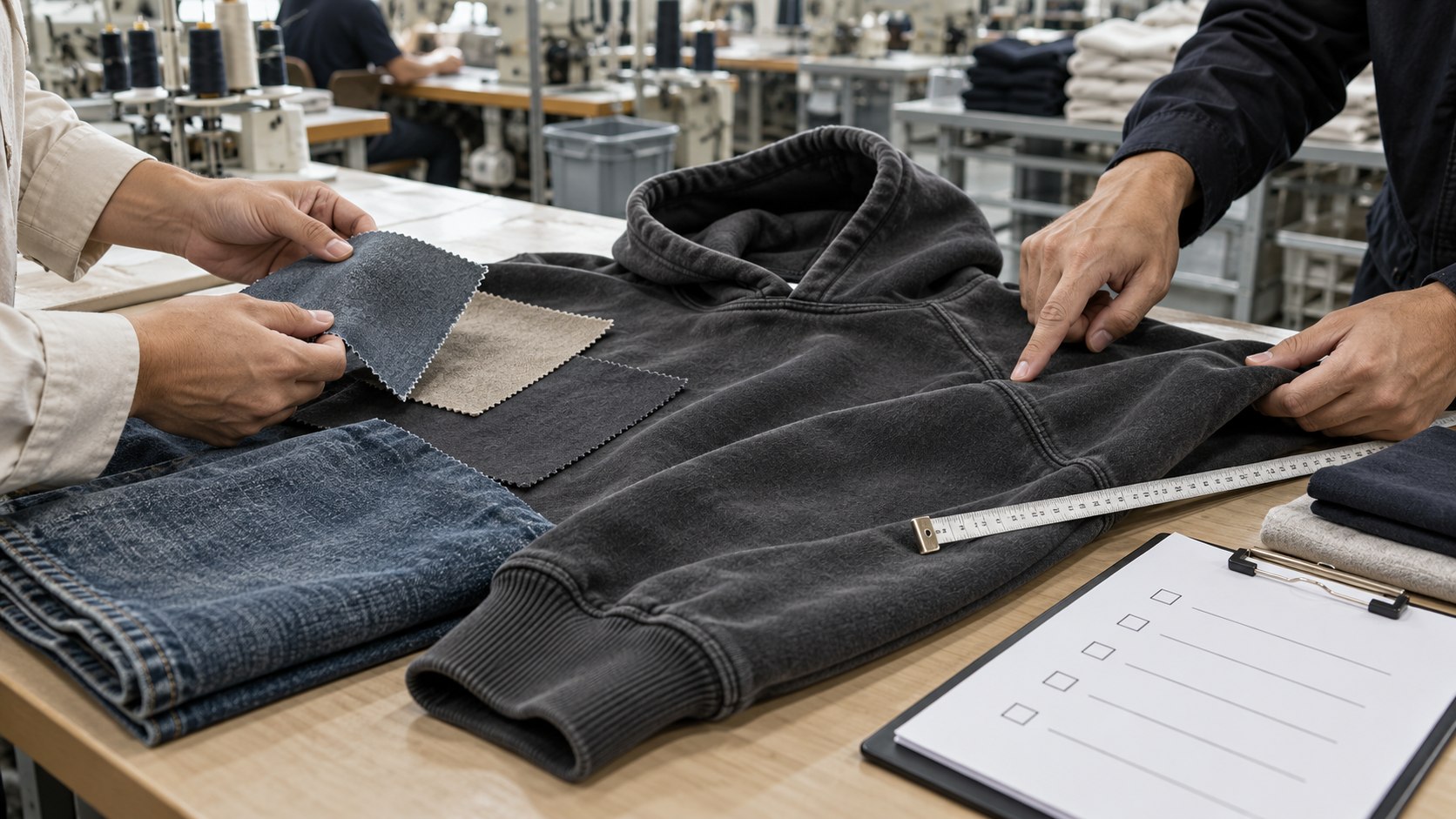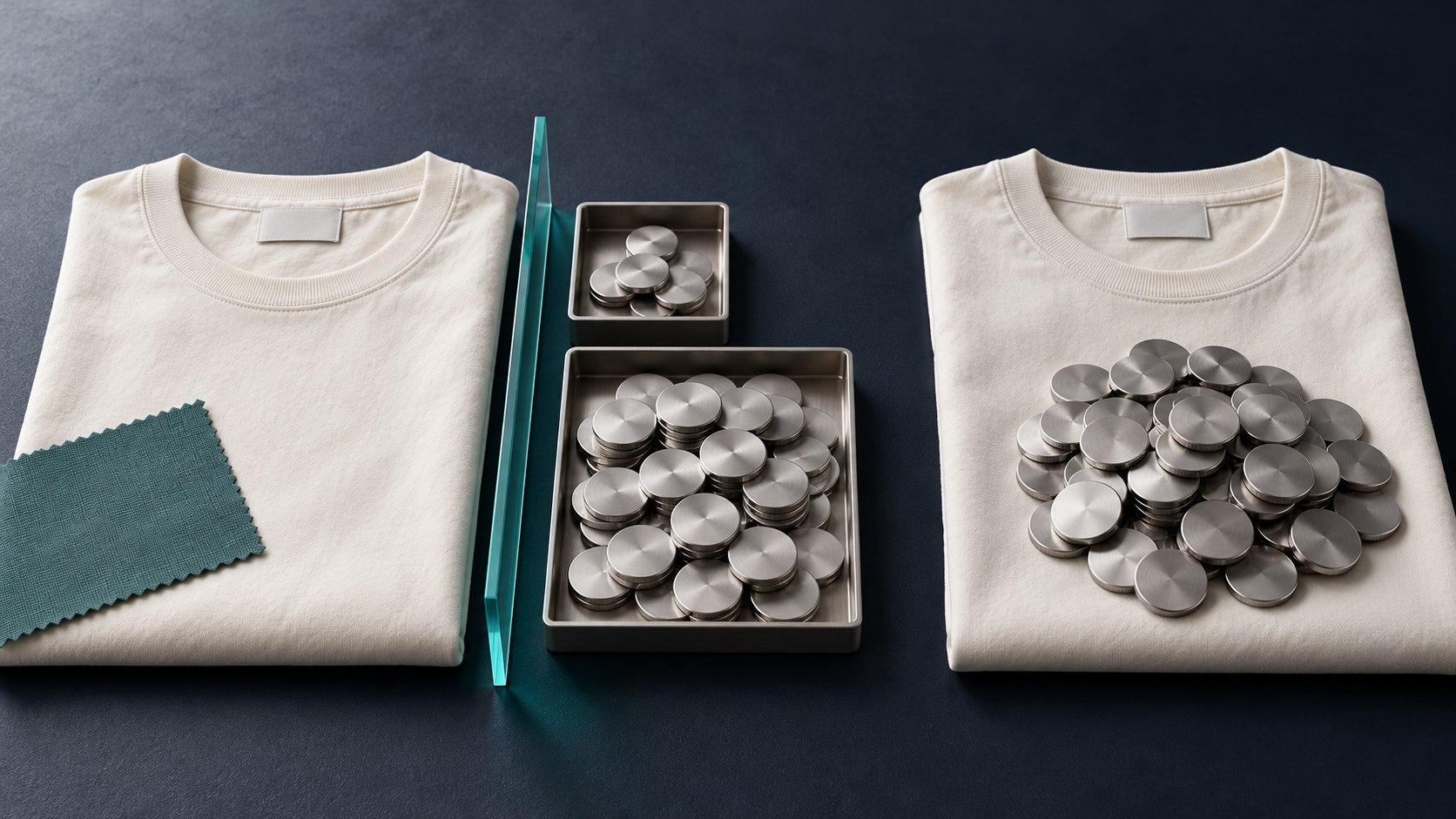

Even inspection firms’ own FAQ pages routinely describe AQL 2.5 as “allowing a 2.5% defect rate.” That’s not what it means. AQL sampling is a statistical decision rule: you inspect a sample from a batch, count the nonconforming units you find, and compare that count to acceptance and rejection numbers, not to a percentage. If you find 6 major-defective garments in an 80-piece sample drawn from an 800-piece order under AQL 2.5, the entire 800-piece batch is rejected. Not 6 out of 800.
This guide covers what clothing buyers actually need before placing an order: the sample size your inspector will draw at each lot size, the Ac (acceptance) and Re (rejection) numbers that determine pass or fail, and the PO clauses that close the commercial and procedural gaps the standard doesn’t address: who pays for re-inspection, what happens when a batch fails, and how your payment terms should protect you.
We’ll also cover the realities of small-batch sampling (where a 100-piece order requires a 20% sample with an acceptance number of 1) and how to set category-specific AQL levels for different garment types, based on what we see on our factory floor running shirts, polos, jackets, denim, and hoodies through final inspection.
What AQL Sampling Actually Is
AQL stands for acceptance quality level in ANSI/ASQ Z1.4 and acceptance quality limit in ISO 2859-1. The standards are equivalent in principle, but must not be assumed interchangeable; use the edition named in your contract. You define a quality level (typically 1.5, 2.5, or 4.0 for apparel), choose an inspection level (almost always General Level II in the industry), and the standard gives you a sample size and two numbers: Ac (accept if nonconforming units ≤ Ac) and Re (reject if nonconforming units ≥ Re).
The standard’s scope covers a continuing series of lots. In practice, buyers commonly handle pre-production samples with spec checks and 100% inspection rather than AQL sampling. That is a practical inference about how to assess a sample, not a statement that the standard prohibits sampling for one-off orders.
The core operating principle: AQL is designed to accept lots most of the time when the supplier’s process actually runs at that quality level. It’s not a tolerance for bad product. The percentage refers to the statistical baseline at which the sampling plan’s risk profile is calibrated. Finding more nonconforming units in your sample than the acceptance number allows means the lot fails the agreed sampling acceptance criterion and is rejected under that plan. It does not measure the lot’s actual defect rate.
The Six-Row Table: Lot Size to Sample Size to Ac/Re
Below is the core reference table for General Inspection Level II, single sampling, normal inspection. It covers six lot-size ranges and three common AQL values (1.5, 2.5, 4.0) for major defects. Throughout this article, every count is by nonconforming units per defect class (clause 4 in the PO section spells out the rule): one garment with three major defects counts as one major-defective unit. These figures are reproduced from ANSI/ASQ Z1.4 Table II-A, cross-checked against published reprints and excerpts. Some original standard pages could not be accessed directly during drafting; the contract-named version governs.
| Lot Size (N) | Code Letter | Sample Size (n) | AQL 1.5 (Ac/Re) | AQL 2.5 (Ac/Re) | AQL 4.0 (Ac/Re) |
|---|---|---|---|---|---|
| 91–150 | F | 20 | 1 / 2 (n=32) | 1 / 2 | 2 / 3 |
| 151–280 | G | 32 | 1 / 2 | 2 / 3 | 3 / 4 |
| 281–500 | H | 50 | 2 / 3 | 3 / 4 | 5 / 6 |
| 501–1,200 | J | 80 | 3 / 4 | 5 / 6 | 7 / 8 |
| 1,201–3,200 | K | 125 | 5 / 6 | 7 / 8 | 10 / 11 |
| 3,201–10,000 | L | 200 | 7 / 8 | 10 / 11 | 14 / 15 |
How to read this table: For a 500-piece order with AQL 2.5 for major defects, you’re in the 281–500 range, which gives code letter H and sample size 50. Accept if you find 3 or fewer major-defective units; reject if you find 4 or more.
The notation in AQL 1.5 for code F: For the 91–150 lot-size range at AQL 1.5, the source table’s downward arrow points, under its legend, to the next available plan: code letter G, n=32, Ac 1 / Re 2. Handle other blanks and arrow directions according to the specific legend in the contract-named edition. Arrow directions may differ between editions; don’t apply this example as a general rule.
Critical defects (safety hazards, regulatory violations, dangerous failures) are typically handled with Ac 0 / Re 1 regardless of lot size. One critical-defective unit in the sample fails the entire batch.
Minor defects (workmanship issues that don’t affect saleability) usually run at AQL 4.0 or are grouped and counted separately.
Small-Batch Reality: 100–1,000 Pieces
Sampling becomes punishing at small lot sizes. Here’s what actually happens:
- 100 pieces → code F → 20-piece sample (20% of your order), AQL 2.5 gives Ac 1 / Re 2. Two major-defective units reject the whole batch.
- 300 pieces → code H → 50-piece sample, AQL 2.5 gives Ac 3 / Re 4. Four major-defective units reject it.
- 800 pieces → code J → 80-piece sample, AQL 2.5 gives Ac 5 / Re 6. Six major-defective units reject it.
The practical consequence: sampling can take a substantial share of a small order, while the absolute acceptance number remains low. For the 100-piece order above, two major-defective units in the sample reject the lot. The commercial risk is concentrated: the decision affects the entire order, not just the sampled pieces.
In our production runs, small-batch buyers often choose one of three workarounds:
- Relax the AQL from 2.5 to 4.0, or step down to General Level I (smaller sample, but less statistical power).
- Agree on Ac 0 with half the sample size plus 100% rework for any defect found. Essentially a zero-defect expectation with a repair path.
- Reject contracts that specify AQL 2.5 or 4.0 without clarifying the inspection level or lot-size bracket.
The standard itself doesn’t say “don’t sample small batches.” The practical issue is the low absolute Ac number: for 100 pieces at AQL 2.5, the plan accepts no more than one major-defective unit in the 20-piece sample. Agree on that decision rule before production.
Setting AQL by Garment Category
Different garment categories have different critical zones. Rather than using AQL 2.5 for all major defects across every product, buyers who work with multiple categories often specify which defects matter most for each type.
This is factory-floor experience, not a standard requirement. Below is what we see drive rejections in our own production runs.
| Garment category | High-risk zones (major-defect focus) | What we see drive rejections |
|---|---|---|
| Shirts (dress shirts, casual wovens) | Collar points and band; placket; armholes; buttonholes | Collar point asymmetry and collar band puckering; placket length difference between left and right sides; armhole ease too tight for movement; buttonhole position offset from center line |
| Polos | Collar; placket buttons and buttonholes; pique fabric | Collar curl and shape asymmetry after washing; placket button/buttonhole misalignment; pique fabric horizontal barre (stripe effect from tension variation) |
| Jackets (bombers, coaches, trucker) | Sleeve caps; zipper and hem; lining; shoulder seams | Sleeve set puckering at the cap; zipper smoothness and hem alignment issues; lining ease that binds during wear; shoulder seam pattern mismatch (plaids, stripes) |
| Denim | Washed front/back panels; fabric surface; hardware; whiskers | Stone-wash or enzyme-wash front/back shade difference; dry and wet crocking (color rub-off); hardware strength issues (rivets, zipper); whisker position asymmetry |
| Hoodies & Sweatshirts | Cuffs and waistband; print or embroidery; fleece; neckline | Poor rib recovery (cuffs and waistband snap-back); print or embroidery cracks and position errors; fleece shedding (pilling within first wash cycle); poor neckline stretch recovery |
Each category gets its own major-defect checklist. One configuration the parties could negotiate is AQL 2.5 for high-risk zones (collar on shirts, zipper on jackets) and AQL 4.0 for lower-impact defects. This is a negotiable example, not a verified industry convention. Under the standard, critical, major, and minor defect groups are counted and assessed separately. Buyers can therefore assign different AQLs to risk zones, provided the PO defines the groups and their counting and acceptance rules.
For a comprehensive item-by-item inspection checklist covering measurement tolerances, fabric defects, construction defects, and packaging, see our apparel quality control checklist. That article answers what to check; this one answers how many to sample, how to judge, and what to do when it fails.
What to Do When the Batch Fails Inspection
The standard tells you how to decide pass or fail. It doesn’t say what happens next. That’s a commercial negotiation, and the PO clauses (next section) are where you lock it down. Here’s the procedural reality we see on the factory floor.
Immediate hold: The batch stays at the factory. The inspector writes a report listing the types of defects found, their locations, and the count of nonconforming units in the sample.
Root cause identification: The factory reviews whether the defects are isolated (one operator’s station, one cutting table, one wash load) or systemic (a pattern error, wrong thread spec, faulty machine setup). As one sourcing guide puts it: a failed sample is not solved by repairing only the selected pieces. If the defects are systemic, the entire batch needs attention.
Three commercial options (negotiated before production, not after):
- Rework and re-inspect: The factory repairs or replaces defective units, then the inspector draws a fresh random sample from the reworked batch. This is the most common path for batches that fail on fixable defects (loose threads, small stains, misaligned labels). Re-inspection fees typically run $280–320 per man-day, and the industry convention is that the supplier pays when the failure is on their end. That’s not a standard rule. It’s what most buyers write into their PO terms.
- Discounted acceptance: The buyer agrees to accept the batch at a price reduction reflecting the defect rate and the commercial impact. This happens when the defects are minor, the shipping deadline is tight, and rejection would cost more in delay than the discount.
- 100% sorting: The factory inspects and sorts every unit, pulling out all nonconforming pieces. The conforming units are then sent for final re-inspection (sampling or 100%, depending on what’s agreed). The buyer decides whether the supplier pays for sorting labor or whether it’s a shared cost.
Timeline from failure to resolution (based on what we see in our production runs): Day 0, inspection report received. Day 1, root cause meeting. Days 2–5, rework (rework capacity is typically 30–50% of the normal production line’s throughput). Day 6, internal re-sample by the factory QC team. Days 7–9, third-party re-inspection scheduling. Total: 7–10 days, which usually eats into the shipping-date buffer. Real cost: the delay, the capacity squeeze, and sometimes air freight to make up lost time.
The standard doesn’t mandate who pays or how long you wait. That’s why the PO clauses below matter.
PO Clauses You Can Copy Into Your Purchase Order
Below are six to seven clauses that close the gaps between the standard’s statistical method and the commercial realities of apparel production. Adapt the specific numbers and timelines to your business, but include the principle.
- Inspection standard and version “Final inspection shall be conducted per ANSI/ASQ Z1.4-[edition year to be filled in by the parties], Table II-A, single sampling, normal inspection, General Inspection Level II, unless the parties agree in writing to a different level or switching rule. If the versions of ANSI/ASQ Z1.4 and ISO 2859-1 conflict, the contract-named version governs.”
- Inspection level and cost of level changes “General Inspection Level II is the default. Any increase in inspection level requested by Buyer after sample approval, such as from General Level II to Level III, shall be at Buyer’s cost.” (This clause only allocates the additional man-day costs caused by Buyer’s changes to the inspection plan.)
- Defect classification and AQL assignment “Critical defects (safety, regulatory, dangerous failure): Ac 0 / Re 1. Major defects (reduce saleability or usability): AQL 2.5. Minor defects (workmanship only): AQL 4.0. Supplier shall receive Buyer’s defect definition list and category-specific major-defect checklist (attached as Annex A) at the time of order confirmation. The same physical defect may be classified differently depending on garment type and placement.”
- Counting method “Defects shall be counted by nonconforming units (a garment with one or more defects = one nonconforming unit), not by nonconformities (individual defect count). A single garment with three major defects counts as one major-defective unit.”
- Failure handling, timeline, and re-inspection cost “If the lot fails final inspection, Supplier shall (a) identify root cause within [__] hours, (b) propose corrective action (rework, replacement, or sorting) within [__] hours, (c) complete corrective action within [__] business days, and (d) notify Buyer to schedule re-inspection. Re-inspection shall be conducted by the same or equivalent third-party inspector. Re-inspection fees are borne by Supplier when the failure is due to Supplier’s nonconformance. If the lot fails re-inspection, Buyer may reject the lot, demand replacement, or accept at a discount to be negotiated. Any delay in the shipping schedule caused by failed inspection and rework shall not extend Buyer’s payment terms.”
- Payment tied to inspection “Balance payment (typically 70% of order value; 30% deposit paid at order confirmation) shall be released only upon receipt of a passing final inspection report and Buyer’s approval of shipping documents. If inspection fails and is not resolved within [__] business days of the scheduled inspection date, Buyer may cancel the order and recover the deposit.” (This is an industry convention. The 30/70 split and the leverage it gives buyers is not standardized, but it’s the commercial norm in apparel sourcing.)
- Inspector designation “Buyer shall designate the third-party inspection firm. Supplier may not refuse access to the inspection firm’s representative during the agreed inspection window. Inspection shall occur at the factory or consolidation warehouse where the finished goods are held, not at an offsite location arranged by Supplier without Buyer approval.”
These clauses turn the standard’s pass/fail logic into an enforceable commercial agreement. The standard is a measurement method; the PO is the contract that says what happens when that measurement goes wrong.
FAQ
Does AQL 2.5 mean 2.5% defects are acceptable? No. AQL 2.5 means the sampling plan is designed to accept lots most of the time when the supplier’s process is running at that quality level. It’s a statistical parameter, not a defect allowance. If the number of nonconforming units in the sample exceeds the acceptance number, the entire batch fails that acceptance criterion. Not a proportional rejection.
What sample size for a 500-piece order? Under General Inspection Level II, 500 pieces falls in the 281–500 range, giving code letter H and a sample size of 50 pieces. At AQL 2.5 for major defects, you accept if you find 3 or fewer major-defective units, reject if you find 4 or more.
Can I use AQL for a one-off custom order or pre-production sample? The standard’s scope covers a continuing series of lots. In practice, buyers commonly assess pre-production samples through spec checks and 100% inspection; that is a practical inference, not a prohibition in the standard. For a one-off order, agree on the inspection method and acceptance criteria in the contract rather than assuming that the AQL number alone settles them.
Who pays for re-inspection when a batch fails? Industry convention is that the supplier pays re-inspection fees (around $280–320 per man-day) when the failure is due to their nonconformance. This is not dictated by the standard; it’s negotiated in the PO. If your PO doesn’t say, expect a dispute.
Can I set different AQL levels for different defect types on the same garment? Yes. It’s common to use Ac 0 / Re 1 for critical defects, AQL 2.5 for major defects, and AQL 4.0 for minor defects. You can also specify different major-defect priorities by garment category (collar symmetry matters more on dress shirts than on hoodies). This is a commercial decision, not a standard requirement. Write it into your PO and defect classification list.
How This Fits Into Your Sourcing Workflow
AQL sampling is the final decision point before shipment, but it’s not the whole quality system. The acceptance or rejection probability you see at final inspection is determined by everything upstream: pattern approval, fabric inspection at receiving, in-process checks at cutting and sewing, and pre-final audits. A defect caught at the cutting table costs you a yard of fabric; the same defect caught at final inspection costs you a finished garment. For a production-stage overview, see NOVITA’s OEM/ODM manufacturing process.
For more on what to check and when:
- Fabric defect types and grading (before cutting)
- Zipper inspection checklist (in-process and final)
- Denim crocking tests (lab testing before bulk)
- Apparel quality control checklist (comprehensive item list for final inspection)
Apply the Inspection Plan to Your Product
AQL is a lot acceptance decision, not a substitute for approving materials or the pre-production sample. For a specific garment, link the written defect classification list to the actual product checks: T-shirts (fit, shrinkage and print), polo shirts (collars and plackets), jackets (lining and hardware), and denim (shade, wash and crocking). Review the sample sign-off example and overall QC checklist, then agree on defect categories, inspection level and acceptance numbers in the purchase order. Discuss a NOVITA inspection scope; do not assume these editorial examples certify any specific order.
AQL gives you the statistical rule. Your PO clauses give you the commercial leverage. And your upstream process controls determine whether you ever have to use either.
If you’re preparing an RFQ or purchase order and want to ensure you’ve covered sampling terms, payment protection, and inspection authority, see our clothing manufacturing RFQ checklist. For questions about minimum order quantities and how they interact with sampling feasibility, see our clothing manufacturer MOQ guide.
The bottom line: Match the sample size and Ac/Re limits to your lot size using the table above, write those numbers into your PO along with who pays when things go wrong, and make sure your defect classification list is attached and referenced. That’s AQL sampling for clothing buyers.