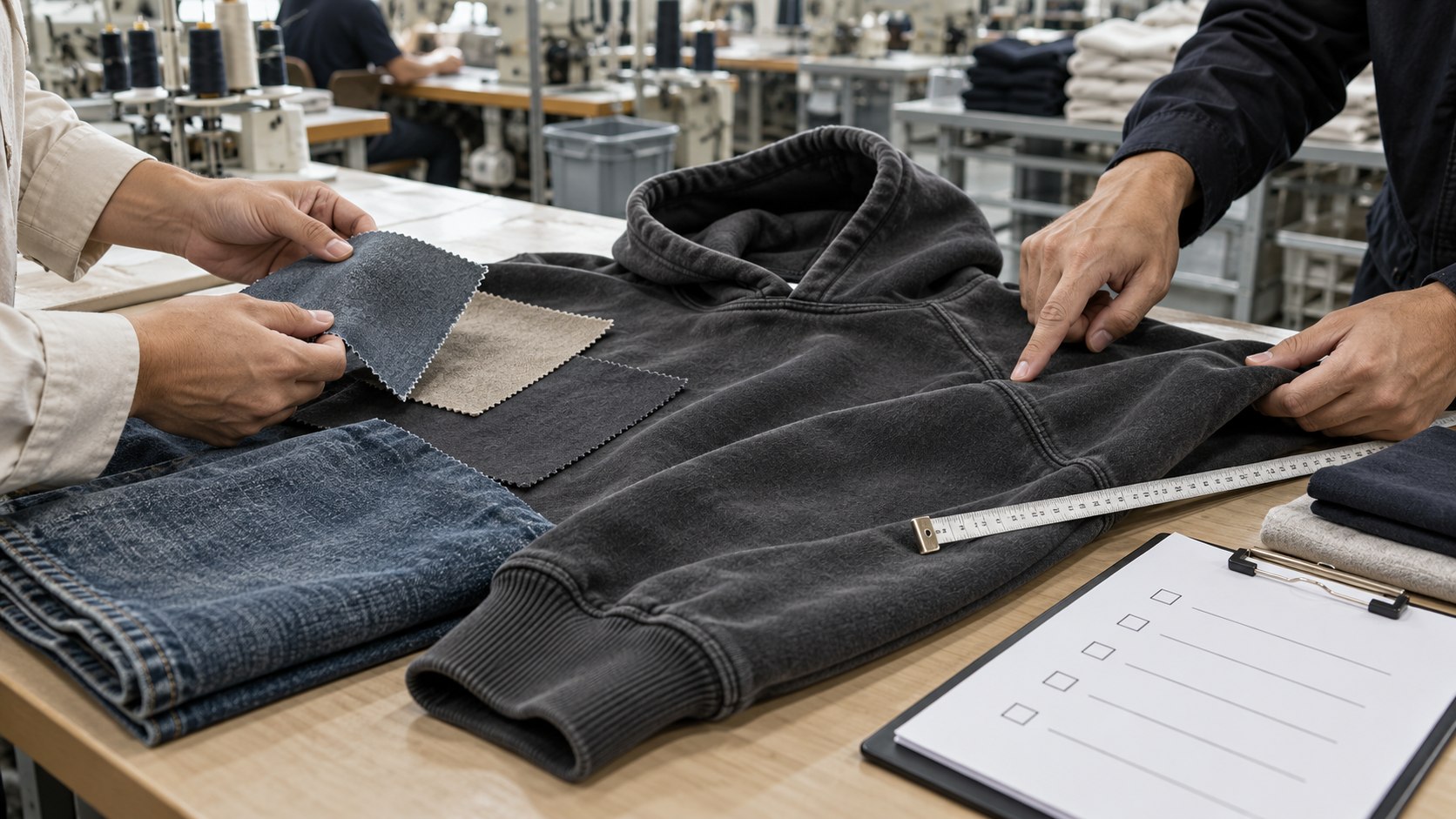
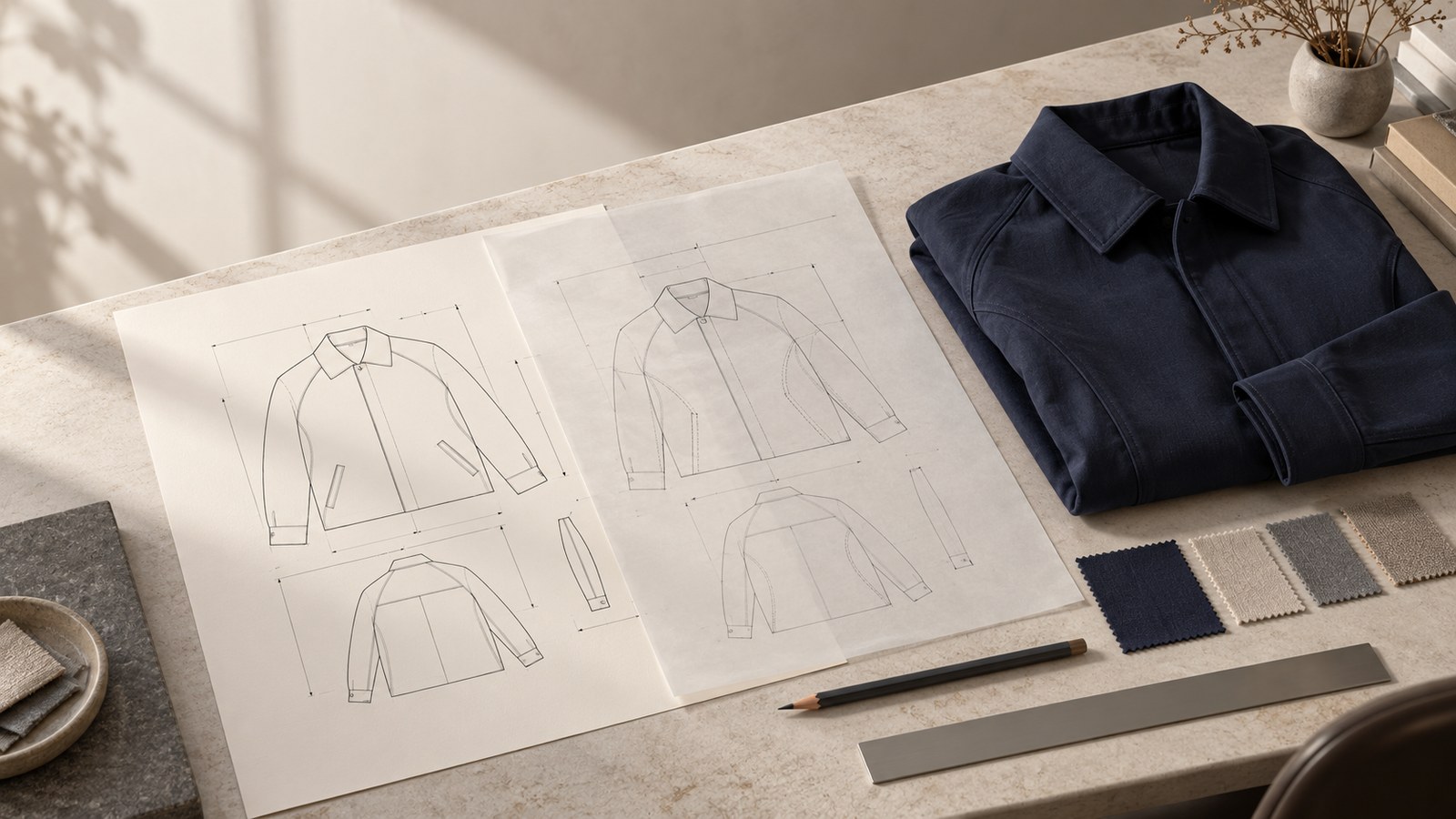
You send a polished PDF. The reply asks which fabric is confirmed, whether the chest measurement is flat, and which drawing takes priority. Those answers appear to be somewhere in the document. Why ask again?
Because finding a statement is not the same as knowing whether it is an instruction, a suggestion, or an outdated note. A useful tech pack for clothing makes those distinctions visible.
This guide follows a factory-side reading path: establish what can be made, identify what the price must cover, then resolve conflicting instructions. It is a proposed decision framework, not a claim that every factory follows an identical procedure. Examples are illustrative, not reports of NOVITA customer orders.
A factory reads for decisions, not completed boxes
A finished-looking document can still leave the manufacturing brief unfinished. Each page needs to tell its reader which decisions have been made and which still need agreement.
If you are asking what is a tech pack, the short answer is a shared technical description of the garment. Techpacker’s guide describes its drawings, specifications, materials, and revision record. White2Label’s guide also identifies sketches, sizing information, reference images, and a bill of materials as core content.
The reading problem begins where those elements disagree. A drawing shows a narrow neck opening; the measurement page describes a wider one. A fabric note says “reference only,” but nothing identifies the actual sourcing requirement. Completing both pages has not settled either decision.
For a China-based OEM/ODM project with NOVITA, distinguish your fixed requirements from the areas where you want development advice. Leave room for answers you do not yet have. “Please propose a material against this approved swatch” is a clearer instruction than an apparently definitive fabric description copied from another style.
A supplier’s question may be asking how much freedom you have allowed. Answering that is more useful than resending the PDF.
Read feasibility first, then make the quote comparable
The most useful reading order follows dependencies rather than the PDF’s contents page.
Start with the garment’s identity and production route. Do the front and back belong to the same style? Does the drawing describe a sewn fabric garment or a shaped knitted product? Does the requested appearance depend on a material or process that remains undecided? These are sensible feasibility questions before any detailed price comparison.
Next, connect the visual result to the material instruction. A costed material must be identifiable, or the supplier needs an agreed basis for proposing it. White2Label’s discussion of the bill of materials distinguishes straightforward products from more complex garments with additional material components. The implication for your brief is practical: a recognizable silhouette alone does not establish what has to be bought.
Then establish the scope being priced. A quote for a proposed material is not directly comparable with a quote for a buyer-nominated material unless that difference is explicit. Likewise, an undecided decoration treatment should not disappear inside an unexplained total.
Finally, establish which information is current. Techpacker explains that revision history records changes and approvals to help prevent production against the wrong version. Apply that principle across the whole handover, including separate artwork and measurement files.
Imagine a zip jacket whose revised drawing removes a lining while the materials page retains it. Neither the lower price nor the higher price proves that a supplier has understood the garment. The useful reply identifies the conflict and asks which instruction controls. Settle that before treating the prices as competing offers for the same product.
What gets skimmed, and what a picture cannot explain
Brand narrative is useful context, but give it less authority than the technical instruction. If a page describes the collection as “quiet luxury,” it cannot settle the width of an opening or the identity of a fabric.
Give mood imagery a quick orientation read, then return to it when a technical instruction needs context. This recommended priority gives the image a useful role without letting it silently override a specification.
A photograph also needs a defined role. Does it show the whole garment you want, only the surface texture, or merely the styling? Write that beside the image. Otherwise, a supplier has to ask which visible details belong in the product.
Measurements need the same discipline. “Chest” can refer to the wearer or to the garment, and those are not interchangeable instructions. The official scope of ASTM D5219-25 is terminology relating to body dimensions for apparel sizing. Citing it does not turn a body-size chart into finished-garment specifications.
Fashion Index’s guide connects garment specifications to points of measurement and recommends tolerances for listed measurements. Give the reader enough information to reproduce the measurement: identify the object being measured, the location, and the method.
Five phrases that invite different garments
The following examples show possible interpretations, not documented error rates. Each replacement makes an unresolved decision easier to identify.
“Use the same fabric as the photo”
A photo is a visual reference, not a material identity. A supplier could interpret it as a request to match the appearance while you expect a particular handle and composition.
Replace it with a statement of authority: “Photo is for surface appearance only. Material selection remains open; submit a proposal against the physical reference.” If you have no physical reference, say so. Do not imply that the factory has received evidence it has never seen.
“Oversized fit”
A supplier could read this as a broad body with otherwise conventional proportions. You might mean a dropped shoulder, longer sleeve, and shorter body. The adjective has not resolved those relationships.
Keep the fit description, but connect it to the relevant finished-garment dimensions and drawing. Fashion Index’s point-of-measurement guidance is useful here: the measurement must identify what is being measured. Do not ask a fit label to do the work of a technical instruction.
“Navy, as approved”
Which approval? A digital image, a submitted swatch, or a previous garment? The sentence can sound final while pointing to no traceable reference.
Name the approved reference and its status. If bulk shade comparison still needs agreement, keep that decision separate from the color name. NOVITA’s guide to fabric shade-band approval covers that later approval issue without turning this handover into a color-control procedure.
“Clean finish inside”
A supplier could understand this as an appearance requirement and propose a construction you did not intend. You may instead mean a particular treatment that changes the assembly.
Identify the required result in a detail drawing, or explicitly request a construction proposal. The official ASTM D6193-16(2025) page distinguishes stitches and seams and discusses matching seam characteristics to material and end use. “Clean” is not a substitute for that distinction. This is a terminology boundary, not a claim that the garment complies with the standard.
“Follow the latest comments”
The factory could interpret an email attachment as the latest instruction while your designer considers the updated PDF authoritative.
Replace the sentence with a named controlling revision and retire the superseded files. Techpacker’s revision-log guidance supports recording what changed, when, and who approved it. Do not leave the reader to reconstruct approval from the order of messages in an inbox.
The missing answer that makes a price conditional
A missing answer matters most when it changes what the price represents. Rather than asking whether every box is filled, ask whether a supplier can price the unresolved item without choosing a different product for you.
Material identity is a clear example. If “cotton jersey” is the whole instruction, ask the supplier to state its proposed material basis rather than treating an unqualified price as final. The pack can remain open for development; the quote should make that openness visible. MakeMine’s explanation includes materials alongside measurements and construction in the manufacturing brief.
Order allocation is another decision to expose. If the proposed order is not allocated across styles and colors, request the allocation assumption used in the price. This is a comparison rule, not a claim that a particular allocation produces a predictable discount.
The intended delivered state also needs agreement. Is the proposed finishing included? Is the decoration confirmed or merely represented in the drawing? An unanswered question does not automatically prevent an indicative estimate. It prevents you from knowing whether that estimate covers your intended garment.
Use NOVITA’s clothing manufacturing RFQ guide for the wider commercial brief. Here, keep the distinction narrow: a preliminary price with disclosed assumptions can be useful; a seemingly firm price with hidden product decisions is difficult to compare.
Read the questions as a map of unresolved responsibility
A useful clarification request tells you which decision needs an owner. Read it that way before assuming the supplier has ignored the file.
“Can we propose an alternative fabric?” asks whether material substitution is permitted. Answer with the boundary: what must remain fixed, what can vary, and what needs approval before proceeding. “Please suggest” and “approved for use” should not mean the same thing.
“Which measurement should we follow?” asks whether the drawing, size specification, or later comment has priority. Sending all the files again does not settle that conflict. Identify the controlling instruction and update the contradictory material.
“Is this artwork final?” asks whether the visual is an executable asset or a placeholder. Hawthorn’s tech-pack page states that high-resolution files are required for custom artwork. A small logo pasted into a PDF should therefore have an explicit status; do not let its presence imply production approval.
Questions also deserve specific answers from the supplier. If you receive only “please provide more details,” ask which decision cannot be made and which existing instruction is ambiguous. That turns a vague request into an actionable discussion.
Keep clarification separate from approval. An agreed interpretation can become an instruction for development, but the resulting sample still needs its own decision. NOVITA’s sample development guide explains that broader stage. The tech pack should record what you have authorized, not imply that an unseen result has already been accepted.
Before sending, make the decisions visible
Read your garment tech pack as someone who cannot ask the designer across the desk. Use these questions to resolve decisions before sending:
- Could different readers choose different products? Tighten the instruction or mark the choice as open. Do not conceal uncertainty with a confident adjective.
- Does each reference have a limited purpose? Specify whether an image governs appearance, proportion, construction, or only styling. Anything outside that purpose needs its own instruction.
- Can the quoted material be identified? If not, request a proposal and require the estimate to name its assumed material. A blank is less misleading than an invented specification.
- Does the controlling version agree with itself? Check the drawing against the related specification and comments. A version date does not resolve contradictions within that version.
- Who can approve a change? Make the approval route explicit so a sourcing suggestion does not become an unauthorized design decision.
- What response do you want next? Ask for feasibility feedback, a conditional quotation, or development against confirmed specifications. Give the supplier a defined response to produce.
For document completeness, use NOVITA’s separate tech-pack preparation checklist. That resource addresses what to prepare. This reading pass addresses whether the prepared information leads to a defensible decision.
Knitwear changes the dependencies
For a sweater or knitted top, resist reading gauge as an isolated promise of appearance or weight. NOVITA’s knitted-tops manufacturing guide explains that gauge is not thickness: yarn, stitch structure, and finishing also affect the result.
That changes the question to ask when reviewing the pack. Instead of “Is the gauge filled in?” ask “Does the specified gauge describe an agreed material-and-structure combination, or is it only a starting point?” A named gauge beside an undecided yarn does not settle the final fabric character.
Make yarn count readable as a specification rather than an unexplained number. Identify the count system and the yarn reference you intend the supplier to assess. If you cannot confirm them, request a proposal rather than copying a number from another product.
The assembly route needs an equally explicit conversation. Does the design intend fully fashioned panels with linked assembly, or cut-and-sew panels? Put that forward as a decision to confirm, not an interchangeable wording choice. This question does not assert that NOVITA offers every route for every design.
Where the route remains open, request separate proposals with their assumptions identified. Approval of the silhouette still leaves the supplier needing an agreed yarn and structure, an assembly route, and finished dimensions. Read those decisions together before authorizing development.
Questions buyers ask before sending a clothing tech pack
Can I send a tech pack for clothing to a factory before everything is final?
Yes, as a request for review rather than an implied production release. Label open decisions and state what response you want. This is the handover approach recommended here, not a promise that every supplier accepts incomplete documentation or can quote it on the same basis.
How do I know whether a tech pack template is enough?
Judge the completed content, not the number of pages. Collective Studio offers a PDF and Excel template, but a template’s existence cannot settle your product decisions. Test whether another reader can identify the intended garment, the assumptions, and the controlling instructions.
How to make a tech pack that produces fewer follow-up questions?
Remove contradictions before adding more pages. Define the authority of references, distinguish proposals from approvals, and give every open decision an owner. These steps target avoidable interpretation questions; they cannot guarantee a particular reduction in emails or sample revisions.
Is a line sheet for clothing enough to start manufacturing?
Do not assume a sales-facing presentation contains manufacturing instructions. If it shows the range but leaves measurements, materials, or construction undecided, treat it as context. The relevant distinction is the content: White2Label’s tech-pack description includes technical information beyond a visual product presentation.
Does a detailed pack mean the factory should have nothing to ask?
No. A request to clarify competing instructions can be more useful than silent agreement. Ask the supplier to identify the specific conflict and propose an interpretation where appropriate. Confirm that interpretation before proceeding so you both know what the next quotation or sample covers.