Clothing manufacturer payment terms are usually quoted as a deposit percentage. Published factory terms commonly quote deposits of 30-50% (Affix Apparel), but the balance trigger matters more than the split. Before releasing the balance, require named evidence such as an accepted inspection report or agreed transport document. An L/C can justify its bank fees when payment risk warrants documentary control. A useful payment clause connects the balance to a precise event, the evidence proving it, and a payment deadline.
Two questions decide everything, and neither is the deposit percentage
Start with the unrecoverable-cost test
Ask what the factory must commit before production, then ask what you will have verified before paying the balance. Use the answers to compare quotes before negotiating the split.
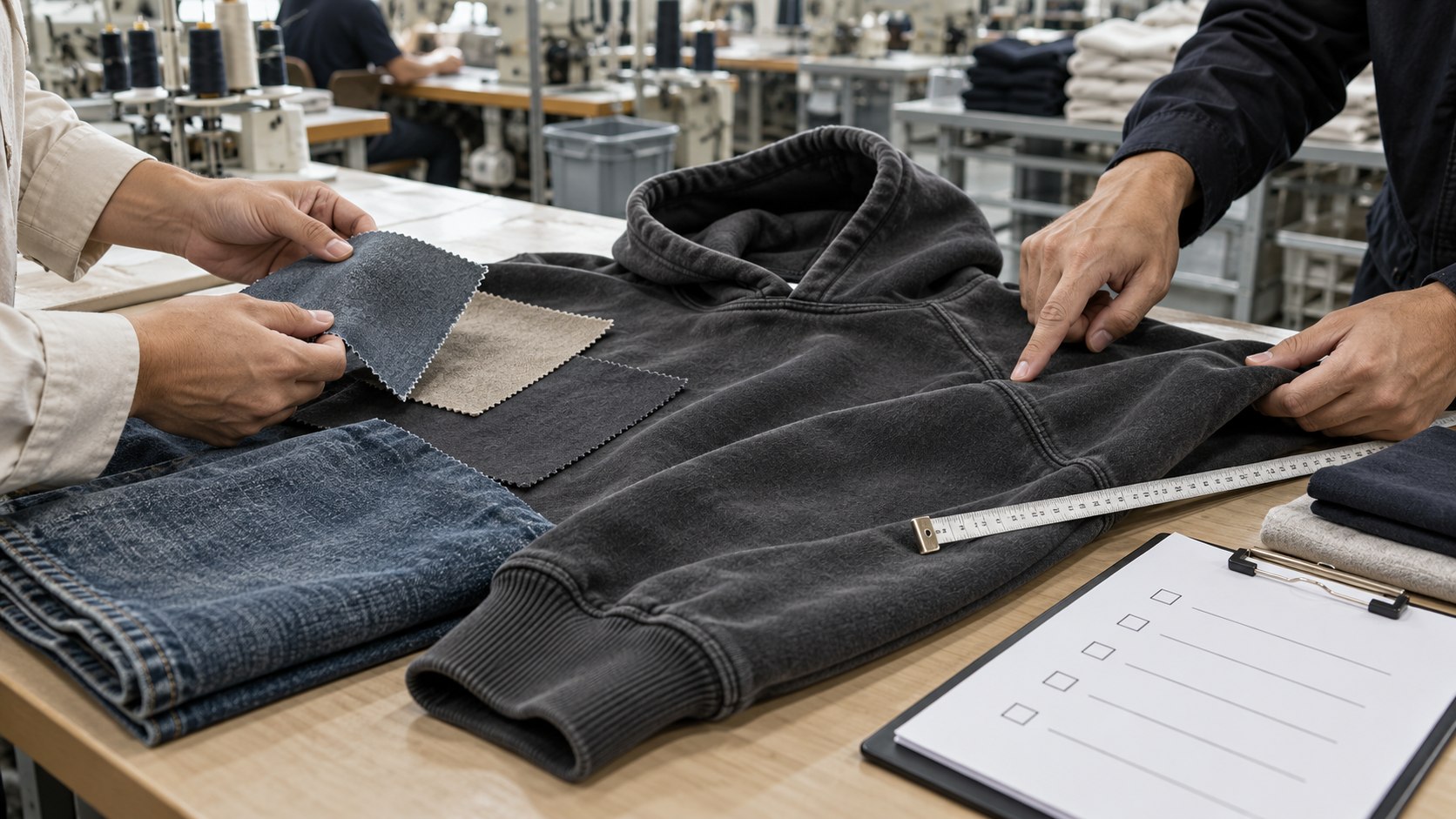
Stock fabric and a mill-developed shade create different commitments. Fabric purchases, dye-batch reservations, branded trims, and reserved line capacity can leave a supplier with costs it cannot recover if the buyer cancels. Luxudress describes the deposit as tracking that unrecoverable exposure; Mugekoo notes that custom materials may become non-cancellable once ordered.
Ask the supplier to itemize those commitments before accepting its advance-payment request.
| Order commitment | Question to ask before agreeing the deposit |
|---|---|
| Available stock fabric | Which materials must actually be purchased for this order? |
| Custom shade or finish | When does the mill commitment become non-cancellable? |
| Branded trims and packaging | Which approved items cannot be reused elsewhere? |
| Reserved sewing capacity | What production slot does the payment secure? |
For the fabric-minimum mechanism, read why small orders attract bigger deposits.
Find the point where your leverage disappears
Buyer exposure peaks when the supplier has most or all of the money but the buyer lacks accepted goods or control over their release. A modest deposit does not fix a balance payable merely because the factory says production is finished.
Compare the evidence available at each payment event. Can you inspect? Can you require correction? Will you control the documents needed for collection? A favorable-looking split can conceal an unfavorable answer.
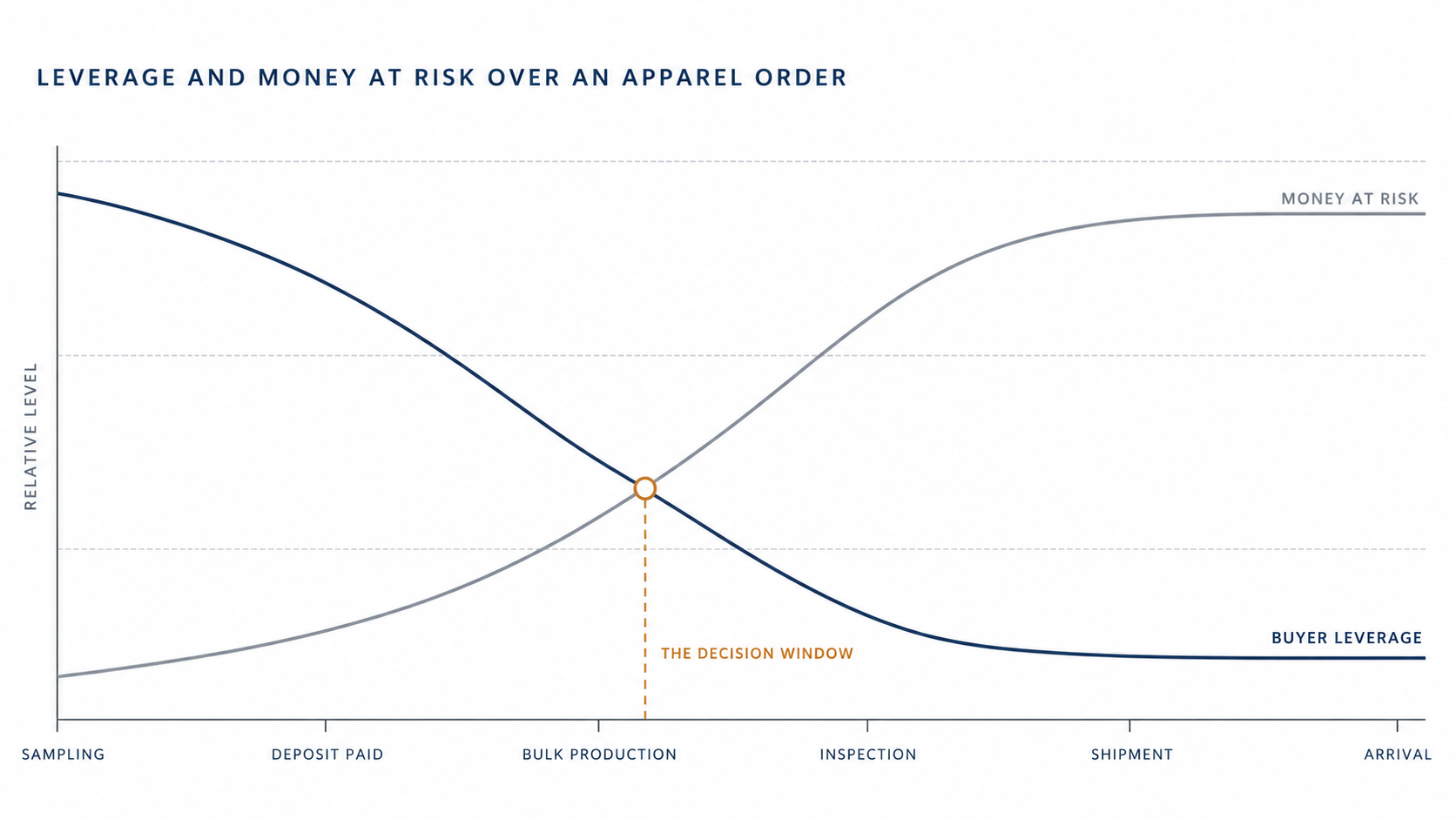
Read any proposed clothing manufacturer payment terms against that curve: the later the balance falls due, the less leverage remains to enforce it.
What deposit percentage is normal for clothing manufacturer payment terms?
The market quotes a range, not a rule
Published factory terms commonly quote 30-50% deposits and 50-70% balances (Ready One). That is market practice reported by suppliers, not an independently established industry standard. ICM rejects the idea of a universal payment term.
A factory calling its preferred split “standard” has not explained why it fits your order. Ask each supplier to state its own clothing manufacturer payment terms in writing, with the commitments and release conditions attached.
Why first orders cost more upfront
Ready One publishes 50/50 for new clients and 30/70 for established brand clients. This illustrates a supplier’s approach, not an entitlement to better terms after an arbitrary waiting period.
A supplier has no payment record for a new buyer. You likewise have no delivery record for that supplier. Resolve both uncertainties with approved specifications, inspection access, and staged evidence rather than asking either side to rely on trust alone.
When an equal split is fair or a warning
An equal split can be defensible if the supplier identifies substantial early commitments and accepts a meaningful balance trigger. It is harder to defend if the specification is still changing, material purchases are unexplained, or inspection happens only after full payment.
Ask what the advance funds and when those commitments become binding. Do not confuse a supplier’s willingness to accept a lower deposit with proof of reliability.
Treat unusually high advances as a different risk category
Full cash-in-advance is not simply a stricter version of staged payment. It removes the buyer’s unpaid balance as leverage. The US International Trade Administration (ITA) calls cash-in-advance the least attractive buyer option because of unfavorable cash flow.
If a supplier requires full prepayment, assess the entire exposure as an advance-payment decision. Do not let the word “deposit” make it sound safer.
“Balance before shipment” is four different terms: pick one in writing
Name the trigger and its evidence
Luxudress distinguishes completion, inspection, transport-document presentation, and arrival as different balance milestones. Arrival plainly is not before departure; the point is to replace loose shipment language with the actual event intended.
| Balance trigger | Evidence to name in the PO | Remaining buyer exposure |
|---|---|---|
| Production completed | Completion notice and agreed production records | Completion alone does not establish conformity or dispatch. |
| Inspection passed | Report from the agreed inspector against the agreed specification and acceptance criteria | Goods may still be awaiting loading; inspection scope matters. |
| Transport document presented | Agreed carrier-issued document; specify whether an on-board B/L copy is required | Documentary evidence is not a quality guarantee; release arrangements still matter. |
| Goods arrived | Defined destination-arrival notice or other agreed arrival evidence | Arrival is not acceptance, customs clearance, or delivery to your warehouse. |
Rank the terms by what you can verify
For an ocean order using an original negotiable bill of lading, payment against its copy can be a balanced negotiating starting point, provided inspection is already accepted and the original-release mechanism is clear. This is a buyer recommendation, not a universal default. Trishakti presents payment against a B/L copy as a better buyer term than payment before shipment.
Inspection-passed payment is workable when you can verify the report and hold payment for unresolved failures. Completion-only payment leaves more unverified. Refuse undefined “before shipment” language rather than arguing later about whether it meant booking freight, loading, or releasing documents. ICM identifies exactly that ambiguity.
Arrival payment asks the supplier to finance transit. Treat it as a negotiated concession, not something a new buyer can assume.
Confirm who holds the original B/L
Trishakti explains that the factory retains the original B/L until payment, preserving control over collection at destination. The copy provides shipment evidence; it is not the original the supplier is withholding.
Do not extend this logic to every transport arrangement. Confirm with the forwarder whether originals are required, whether surrender or electronic release is planned, and who can authorize release. A sea waybill or a surrendered original changes the control mechanism. Write the actual arrangement into the order rather than relying on the abbreviation “B/L.”
Put the trigger, evidence, and deadline into a sentence
Use this model for an inspection-triggered balance, filling every bracket before signing:
“The balance becomes payable within [agreed payment period] after Buyer receives and accepts the inspection report issued by [named inspector] confirming compliance with specification [version/date] and acceptance criteria [attached standard]; unresolved nonconformities suspend the balance obligation until the agreed corrective-action and reinspection requirements are met.”
Also set a review period for accepting the report or identifying specific failures. For an original-B/L arrangement, an alternative clause is:
“Following accepted inspection, the balance becomes payable within [payment period] after Buyer receives the carrier-issued on-board B/L copy identifying the agreed shipment; Seller must dispatch the complete original B/L set to [recipient] by [deadline after cleared payment], using [agreed delivery method].”
Select the clause that matches the agreed transaction. Confirm document custody and release with the forwarder before signing.
T/T vs. L/C vs. documentary collection: what each buys
T/T moves money; it does not create a release condition
T/T describes a bank transfer, not a payment schedule. It can fund a deposit or a balance. The US ITA lists wire transfers and cards as common advance-payment instruments, with escrow emerging for small transactions.
A direct transfer can be administratively straightforward, but do not assume it is recoverable if the order fails. The PO must supply the commercial conditions the transfer itself lacks.
| Method | What it provides | What it does not provide |
|---|---|---|
| T/T | Direct funds transfer at the agreed milestone | Independent verification of goods or automatic buyer recourse |
| L/C | Bank payment undertaking against complying documents | A bank judgment on garment quality |
| Documentary collection | Banks facilitate document handling against payment or acceptance | L/C-style document verification or equivalent payment protection |
An L/C checks documents, not garments
The US ITA describes L/Cs as secure but labor-intensive and relatively expensive because of bank fees. The value is documentary control, not protection from poor stitching, shade variation, or an incorrectly approved sample.
Under UCP 600, as summarized by IIBF Store, the rules apply only when the credit expressly incorporates them, and banks deal in documents separately from the underlying sales contract.
The same summary lists the typical document set: commercial invoice, transport document, insurance document, packing list, certificate of origin, and any required inspection or analysis certificate. Agree which documents your transaction actually needs before the issuing bank drafts the credit. Make every requirement obtainable by the party responsible for presenting it.
Under UCP 600 Article 14, as summarized by IIBF Store, banks have a maximum of five banking days following presentation to examine documents. The same summary states that, on refusal, the bank must give a single notice identifying each discrepancy. That clock is not a guarantee of immediate payment after shipment.
Inconsistent goods descriptions, missing endorsements, late shipment, and expired presentation deadlines can stall payment. Spelling or naming differences that create inconsistency deserve checking before presentation. The US ITA warns that document errors and discrepancies require amendment and resubmission. Align the PO, credit, and document templates early.
Documentary collection deserves a separate quote
With documents against payment, document release is tied to payment; with documents against acceptance, it is tied to acceptance of a future payment obligation. These are not interchangeable buyer promises.
The US ITA says collections generally cost less than L/Cs but offer no verification process and limited recourse for nonpayment. Banks facilitate the collection; they do not turn a weak commercial agreement into a payment guarantee.
Choose by exposure and relationship, not an invented threshold
Consider an L/C when the amount at risk, unfamiliar relationship, or requested credit makes bank involvement worthwhile. This follows the US ITA’s risk-based guidance; no universal order-value threshold settles the decision.
Ask your bank to quote the fees and review the document burden. For repeat orders, compare documentary collection or carefully earned open-account credit. Consignment is a separate seller-risk proposition: the US ITA defines it as payment only after the goods sell.
Sample fees and development charges: three different deals
Separate development work from production funding
Before paying, ask whether the charge covers pattern work, sample sewing, small-quantity material sourcing, mill commitments, or courier delivery. Use where sample fees come from to prepare that discussion rather than assuming every supplier includes the same work.
Credited, refundable, and sunk are different agreements
Luxudress says development charges are often deductible against a subsequent production order, but the conditions need agreement. That is a possible credit, not a promise to return cash.
A credited charge reduces a later production invoice under written conditions. A refundable charge requires an explicit agreement to return money under a named condition; do not assume such a policy exists. A sunk charge pays for completed development without a later offset. None of these arrangements makes the bulk-production deposit refundable.
Ask these questions before paying
What work and revisions does the charge cover? Which production order qualifies for a credit? Does the credit expire or depend on an agreed commitment? Will the deduction appear on the deposit invoice or the balance invoice?
Require the amount and conditions on the sample invoice or development agreement. A salesperson’s “we can deduct it later” leaves too much unsettled.
The purchase order: clauses that decide the later argument
Attach the schedule to events
Write separate events for deposit authorization and balance release. Calendar dates can serve as deadlines, but should not silently override unmet prerequisites. Specify what happens if approval, inspection, or dispatch is delayed.
Define the balance evidence and “inspection passed”
Use the model sentence above, then attach the inspection standard. Name the inspector, sampling plan, AQL acceptance limits where applicable, defect classifications, measurement tolerances, and unresolved-failure procedure. A report labeled “passed” means little without its scope.
Before signing, define what ‘inspection passed’ means before you tie money to it. Also agree whether the report must cover packing, labeling, and assortment as well as garment appearance.
Lock the beneficiary and verify any change independently
Record the contracting entity, beneficiary name, account, currency, and bank details. If the beneficiary differs, stop until the relationship and payment authority are independently documented and accepted. A familiar email signature is not evidence.
The FBI IC3 recorded 305,033 business-email-compromise incidents and $55,499,915,582 in exposed losses between October 2013 and December 2023. Those are exposed losses across the reported scheme, not an apparel-specific loss estimate.
Use a clause such as:
“No change to beneficiary or bank details is effective until Buyer independently verifies it through a previously established secondary channel and confirms acceptance in writing; an email instruction alone does not authorize payment.”
This follows IC3’s recommendation to use secondary channels and/or two-factor authentication for account-information changes. Call a contact through a previously verified number, not the number supplied in the change request.
Identify the specification and delivery term
Attach the approved specification version, sample reference, inspection criteria, and change-control process. Record the agreed delivery rule and named place separately from the payment trigger.
ICC’s Incoterms 2020 framework allocates delivery-related costs, risks, and obligations. It does not substitute for your written payment schedule. This distinction keeps a delivery term from being mistaken for a balance-release instruction.
Allocate currency, fees, and shortfalls
Name the invoice currency and who bears sending, receiving, and correspondent-bank charges. State whether the obligation is satisfied by the amount sent or the amount received, and how any shortfall will be reconciled. Otherwise a bank deduction can become an argument about an unpaid balance.
If the factory will not sign a separate contract
Seek written acceptance of the PO and its complete attachments, with their versions identified. That creates an operational record; it is not a substitute for legal advice on enforceability.
Without written agreement on the trigger, specification, and delivery arrangement, the core transaction remains undefined.
Four things to refuse
Full upfront payment with no milestone. You would fund the entire order before the supplier must demonstrate agreed performance. If considering cash-in-advance at all, assess the full advance-payment exposure.
An unexplained beneficiary mismatch. Money paid to an unrelated account may be difficult to connect to the supplier’s invoice or contractual discharge. Obtain and independently verify the explanation before deciding whether to proceed.
A deposit before the specification is fixed. The supplier cannot reliably identify the committed materials while shade, construction, or trims remain undecided. Sign off the production basis first; handle genuine development work under its separate agreement.
An unverified mid-order bank change. Pause the transfer. Do not reply “confirmed” within the same potentially compromised email chain and treat that as verification. Independently establish whether the instruction is genuine.
Negotiate without souring the first order
Trade something the supplier can price: a credible repeat-order commitment, consolidated purchasing, or a clearer approval process. Ask whether those changes reduce the early material exposure or support a later balance trigger. Do not promise future volume you cannot authorize.
Inspection access is part of a workable payment structure. Agree its timing before production so the factory can plan around it; do not announce a new release condition when the goods are packed.
Keep the trigger and verified account identity out of bargaining. You can negotiate the time allowed after receipt of evidence without removing the evidence requirement.
Requesting Net 30 open-account credit (US ITA) on an unproven relationship can make the discussion sound disconnected from the supplier’s exposure. Ask what payment history and commercial safeguards would support future credit instead. Extended terms are an earned concession, not a norm or proof of supplier quality.
When comparing clothing manufacturer payment terms across quotes, normalize the payment events alongside price. A lower unit price that requires earlier full payment may not be the better commercial offer.
FAQ
Is a 50% deposit normal for clothing manufacturing, and where do clothing manufacturer payment terms usually land?
Ready One publishes 50/50 for new clients, so it is a documented market practice. It is not a universal standard. Judge whether the supplier explains its early commitments and accepts a clear balance trigger, not just whether the percentage appears elsewhere.
Can I pay the balance after inspection?
You can propose it, but the supplier must agree before the order starts. Name the inspector, acceptance criteria, report recipient, corrective-action process, and payment deadline. “After inspection” is insufficient if a failed inspection still starts the payment clock.
Is an L/C safer than a wire transfer?
It adds a bank undertaking against complying documents, which a direct wire does not. The US ITA also warns about fees, paperwork, and discrepancies. It does not guarantee garment quality; require an appropriate inspection document if that is part of the agreed control.
Do sample fees get refunded?
Not automatically. Luxudress describes possible credits against later production, which differ from cash refunds. Ask for the qualification conditions and deduction point in writing before paying for development.
What if the factory changes its bank details?
Hold payment and verify through a previously established independent channel. FBI IC3 recommends secondary-channel verification for account changes. Do not use contact details supplied only in the change message.
Should payment terms be in the PO or a separate contract?
Clothing manufacturer payment terms can be recorded in the accepted PO and incorporated attachments, or in a contract expressly referenced by it. Avoid conflicting versions. Have counsel address governing law, enforceability, and dispute procedures where needed; the operational priority is a shared written record.
Is a copy of the B/L enough to collect the goods?
Do not assume so. Trishakti describes the factory retaining the original B/L pending payment. Confirm the actual release arrangement with the forwarder. Paying against a copy and obtaining cargo release are distinct steps.
Before you wire: closing checklist
Confirm each item against the accepted order, not a sales conversation:
- The specification and approved sample references are fixed.
- The deposit funds identified production commitments.
- Each payment is attached to a defined event.
- The balance evidence and acceptance criteria are named.
- Nonconformity and reinspection procedures are agreed.
- Transport-document custody and cargo release are understood.
- Beneficiary details are verified independently; fees and currency are allocated.
- Any sample-fee credit is recorded on the relevant invoice.
NOVITA is a China-based men’s casualwear OEM/ODM and private-label manufacturer. Send your tech pack or reference garment with the payment structure you want suppliers to quote. Ask each supplier to state its own deposit, balance trigger, evidence requirements, and development-credit conditions in writing; do not infer NOVITA’s terms from the market examples here.
Start with what to put in the RFQ so the quote is comparable. Use the answers to write a purchase order that records the agreed clothing manufacturer payment terms and tells both sides exactly what must happen before the next payment moves.