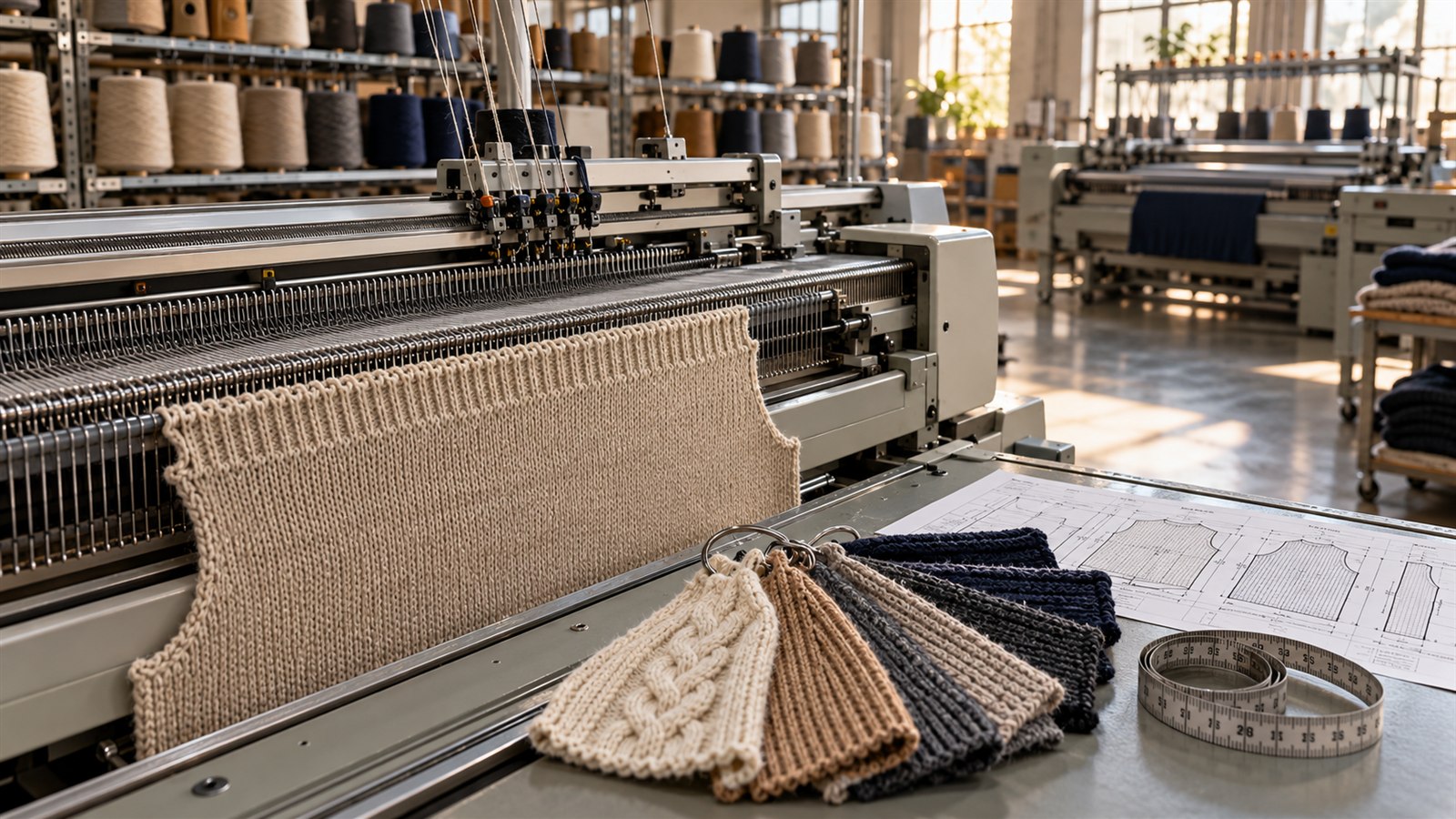
A sweater reference photo leaves several decisions open: how the garment is constructed, which yarn creates the surface, and what happens to the fit after washing. A knitwear manufacturer needs those decisions, or clearly labeled requests for recommendations, before a quotation can describe the garment you intend to buy.
For brand owners and sourcing managers buying from China for US, UK, or EU collections, the first step is to separate a supplier’s confirmed proposal from its assumptions. Send the same brief to each factory and ask each to identify substitutions. Otherwise, apparently comparable offers may describe different garments.
This guide covers sweaters, pullovers, cardigans, and knitted tops. Use it to turn a design reference into an RFQ, then carry the agreed specifications through sampling and bulk approval.
Confirm the construction route before choosing a supplier
Ask how the factory proposes to make your garment before discussing surface details. Knitted panels joined by linking and garments cut from knitted fabric need different construction instructions.
Linking joins the loops along knitted panel edges. Cut-and-sew production starts with knitted fabric that is cut into garment pieces and sewn together. Both involve knitting, but a photo of a finished top does not tell a buyer which route a supplier is quoting. Seams, shaping, and edge details deserve close-up references.
A knitwear manufacturer should confirm the proposed construction in writing. For a cardigan, include the opening and fastening details. For a pullover, show the neckline, shoulder, and armhole. If you want the supplier to recommend a route, say which features must remain unchanged and which are open to development.
A factory’s knitted product category is a starting point for discussion, not confirmation that it can reproduce every reference. NOVITA lists knitted tops among its product lines; its knitted tops range can help you frame an inquiry. Confirm the construction and quality your supplier quotes for the specific design.
What to put in a knitwear RFQ
Give the supplier one revision-controlled brief with a clear status for each specification: fixed, proposed, or awaiting advice. The table below is a practical starting point, not a substitute for drawings and measurement diagrams.
| Spec item | What to state | Why it changes the quote |
|---|---|---|
| Construction | Linked knitted panels or cut-and-sew; seam and edge references | Defines the proposed assembly and finishing work |
| Gauge and stitch structure | Requested gauge or reference swatch; surface and rib details | Changes the fabric structure the factory must develop |
| Yarn | Fiber composition, count system, count, ply, and approved alternatives | Defines the material and yarn construction being quoted |
| Color and decoration | Color reference, lot approval, artwork, placement, and technique | Adds material approval and decoration requirements |
| Fit and care | Size chart, measurement method, finished condition, and proposed care | Defines the fit and dimensional-change checks |
| Order scope | Quantity by style, color, and size; sample and bulk approval needs | Establishes the actual order and development scope |
Ask the knitwear manufacturer to return the same fields with its proposal. A blank field should remain an open question; it should not silently become a factory choice. Check that artwork and measurements belong to the same revision, especially when several people have commented on the design.
NOVITA’s guide to how a factory reads a tech pack explains how to organize the supporting information. Keep a separate list of unresolved decisions so the supplier can distinguish a provisional quotation from an approved production specification.
Specify gauge alongside the fabric you want
Gauge describes the number of needles per inch on a flat knitting machine. A coarser gauge generally gives a heavier, more open appearance; a finer gauge generally gives a lighter, denser appearance. Yarn and stitch structure also affect the result, so gauge alone cannot guarantee weight, softness, or coverage.
Confirm the gauge your supplier quotes. If you have a reference garment, provide close-up images and, where possible, a physical swatch. Explain whether you want to preserve the visible stitch size, the openness, or the overall hand-feel. Those preferences may need different development choices.
Ask the knitwear manufacturer to identify the gauge and stitch structure used for the sample. If the supplier proposes an alternative, approve the knitted result before treating it as equivalent. A change that looks acceptable in a small swatch may still need a garment check for drape and fit.
In the brief, connect the gauge request to a named reference and mark whether it is mandatory or subject to sampling. Keep the approved swatch with the written specification. A photograph alone is a weak reference for judging fabric density and handle across later revisions.
Define yarn quality beyond the fiber name
A fiber description does not fully specify yarn. Count describes yarn fineness within a particular count system; ply describes the strands combined to make the yarn. Ask for the system as well as the count, because a bare count value leaves the specification incomplete.
List the fiber composition you want and ask the supplier to confirm it. Then record the proposed yarn count, ply, and hand-feel against the sample reference. Avoid treating two yarns as interchangeable simply because their fiber descriptions match.
For custom knit sweaters, describe the surface in ordinary, testable language. State whether you want a smooth or visibly textured surface, a soft or firmer handle, and how the garment should drape. A physical reference is more useful than a string of adjectives such as “premium” or “luxury.”
A knitwear manufacturer may need to propose a yarn before a garment sample can be made. Ask it to identify which material is the quotation basis and which options remain unapproved. If a proposed yarn changes, request a fresh review of the fabric and finished garment instead of carrying the old approval forward automatically.
Put the agreed yarn description into the RFQ and sample comments. Keep acceptable alternatives separate from the approved choice so purchasing does not interpret a development option as permission to substitute it in bulk.
Approve color, ribs, and decoration together
Specify a physical color reference and ask how the supplier will identify the yarn lot used for approval. Screen images can help communicate a direction, but they should not be your only basis for accepting bulk color. Record whether contrast ribs, buttons, or other trims must match the body or create a deliberate contrast.
Keep the approved color reference available when reviewing bulk material. NOVITA’s shade band approval guide provides a useful approval framework, although a knit program still needs its own agreement on yarn-lot and finished-garment color references.
Ribs also need construction instructions. Show the collar, cuff, and hem shape, their finished dimensions, and the recovery you expect after stretching. A cuff that looks right on a flat sample may feel wrong when worn, so include the intended fit in your comments.
For personalized knit sweaters, distinguish a design knitted into the fabric from embroidery or printing applied afterward. Send artwork with placement and finished dimensions. Ask for decoration on the proposed knit quality so you can review whether it distorts the fabric or changes the handle. Do not approve artwork positioning on a drawing and assume that approval also covers the decorated garment.
Agree measurements and shrinkage checks before sampling
State whether each measurement describes a body or a garment. Then define how the garment will be laid out and measured. Knits stretch, so pulling the fabric while measuring can turn a fit discussion into a disagreement about technique.
ISO 8559-1:2017 covers anthropometric definitions for body measurement. It does not supply your finished sweater dimensions. Use it as a measurement-definition reference where relevant, and provide a separate garment measurement chart with diagrams and buyer-agreed tolerances.
For dimensional change, ISO 5077:2007 covers determination of dimensional change in washing and drying. Identify the method in the brief if you intend to use it, then agree the washing and drying conditions and the acceptable change with the supplier. Do not describe a buyer’s acceptance limit as an ISO requirement.
Ask to review measurements in the agreed finished condition and after the proposed care treatment. Include the points that affect the silhouette, such as body length, chest width, and sleeve length, along with relevant rib dimensions. Record the measuring condition beside the results.
Shrinkage decisions belong before bulk approval. If the sample changes shape or size after care, decide whether to revise the yarn, construction, finishing, or fit specification. Recheck the revised garment before approving it. Adjusting a measurement chart without checking the actual result leaves the fit unresolved.
Base care labeling on the approved garment
Propose the intended care treatment early enough to check the sample against it. A fiber name alone is an incomplete basis for care instructions because the garment also includes its knitted structure, finishing, decoration, and trims.
ISO 3758:2023 covers the care labeling code using symbols. Treat it as a symbol system, not evidence that a sweater can withstand a particular treatment. Select the instructions after reviewing the agreed checks on the actual garment.
Across these references, the standards define methods, measurement terminology, or a symbol system. Acceptable dimensional change, garment tolerances, and other product acceptance values are terms the buyer and supplier agree; they should not be presented as limits set by those standards.
In the brief, include the proposed care instructions, label artwork, and label placement. Mark the care artwork as provisional until the garment review supports it. If a yarn, trim, or decoration changes during development, revisit the care decision before releasing labels for bulk use.
Separate sample approval from bulk-lot approval
A sample establishes a development reference. It does not, by itself, confirm that a later bulk lot uses the same approved yarn quality, color, construction, and finishing.
Ask the knitwear manufacturer to identify the material used in the sample and any differences expected in bulk. If a sample uses a temporary yarn or color, label that exception clearly. Approval of the shape should not be read as approval of an unreviewed bulk material.
For a sweater manufacturer, sample comments should distinguish fit changes from yarn and construction changes. “Make it softer” leaves the factory to choose the mechanism; explain the reference you want to match and ask what will change. When reviewing a revision, check the affected measurements and care behavior as well as the surface.
Use NOVITA’s knit sampling process guide to organize the development handoff, then add the yarn and gauge decisions specific to your garment. Name the approved sample and brief revision in the bulk instructions.
Before bulk approval, request confirmation of the production material and review any proposed deviations. Retain the approved physical reference and written comments together. If a factory cannot confirm an input yet, keep that approval open rather than allowing an estimated specification to become the production instruction.
Define the quality checks and approval owner
Write down what inspectors will compare with the approved sample. Include visible knitting faults, panel joins or sewn seams, rib shape, color consistency, decoration, and finished measurements. Define the appearance you will accept instead of relying on “good workmanship.”
Use the apparel quality control checklist as a starting point for the inspection brief. Where the garment has sewn construction, identify the seam location and required finish; the guide to stitch types can help organize those instructions. Do not confuse a sewing stitch specification with the knitted fabric’s stitch structure.
Assign an approval owner on the buyer’s side. State which differences require written approval and what evidence the factory should send. Keep unresolved issues visible until someone makes a decision.
NOVITA states that AQL-based inspection can be arranged on request. Treat this as an optional arrangement under NOVITA’s own terms, and agree the inspection scope before ordering. An inspection arrangement does not replace the product specification or prove that a bulk lot has already passed.
Confirm NOVITA’s terms for your knit program
NOVITA is a garment factory in Foshan, Guangdong, China, with knitted tops among its product lines. Its published terms provide a starting point for an inquiry, subject to confirmation for your garment.
NOVITA’s own stated minimum is 100 pieces per style per color; confirm this for the proposed knit program. Its sampling timeframe is approximately 7-15 days after fabric, measurements, construction details, and workmanship requirements are confirmed. Bulk production generally takes about 60 days after sample approval, depending on quantity, fabric availability, and customization. These are NOVITA’s terms, not industry averages or guaranteed dates for every order.
When asking NOVITA or another knitwear manufacturer to quote, request confirmation of the construction route and proposed material first. Then confirm what starts the sampling and bulk timelines. Keep open yarn approvals or design changes visible in the schedule discussion.
NOVITA’s OEM and ODM process outlines the broader handoff. Use the inquiry to establish whether the factory’s proposed quality and construction match your design before treating its timing as a production commitment.
Frequently asked questions
What should I send a knitwear manufacturer for a first quote?
Send reference images, construction details, the yarn and gauge request, a measurement chart, color references, and quantities by style, color, and size. Mark undecided specifications as requests for advice. Ask the supplier to list its assumptions beside the quotation.
Is a sweater manufacturer the same as a cut-and-sew factory?
The labels alone do not establish capability. Ask whether the proposed garment uses knitted panels joined by linking or pieces cut from knitted fabric and sewn together. Have the supplier confirm the route for your design, including its seams and edges.
Can I order custom knit sweaters from a photograph?
A photograph can start development, but it leaves yarn, gauge, measurements, and hidden construction details open. Add close-ups and a physical reference when available. Ask the supplier to propose the missing specifications, then approve the sample against the completed brief.
How should I compare custom knit sweater manufacturers?
Give each supplier the same brief. Compare their proposed yarn, construction, approval stages, and stated exceptions. If the offers use different materials or leave different inputs unresolved, ask for clarification before treating them as equivalent proposals.
Does a finer gauge always mean better quality?
No. Gauge is a construction choice. A finer appearance may suit one design while a coarser, more open knit suits another. Confirm the quoted gauge against the yarn and stitch structure, then judge the sample against your intended appearance, fit, and care behavior.
Does an ISO reference set my shrinkage acceptance limit?
No. ISO 5077:2007 covers determination of dimensional change in washing and drying. Agree the care conditions and acceptable dimensional change separately with the supplier, and put them in the brief. A method reference without an agreed acceptance value leaves the approval decision incomplete.
To discuss a knit program with NOVITA’s Foshan factory, send your tech pack or reference garment, proposed yarn and gauge, measurement chart, care expectations, and order breakdown. Ask for construction confirmation and a list of unresolved specifications before requesting the final quotation.