The first uniform order rarely causes the trouble. The second one does. Six months after launch, a new site opens, staff turnover adds forty people in mixed sizes, and the reorder arrives with a slightly different navy, a crest sitting 1.5 cm lower, and a size M that fits like the old L. Nobody changed the logo file. The problem is that nobody wrote down everything else.
A uniform manufacturer can only repeat what the buyer has fixed in writing and approved on a physical sample. This guide covers how to turn a uniform program into a specification a factory can rebuild lot after lot: who controls which decisions, what the spec sheet must contain, how sizes, colors and logo positions are locked, and why quotes change when any of them move.
What a uniform program buys that a one-off order does not
A one-off order buys garments. A uniform program buys repeatability: the ability to order 60 pieces next March and have them match the 600 pieces already being worn. That changes what you should evaluate when choosing a uniform manufacturer.
For a single retail drop, the main questions are price, sample quality and delivery date. For a program, add three more. Can the factory reproduce the color and fit from an approved reference rather than from memory? Will it keep the size grading, trims and logo placement documented between orders? And how does a small replenishment order get priced and scheduled once the launch volume is gone?
Most uniform manufacturer pages answer none of these with numbers. They list industries served and promise “consistent sizing across reorders” without saying how consistency is controlled. Treat that promise as a question to ask, not as evidence.
Manufacturer, supplier or decorator: who controls what
The terms overlap in search results, but they describe different responsibilities. Knowing which one you are dealing with tells you who can fix a problem.
| Role | Typically controls | Typically does not control |
|---|---|---|
| Uniform manufacturer (cut and sew) | Pattern, grading, fabric sourcing, construction, trims, decoration in-house or by approved partner, packing | Local stock holding and next-day delivery to your sites, unless contracted separately |
| Uniform supplier or distributor | Catalog stock, local warehousing, staff ordering portals, small top-up quantities | The base garment’s pattern, fabric and color; a reorder depends on the brand they buy from staying unchanged |
| Decorator | Embroidery or print placed on blank garments | Fit, fabric and color of the garment itself |
Searches for “uniform supplier” in the US are dominated by local stock and rental companies, which suits small teams that can accept catalog garments. A cut-and-sew manufacturer makes sense when you need your own colors, fit or construction, or when catalog styles keep being discontinued under you. The trade-off is lead time and minimums: you are commissioning production, not picking from a shelf.
Write the program spec at bill-of-materials level
A tech pack for a fashion style describes one garment. A uniform program spec has to describe the garment and the rules for making more of it. If a field is missing, the factory will fill it with whatever is available on the day of the reorder.
| Field | What to fix in writing | Why it matters on reorder |
|---|---|---|
| Base fabric | Fiber composition, knit or weave structure, weight with tolerance, finish (e.g., pre-shrunk) | “Navy piqué” can be sourced several ways; each changes hand feel and shrinkage |
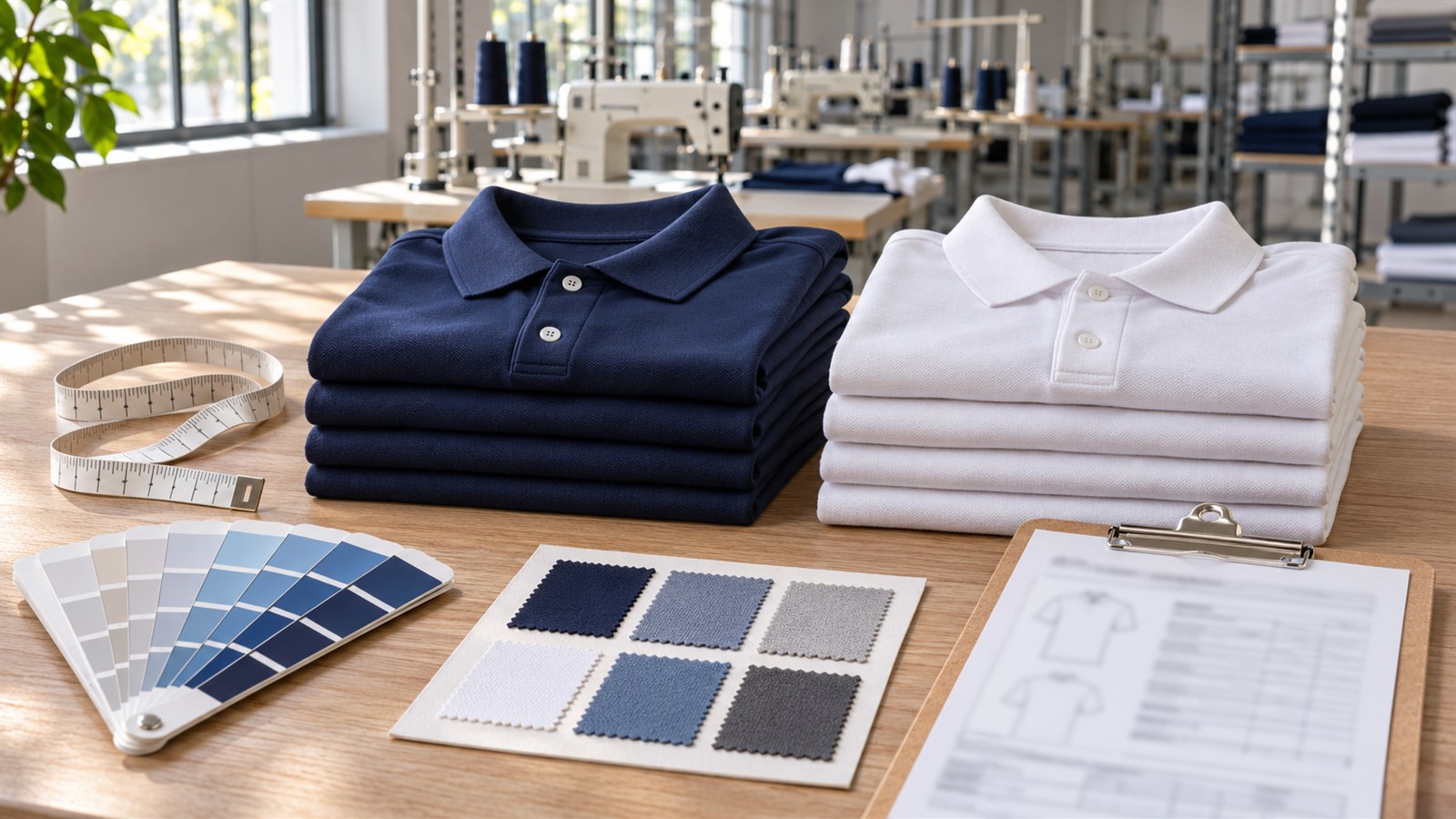
| Color references | Pantone or physical standard per component, approved lab dip ID, light source used for approval | Body, collar, cuff and thread can each drift separately |
| Trims | Buttons, zips, snaps, labels: supplier article, size, color, quantity per garment | Substituted trims are the most common silent change |
| Size grid | Measurement chart per size, points of measure, tolerance, grade rule | Keeps size M the same garment across lots |
| Decoration | Method, artwork file version, finished size, thread or ink colors, position measured from a seam | A logo proof does not fix where the logo sits on each size |
| Labels and packing | Care label text, size labels, fold method, polybag, carton marks per site or wearer | Mis-packed cartons cost more to sort than they cost to pack correctly |
| Approved reference | Dated approved sample retained by both sides, with the spec revision number | The physical tie-breaker when the paperwork is ambiguous |
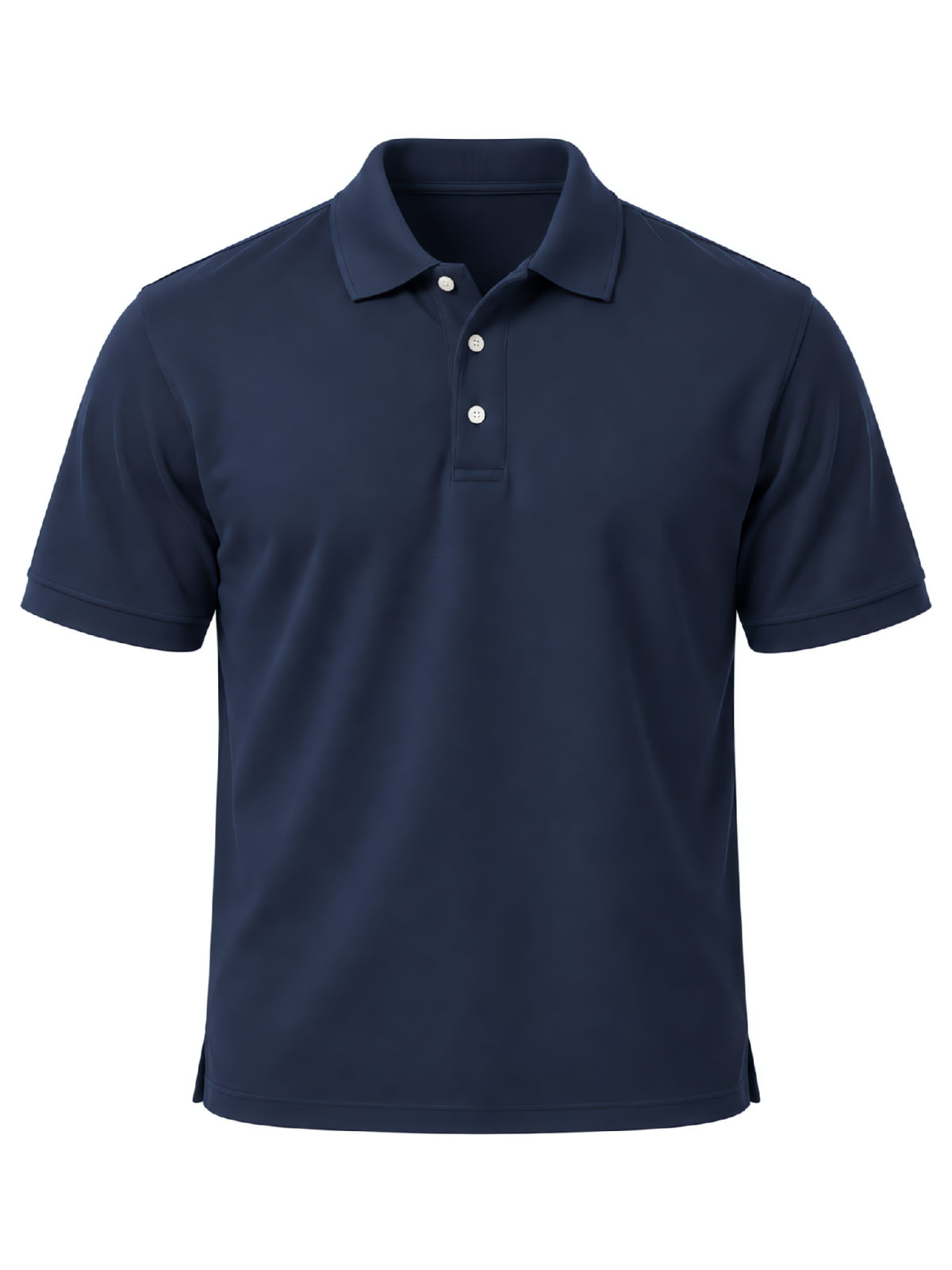
NOVITA’s tech pack preparation checklist covers the garment side of this sheet in more detail. For the uniform-specific rows, the instruction on NOVITA’s own two-tone corporate polo page is a useful benchmark: agree the uniform size breakdown and a dated approved reference for reorders, because a logo proof alone will not control the collar shape across production lots.
Choose fabric by role and laundering, not by a GSM number
Fabric weight is the number buyers ask for first and the one that settles least. Weight tells you mass per square meter. It does not tell you how a polo behaves after fifty industrial washes or whether a work jacket survives a warehouse shift.
Compare fabric by its intended use and care. A lighter piqué can suit warm conditions, while a twill may suit a garment that needs more structure. Request a swatch and a wear trial under the agreed laundering conditions.
Start the fabric conversation from the wearer instead:
- Role and movement. Front-of-house staff need a garment that holds its shape and collar. Warehouse or field staff need abrasion resistance at elbows, knees and pocket edges.
- Climate. A program covering several regions may need two weights of the same color, which doubles the color-matching work.
- Laundering. Home washing, industrial laundry and tumble drying stress fabric and decoration differently. Tell the factory which applies, then name a wash procedure for testing, such as ISO 6330 domestic washing or AATCC TM135 for dimensional change after home laundering.
- Color count. Every program color is a separate dye lot to control. Fewer colors make reorders cheaper and safer.
NOVITA does not publish fixed fabric weights for its uniform styles; weight is specified per project and confirmed on the approved prototype. Ask the uniform manufacturer for the proposed fabric’s composition, weight and shrinkage result in writing before you approve a sample.
Keep color and trims consistent across lots
Color drift in a uniform program is visible in a way it is not in retail. Two staff members standing side by side in different lots make the problem obvious to customers.
Control it at three points. First, approve a lab dip for each component that carries color, not only the body fabric: collar rib, cuff, contrast panels and embroidery thread all come from different dye processes. NOVITA’s guide to lab dip approval explains how to record the light source and tolerance so the approval can be repeated. Second, keep a physical color standard, not just a Pantone number on a screen. Third, decide in advance whether bulk lots will be checked against the original standard or the previous lot. Comparing each lot only to the last one lets small shifts accumulate.
Trims need the same discipline. Record the trim supplier’s article number where the factory can share it, and require written approval for any substitution. A button that is one shade lighter, or a zip with a different puller, is exactly the change that reaches the wearer without anyone deciding on it.
Build the size grid from the wearer list
There is no reliable public ratio for uniform size breakdowns, and any fixed percentage applied to your workforce will be wrong somewhere. The safer method is to build the size grid from people you actually need to dress.
- Collect the wearer list. Headcount by site, role and, where styles differ, by men’s and women’s fits. If the program needs a women’s fit, treat it as a separate pattern block with its own size set, and confirm with the factory how it counts toward style and color minimums.
- Run a fit session. Send a size set to one or two sites and let staff try sizes on. Record which size each person chose, not which size they usually buy in retail.
- Convert choices to a breakdown. Order from the fitted results, then add a buffer for new starters and replacements based on your own staff turnover.
- Freeze the measurement chart. Once a size set is approved, the chart and grade rule become part of the spec. NOVITA’s polo shirt size chart for manufacturing shows how points of measure and tolerances are written.
Extended sizes deserve their own check. Large sizes often need a separate grade step rather than a straight extension of the base grade, and they are the sizes most often short at reorder time. Confirm how the factory handles mixed sizes inside the minimum order.
Fix logo placement and stitch detail in measurements
“Left chest, as per logo proof” is not a placement instruction. On a size S and a size 3XL, the same proof can land in noticeably different places relative to the shoulder and placket.
Write placement as a measurement from a stable reference on each size: for example, distance down from the shoulder seam at the high point and distance across from the center front or placket edge. The same NOVITA corporate polo page states the rule directly: dimension embroidery position from a stable seam for every size. Printed and transferred marks need the same treatment. NOVITA offers screen print, puff print, digital print, foil, embroidery and heat transfer, and each position in the program, whatever the method, should have its own measured placement and a wash-tested approval.
For embroidered crests, also fix the finished logo size, thread colors, the digitized file version, and whether the fabric needs backing. Changing the digitized file between orders changes the stitch structure even when the artwork looks the same. NOVITA’s custom embroidered polo shirts guide covers logo approval in more depth.
Sample, wear-trial, then approve a dated reference
A uniform sample has two jobs. It must match the specification, and it must work for people wearing it for a full shift. Approving on appearance alone skips the second job.
A practical sequence looks like this:
- Prototype to confirm style, fabric and construction.
- Size set across the range you will order, checked against the measurement chart.
- Wear trial with a small group doing their real jobs for one to two weeks, then a wash test on the worn garments.
- Pre-production approval of the final sample with production fabric, trims and decoration.
Label the approved sample with the date and spec revision and keep one at each end. NOVITA states that sample development typically takes 7–15 days and that bulk production is generally 60 days after sample approval, depending on order quantity and fabric availability. A wear trial adds time on your side, so plan it into the launch date rather than squeezing it out. The sample development process guide explains what each round should resolve.
Why the quote changes by color, size and placement
Uniform buyers often compare quotes as a single unit price. That number hides several cost drivers that move independently.
- Colors. Each program color needs its own fabric lot and, often, its own minimum. Splitting 300 pieces across five colors is a different job from 300 pieces in one color. NOVITA’s custom minimum is 100 pieces per style and per colour (mixed sizes within each colour).
- Size spread. A wide size range with small quantities per size raises cutting and handling cost compared with a concentrated run.
- Decoration positions. Each extra position (sleeve flag, back print, name embroidery) adds a separate setup and handling step.
- Custom inputs. NOVITA notes that minimums can be higher when custom fabric, custom dye lots, custom hardware or printed packaging are involved.
- Packing rules. Packing by wearer name or by site costs more labor than bulk packing by size.
Ask for quotes broken out by these drivers. It makes suppliers comparable, and it shows you which design choice is costing the most before you lock the program. NOVITA’s clothing manufacturer MOQ guide explains how minimums interact with color and style counts.
Plan reorders before the first bulk order ships
The reorder plan should exist before the launch order ships, because that is when the uniform manufacturer still has the fabric supplier, the dye recipes and the people who made the sample in place.
Agree the following in writing:
- Trigger point. The stock level at which you place a reorder, worked back from sampling (if needed), bulk lead time and freight.
- Minimum reorder quantity. Whether the reorder is held to the same per-color minimum as the launch order.
- Reference control. Which approved sample and spec revision the reorder will be built and inspected against.
- Change log. Any substitution in fabric, trim or decoration is recorded and approved before production, not reported after delivery.
- Inspection. The acceptance criteria for each lot. NOVITA can apply AQL 2.5 when a project requires it; the apparel quality control checklist lists what to inspect.
Small top-up orders below the minimum are where programs usually break. If your turnover means you will regularly need a few dozen pieces, decide early whether you will hold buffer stock from each bulk run or pay for small runs at a higher unit cost.
Treat compliance claims as documents, not adjectives
Uniform marketing often mentions flame resistance, high visibility or “compliance-ready” fabrics without naming a standard. If your wearers need protective clothing, ask the uniform manufacturer for the specific standard number, the test report, the laboratory, and the exact fabric and garment the report covers. A report on a fabric does not automatically cover a finished garment with different seams, trims or decoration.
NOVITA’s uniform styles are casualwear and corporate wear such as polos, T-shirts and jackets. NOVITA does not claim certified flame-resistant or high-visibility protective garments, so programs that legally require them should source those items from a specialist and keep them on a separate specification.
Frequently asked questions
What is the difference between a uniform manufacturer and a uniform supplier?
A manufacturer makes the garment from pattern and fabric, so it can control fit, color and construction. A supplier usually sells and stocks garments made by others, which offers faster local access but less control over what changes between orders.
What minimum order should I expect for a custom uniform?
It depends on the factory and on how many colors and styles you need. NOVITA’s standard custom minimum is 100 pieces per style and per colour (mixed sizes within each colour), and it can be higher for custom fabrics, dye lots, hardware or printed packaging. Confirm the minimum for your exact color and size split.
How do I keep sizes consistent across reorders?
Freeze the measurement chart and grade rule after size-set approval, keep a dated approved sample at both ends, and inspect each reorder against that chart rather than against the previous lot.
Can a reorder use only the original logo file?
Not reliably. The logo file does not record placement per size, thread colors, backing or the garment’s own color and fit. Reorders need the full approved specification and reference sample.
How long does a uniform program take to launch?
At NOVITA, sample development typically takes 7–15 days and bulk production is generally 60 days after sample approval. Add your own wear-trial time and freight, and allow extra rounds if colors or sizes change after the first sample.
Start your uniform program specification
If you are planning a uniform program, send NOVITA your style references, wearer headcount by site and the decoration you need through the contact page. The project team will confirm fabric options, minimums and sample timing for your exact breakdown.