Minimum order quantity in clothing is not one number. It is the highest of several minimums that apply at different points in the supply chain — and the figure a factory quotes you is often not the one that actually decides how small your first order can be.
Most buyers learn this the expensive way. They find a manufacturer advertising a low minimum, plan a three-colour launch, and discover their real commitment is several times larger — or that the fabric itself demands more than the factory ever asked for.
This guide explains how minimum order quantity actually works in clothing production: which minimums exist, which one binds, and how to calculate the true floor for your first collection before you commit to a quote.
What Is Minimum Order Quantity in Clothing Manufacturing?
Minimum order quantity (MOQ) is the smallest production run a supplier will accept for a defined product setup.
The critical word is defined. A minimum is not a single policy number. It is the output of the physical constraints involved in making that specific garment:
- the smallest batch a dyehouse can load for one shade
- the smallest run a fabric mill will weave or knit
- the setup required for labels, hangtags and decoration
- the changeover cost at the sewing line
Because each of these has its own floor, a garment does not have one MOQ. It has a stack of them.
Why the Factory’s Quoted MOQ Is Often Not the Real One
When a manufacturer quotes a minimum, that number usually reflects the sewing floor’s own constraint. But the sewing floor is only one tier — and it is frequently not the tightest one.
The materials supplied to that factory carry their own minimums, set before a single garment is cut. If the fabric minimum implies more pieces than the sewing minimum, the fabric wins — regardless of what the factory told you.
This is the single most common sourcing misunderstanding. Buyers compare manufacturers on the headline number, when the number that governs their order is often set upstream of the factory.
For a full breakdown of how factories themselves arrive at their stated figure, see our guide to the minimum order quantity in clothing manufacturing.
The Four Tiers of Minimum Order Quantity
1. Fabric mill minimum
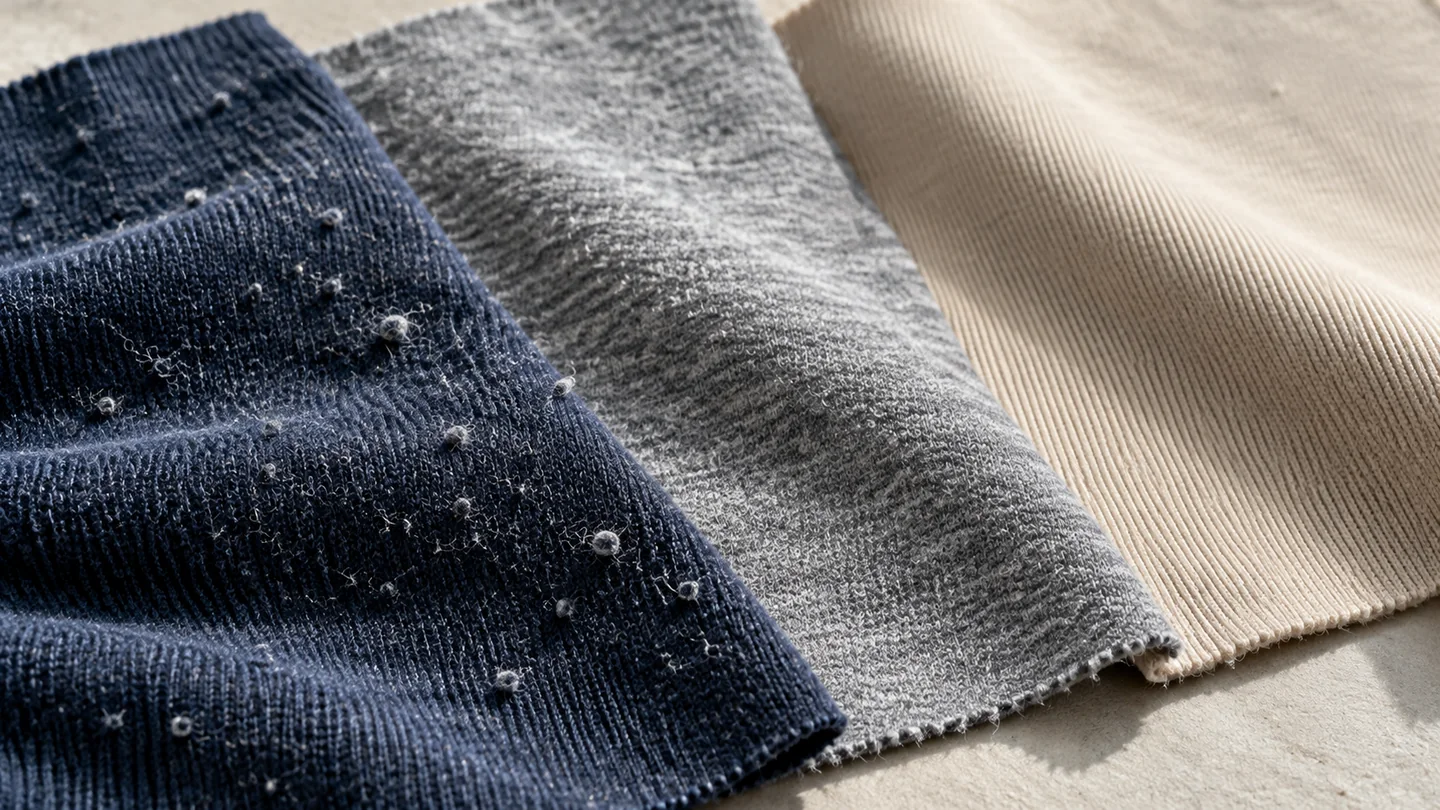
Fabric minimums are quoted per colour or per dye lot, not per order. A dyehouse loads one shade per batch, so each colourway is a separate production event with its own minimum.
This is a physical constraint rather than a sales policy. Below the vessel’s minimum load, shade consistency cannot be guaranteed.
The actual figure varies widely depending on the mill, the fabric construction and whether the shade is stock or custom-developed. Custom colour development typically raises the minimum substantially, because the dye lot has to be run specifically for you. Knitted and dyed yarn is usually measured by weight rather than length.
Measurement is normally in metres or kilograms — never in pieces.
2. Garment factory minimum
This is the number most manufacturers advertise. It is quoted per style, per colourway.
The figure varies widely depending on the factory’s size, its specialisation and your product. Smaller cut-and-sew workshops generally accept lower quantities at a higher unit price, while large export-oriented facilities usually require considerably more. A factory’s quoted minimum is also shaped by the fabric it expects to use.
One point that surprises buyers: sizes generally mix freely inside that per-colour minimum. A minimum quoted per colour typically accepts a full XS–XXL size curve without multiplying the requirement. Sizes affect fabric consumption, not the minimum itself.
3. Trim and accessory minimum
Labels, hangtags and custom packaging carry their own minimums, and they do not scale down with your garment order.
The reason is that these items are manufactured, not sewn — a woven label runs on a loom with its own setup. A custom woven label minimum can therefore exceed your garment minimum entirely. The exact figure varies widely by supplier and by label construction.
Printed hangtags are usually ordered in the low hundreds per SKU. Custom-branded hardware such as engraved buttons or custom pulls carries its own tooling minimum. Standard stock hardware generally does not, because the factory buys it off the shelf.
4. Decoration minimum
Printing and embroidery minimums are driven by tooling:
- Screen printing requires one physical screen per ink colour per print location, so minimums scale with colour count.
- Embroidery requires a one-time digitised file per design.
- Digital printing (DTG/DTF) typically has no setup and therefore no meaningful minimum.
Note that printing onto fabric by the metre is a completely different regime from printing onto finished garments. Buyers conflate the two constantly, and the difference in minimum can be an order of magnitude.
Print and embroidery quality is worth confirming at this stage — our apparel quality control checklist covers what to inspect before bulk production.
How to Calculate Your Real Minimum
Your effective minimum is the highest of all applicable tiers — not the factory’s quoted figure.
Effective minimum = the maximum of every tier that applies to your order
A worked example using round numbers:
| Tier | Requirement |
|---|---|
| Fabric mill minimum | 300 metres per colour |
| Fabric consumption | ~1.4 metres per garment |
| Fabric-implied pieces | 300 ÷ 1.4 ≈ 215 pieces |
| Factory stated minimum | 100 pieces |
| Your real minimum | ≈215 pieces |
The factory said 100. The fabric requires roughly 215. And this is before allowing for cutting waste — marker loss and fabric faults typically add a further few percent, which pushes the true figure slightly higher again.
The lesson is not the specific numbers in this example, which are illustrative and will differ for your fabric and mill. It is the arithmetic: always convert every minimum into pieces for your specific garment before comparing suppliers.
Per Style, Per Colour, Per Size: Which One Multiplies?
This is where budgets break.
| Unit | Does it multiply the minimum? |
|---|---|
| Per style | Yes — each design needs its own pattern, grading and marker |
| Per colour | Yes — and this is usually where costs escalate |
| Per size | Usually no — sizes mix within a per-colour minimum |
| Per size (ready-to-order catalogues) | Yes, a small per-size floor |
The practical consequence:
- A minimum quoted per colour across three colours means three separate minimums — three times the quantity.
- A minimum quoted per order across three colours stays at the order quantity — but the unit price rises.
Before requesting a quote, confirm the unit explicitly. Ask the literal question: “Is that per style, per colour, or per order?”
One legitimate way to reduce the burden: if several styles share the same fabric and same colour, they can often be consolidated into a single dye lot, meeting one colour minimum rather than several. This is one of the few genuine levers available, and it is worth raising early.
Why Lower Minimums Are Not Automatically Better
A very low advertised minimum usually signals something about the service model, and buyers should understand what.
A supplier accepting only a few dozen pieces is often buying pre-made garments and decorating them, rather than cutting and sewing from fabric. That is a different business with different economics. You may lose control of the pattern, fabric and fit, and custom dyeing is generally unavailable.
Genuine cut-and-sew production from your own pattern has a floor — because fabric, tooling and line changeover all have floors. A minimum that looks impossibly low is usually a different service, not a better deal.
Does Below-Minimum Mean Refused?
Usually not. It normally means a premium rather than a rejection:
- a higher unit cost, because setup is spread across fewer pieces
- potential setup or tooling charges
- longer lead times, as small runs are scheduled around larger ones
If your quantities fall below a supplier’s minimum, it is worth asking what the below-minimum terms actually are rather than assuming the answer is no.
What to Prepare Before Asking for a Minimum Order Quantity Quote
Suppliers can give a realistic minimum only when they understand the product. Prepare:
- Tech pack or detailed spec — construction, measurements, materials
- Target quantity per style and per colour — stated as separate numbers
- Size curve — how many units per size
- Fabric direction — preferred fabric, or stock versus custom-dyed
- Colourways — each colour is a separate minimum
- Branding and packaging — labels, hangtags, custom packaging
- Target ship date — affects how the run is scheduled
Sourcing across multiple factories? Our guide to clothing manufacturers in China covers how to compare quotes on a like-for-like basis.
The most useful question you can ask is not “what is your MOQ?” but “what is my real minimum for this specific garment, and which tier sets it?”
Minimum Order Quantity at NOVITA
NOVITA is a men’s casualwear OEM and ODM manufacturer based in Foshan, China.
Our production options include:
- Ready styles starting from 50 pieces
- Custom production starting from 100 pieces per style/colour
- Sample development typically within 7–15 days
- Bulk production generally around 60 days, depending on order quantity and product requirements
We produce men’s casualwear across T-shirts, polo shirts, denim jeans, knitted tops and hoodies and sweatshirts, together with overshirts and lightweight jackets. We support both OEM and ODM programmes, from product development through to bulk manufacturing, and work with brands on private label clothing manufacturing and sample development.
Because our product range concentrates on men’s casualwear, we can give buyers a straight answer about which tier sets their minimum — and what the realistic floor is for their specific garment.
To discuss your first run, contact us.
Final Thoughts
Minimum order quantity in clothing is a stack, not a number.
Before committing to a manufacturer, convert every applicable minimum into pieces for your specific garment, confirm whether the quoted figure is per style and per colour, and check the fabric and trim minimums that sit behind the factory’s headline number.
The supplier with the lowest advertised MOQ is not necessarily the one that lets you order the smallest quantity. The one that tells you honestly which tier binds — and what your real floor is — is the more useful partner.
FAQ: Minimum Order Quantity in Clothing
What is the minimum order quantity in clothing manufacturing?
There is no single figure. MOQ is the highest of several minimums — fabric mill, garment factory, trims and decoration. The factory’s quoted number is often not the binding one, because fabric minimums are set per colour and can require more pieces than the sewing minimum.
Is MOQ counted per style, per colour, or per order?
Unless your supplier states otherwise, assume per style and per colour. This is standard in cut-and-sew production. A per-colour minimum across three colours means three separate minimums, not one. Always confirm the unit in writing before quoting internally.
Do sizes multiply the minimum order quantity?
Usually not at cut-and-sew factories. Sizes generally mix freely within a per-colour minimum, so a single run can include a full size curve. Ready-to-order catalogue programmes sometimes apply a small per-size floor, so confirm for your specific product.
What is the minimum order quantity for a custom style at NOVITA?
Custom production starts from 100 pieces per style/colour, and ready styles start from 50 pieces. Sample development typically takes 7–15 days, with bulk production generally around 60 days. Final quantity may vary depending on fabric selection, customization requirements and product details.
Is a low MOQ manufacturer always cheaper?
No — usually the opposite per unit. Lower quantities spread fixed setup costs across fewer pieces, so unit cost rises. Very low minimums may also indicate decoration of pre-made garments rather than true cut-and-sew production from your own pattern.