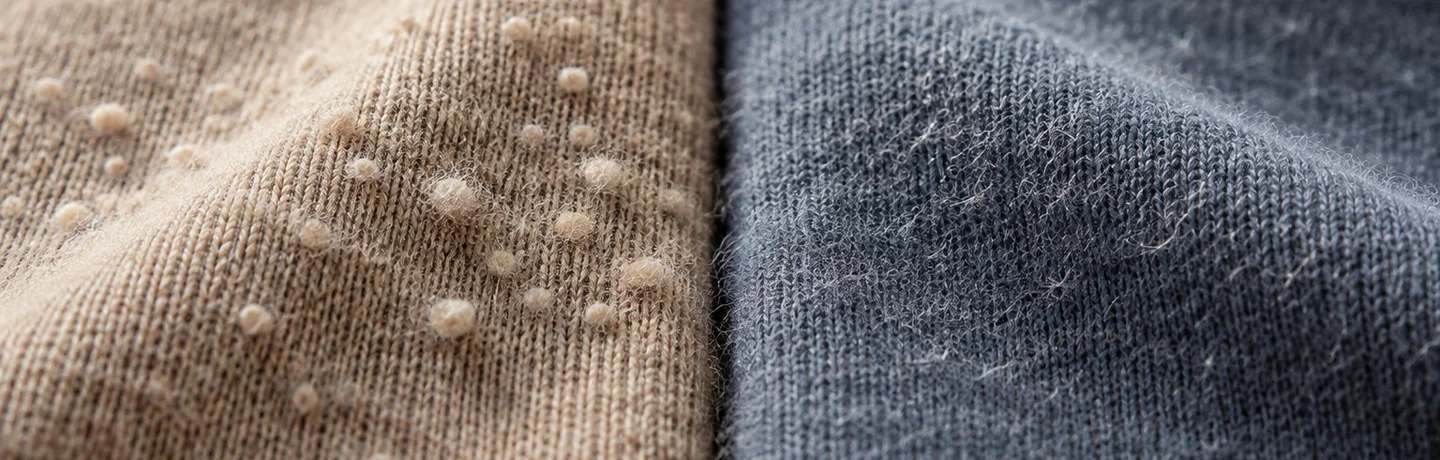
Fabric pilling is the formation of small, attached fiber balls on a fabric surface. Check pilling resistance during sample confirmation so the material, finishing state and performance requirements can be reviewed before bulk production. A smooth new sample alone does not establish resistance to later rubbing or laundering.
An “anti-pill” description, fiber composition and GSM cannot predict actual performance on their own. Yarn, fabric construction and finishing also influence the result. Begin by identifying the surface change, then assess evidence for the material in the finished state intended for the order.
What Is Fabric Pilling—and What Is Not?
Identify the surface change before assigning a cause. Attached fiber balls, increased surface hairiness and pulled yarns can require different investigations.
Pilling vs Fuzzing, Matting, Snagging and Lint
ISO 12945-4:2020 covers visual assessment of pilling, fuzzing and matting separately. It is the visual-assessment part of the series, not another method for exposing specimens to rubbing. The table below helps identify surface changes; it is not a laboratory grading reference.
| Surface change | What to look for |
|---|---|
| Pilling | Small balls of entangled fibers attached to the surface. |
| Fuzzing | Increased protruding fibers compared with the reference surface, without distinct balls. |
| Matting | Raised nap becomes tangled, flattened or loses its original alignment. |
| Snagging | A pulled yarn or loop, sometimes with surrounding distortion. |
| Loose lint | Loose fibers or debris resting on the surface. |
These conditions can coexist. Compare brushed or raised surfaces with the reference sample before classifying a change.
Why the Surface Change Must Be Identified First
Before brushing, shaving or washing the sample, photograph the whole sample and the affected area. Record its fabric reference, color, side, location and condition, including any washing or wear.
Illustrative example: A buyer sees loose fibers on a development swatch and requests an anti-pilling treatment. Document the surface first: loose lint alone does not justify that diagnosis or correction.
A sample photograph alone does not establish a laboratory pilling grade, confirm the root cause or characterize an entire lot. Visual roll grading is covered in the fabric defects guide; this check identifies the surface change.
Why Fabrics Pill: Fiber, Yarn, Construction and Finish
Pilling reflects interacting material variables, so matching composition and weight do not establish matching performance. ASTM D4970/D4970M-22(2026) identifies fibers and blends, fiber dimensions, yarn and fabric construction, and finishing as relevant factors.
How Surface Fibers Form and Retain Pills
Rubbing can bring fiber ends to the surface. Those fibers may entangle into pills, which remain attached or eventually break away as their supporting fibers fail. The visible result reflects both formation and wear-off.
Research on polyester–cotton woven fabrics shows how polyester fibers can retain pills containing broken cotton fibers. That mechanism does not establish a performance ranking for all cotton blends.
CottonWorks’ Quality Testing guidance also notes that friction during laundering and drying can cause fuzzing or pilling.
Why Fiber Content and GSM Cannot Predict the Result Alone
GSM measures mass per unit area; it does not specify fiber length, yarn hairiness or surface treatment. The T-shirt fabric guide covers broader composition choices.
When comparing submissions, check these details:
- Fiber: Confirm blend proportions and specified fiber characteristics; the composition label omits fiber dimensions.
- Yarn: Ask whether spinning method, twist or hairiness differs between samples, where documented.
- Construction: Match the sample to the specified knit or weave structure and density; GSM is not a substitute.
- Finish: Confirm the treatment and preparation state so the submitted sample represents the intended production finish.
Cotton Incorporated’s Textile Yarns explains how compact ring spinning can reduce hairiness and pilling, making yarn details relevant alongside composition and weight.
Compare materials in the same preparation state. Their identity and intended use provide the basis for selecting a test method and defining the order’s acceptance requirements.
How to Evaluate Pilling in T-Shirts, Polos and Fleece
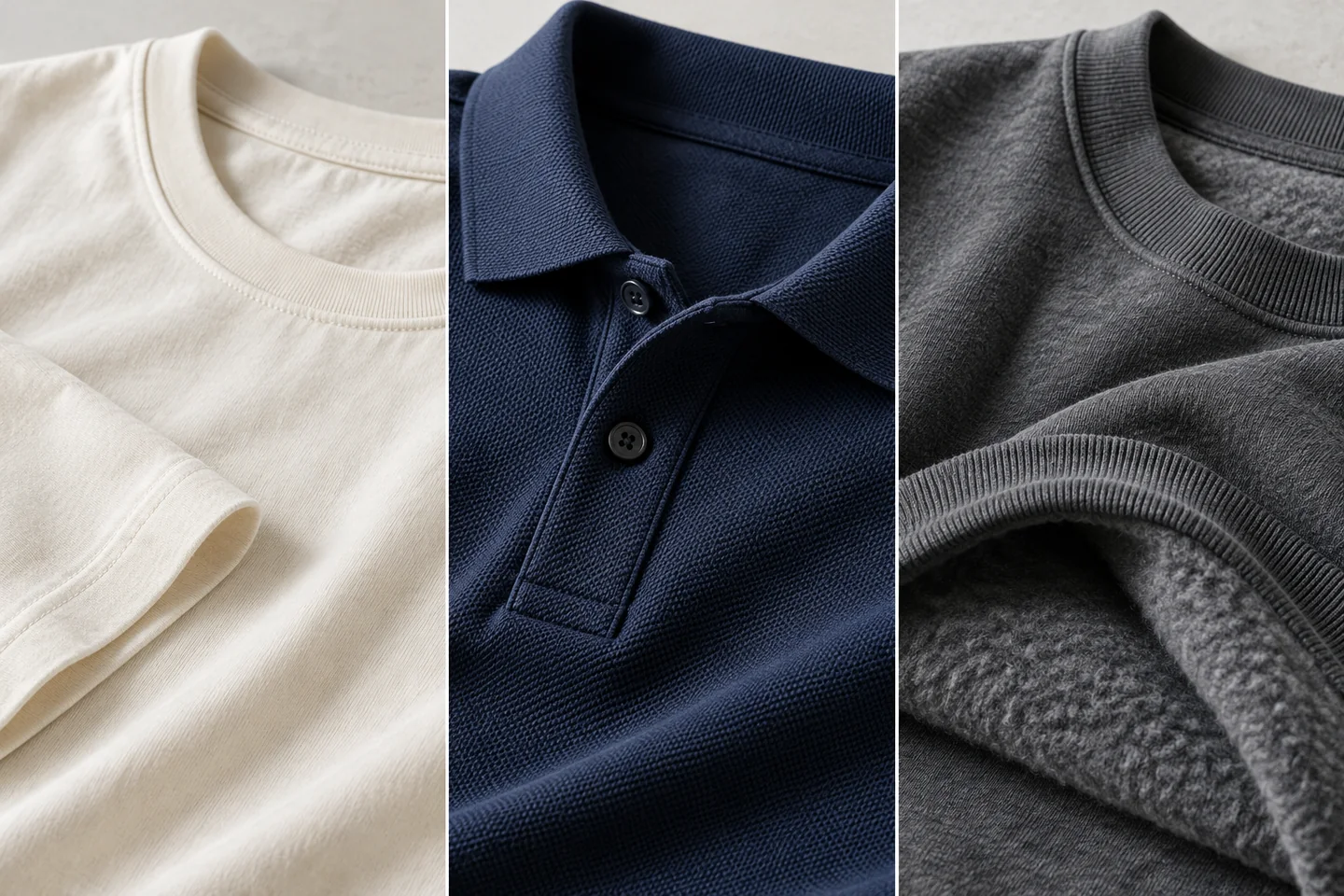
Set evaluation priorities by the garment’s actual surface and intended use. A product name alone does not identify which side matters to the buyer or which finished state the submitted sample represents.
Jersey T-Shirts and Cotton-Blend Polos
For jersey T-shirts and cotton-blend polos, identify the body fabric’s visible face and the appearance the brand expects to retain. Specify intended layer contact or other relevant use conditions. The polo fabric guide covers structure choices; the evaluation scope here must follow the actual product.
Brushed Fleece and Other Knitted Tops
For brushed fleece, record which side is raised and whether it is visible or skin-facing. Agree the surface target for each relevant side; an evaluation of one side does not automatically describe the other.
Illustrative buyer priorities:
| Development situation | Scope to confirm |
|---|---|
| Layered jersey T-shirt | Visible face; intended layer contact; final wash/finish state. |
| Cotton-blend polo | Body face and agreed appearance; intended use; final wash/finish state. |
| Brushed fleece top | Face versus brushed back; contact and nap targets; final production treatment. |
This matrix defines review questions, not a risk ranking. Request evidence for the intended production state: CottonWorks’ Quality Testing explains that laundering and drying friction can change surface appearance. An unwashed development sample may leave that part of the evaluation unresolved.
A NOVITA Product Example: The 260 gsm Boxy T-Shirt
NOVITA’s 260 gsm oversized boxy T-shirt page lists clean, mineral, vintage and acid wash options. Its Fabric & Trims table states that final fiber composition is confirmed on the approved prototype.
When developing this style, record the chosen composition and wash route with the approved fabric reference. Confirm that any pilling report represents that selected version and its intended final state. A result for one finishing route should not automatically be used to approve a different route.
The listed 260 gsm weight identifies the product option; it is not a pilling grade or pass threshold. Use the product listing to prepare the brief, then use the agreed method and requirement to evaluate evidence for the approved sample.
What Pilling Tests Measure—and How to Read the Grade
A grade supports a purchasing decision only when its method, specimen state and assessment basis are identifiable. The order’s acceptance requirement remains a separate decision.
Pilling Box, Modified Martindale and Random Tumble
| Method or assessment | Purchasing implication |
|---|---|
| Pilling box — ISO 12945-1:2020 | Confirm rotating-box exposure is the method reported. |
| Modified Martindale — ISO 12945-2:2020 | Confirm a pilling result, rather than an abrasion result. |
| Random tumble — ISO 12945-3:2020 | Most woven and knitted fabrics, including napped fabrics; specimens must tumble freely. |
| Martindale — ASTM D4970/D4970M-22(2026) | A pilling method for woven and knitted fabrics; check thickness suitability and the acceptance-testing limitation below. |
| Visual assessment — ISO 12945-4:2020 | Visual assessment of pilling, fuzzing and matting, including napped fabrics; not an exposure method. |
The ISO 12947 series concerns Martindale abrasion testing. ISO 12947-2:2016, for example, measures specimen breakdown, not a pilling grade.
ASTM D4970 evaluates pilling resistance and related surface changes using a Martindale tester. Its published §5.1 does not recommend it for acceptance testing; if used, caution is advised because interlaboratory data are unavailable. Its score does not automatically approve a bulk order.
The Grade Needs a Method, State and Assessment Point
For ASTM D4970, the published scale runs from 5 (no pilling) to 1 (very severe pilling). Those endpoints do not establish an order’s pass/fail line. See ASTM D4970 §5.6.
Buyer’s Test Report Checklist
- Identity: laboratory, report number/date, fabric or style ID, color/lot and represented production state.
- Procedure: standard and edition, tested side, conditioning and preparation or laundering, exposure and assessment point, and deviations.
- Rating basis: visual reference or assessment procedure, and separately reported surface-change results.
- Order comparison: the buyer–supplier acceptance requirement and whether the report covers the submitted order material.
Buyer and supplier should specify the applicable method and edition, agree the specimen state and only the choices that method permits, and separately set the order’s acceptance requirement. The laboratory must follow the selected standard’s procedure and assessment basis.
Why a Lab Result Does Not Predict Garment Life
For illustration, two reports stating grade 4 are not equivalent merely because their numbers match. Check their methods and conditions first. Laboratory results describe submitted material under specified conditions; they do not establish garment life or guarantee every bulk lot. Investigate conflicting results before using them to support acceptance.
Specify the Pilling Requirement Before Fabric Approval
Agree the order’s pilling requirement before deciding whether the fabric passes. Record the required result at the specified assessment point, the material it covers and who can approve it. A supplier’s general “anti-pill” description leaves those decisions open.
A Buyer’s Pilling Approval Card
Use this blank card alongside the report checklist above. It is an editorial buyer tool; fill project values with the supplier and laboratory, following the selected method’s permitted choices.
| Approval field | Complete for this order |
|---|---|
| Material and scope | Fabric/style ID: ___; composition/structure: ___; color/lot: ___; represented order quantity or scope: ___ |
| Sample and state | Retained sample ID: ___; finish/wash revision: ___; tested side: ___; agreed conditioning and care preparation: ___ |
| Method and assessment | Standard/edition: ___; laboratory: ___; exposure and assessment point(s): ___; visual assessment/reference: ___ |
| Requirement and evidence | Buyer–supplier acceptance requirement and decision rule: ___; report ID/date: ___; result(s): ___ |
| Decision record | Approve / hold / revise: ___; approver/date: ___; approved material revision and covered scope: ___; review trigger: ___ |
Keep the retained sample, finish specification, complete report and signed decision together before bulk release. Appearance and hand-feel approval alone does not establish test approval; record both decisions. Leave the acceptance value open until buyer and supplier agree it.
A Recommended Pilling Review for NOVITA Projects
NOVITA’s published manufacturing process places material confirmation and sample development before bulk production. We recommend using the approval card at these checkpoints:
| Project checkpoint | Pilling decision | Record to keep |
|---|---|---|
| Material confirmation | Agree the selected fabric, finish, tested side, method and acceptance requirement. | Fabric reference and completed requirement fields. |
| Sample development | Match the report to the submitted material and review it against the agreed requirement. | Sample ID, report and written sample comments. |
| Before bulk production | Resolve open corrections or evidence gaps; record the approved material revision and covered scope. | Named approver, decision date and represented colors/lots. |
Agree the testing arrangements and approval responsibilities for the order. If the material or finish changes, reopen the affected review before carrying the decision forward.
Separate an Incomplete Report from a Failed Result
A missing tested side or finish revision leaves applicability unresolved. Request clarification and any necessary testing before making a pass/fail decision. A confirmed result below the agreed requirement calls for correction or material reselection. If laboratories disagree, resolve comparability and possible bias before accepting either result. Record any revised requirement explicitly; do not silently lower it to match the submission.
What to Change When the Result Misses Your Requirement
Choose a correction only after confirming that the result applies to the intended material and agreed test conditions. A low score identifies a performance gap; it does not identify which production variable caused it.
Confirm the Cause Before Choosing a Correction
If evidence is incomplete, complete it. If conditions differ, establish a comparable basis. For a confirmed failure, ask the mill to compare the submitted material with its specification and available yarn, construction and finishing records. Trial documented changes and evaluate the revised sample rather than attributing the failure to one variable from the grade alone.
Compare Yarn, Construction and Finishing Options
For a soft cotton jersey, consider a less-hairy yarn option before accepting a harsher feel from added twist. Cotton Incorporated’s Textile Yarns supports compact-spinning and twist considerations; the finished fabric still needs evaluation.
Illustrative correction choices—not guaranteed remedies:
| Product goal | Option to discuss | Trade-off to check | Evidence before approval |
|---|---|---|---|
| Keep a soft jersey hand | Discuss less-hairy yarn or an appropriate twist trial. | Added twist can stiffen the hand. | Compare finished swatches, yarn records and matched pilling reports. |
| Keep polo structure or fleece nap | Trial a documented construction or brushing adjustment. | Recheck texture, stretch, drape and nap against the approved sample. | Record the changed variable; evaluate the relevant face/back and final state. |
| Clean a cotton-rich surface | Ask the finisher whether cellulase biopolishing is suitable. | Surface fiber removal may reduce weight or strength. | Confirm fiber applicability; review revised surface, GSM, strength and pilling evidence. |
CottonWorks’ Garment Finishing describes cellulase action on cotton and possible weight and strength loss in an enzyme-washing context. This supports discussing suitability with the finisher; it does not establish a jersey/fleece recipe or a remedy for synthetic fibers.
Recheck the Properties the Buyer Already Approved
Evaluate the revised sample in its intended final state against both the pilling requirement and approved hand, appearance and relevant physical properties. Record the change, new evidence and buyer decision. If the trade-off is unacceptable, compare another material before bulk release.
When Sample Approval Needs to Be Reopened Before Bulk
Reopen the pilling decision when a change may move the proposed production material outside the evidence already approved. A passing development sample does not automatically cover a different yarn, finish, wash route or represented lot.
Changes to Yarn, Finish, Wash Route or Represented Material
Compare the proposed material with the retained sample and approval card. For each change, identify what the original report covers and what remains unconfirmed. Decide whether each new color or lot is covered; record the basis for retaining approval or requesting fresh evidence.
| Change to review | Evidence to check | Decision to document |
|---|---|---|
| Yarn or construction | Revised specification and retained sample. | Identify the changed material; decide on resampling and testing. |
| Finish, brushing or wash route | Final-state sample and processing revision. | Evaluate the revised surface and agreed preparation state. |
| Color or lot | Traceable identity and original report scope. | Record the coverage basis or request evidence for the new material. |
| Laboratory, method or preparation | Changed conditions and result comparability. | Resolve comparability before using the result for release. |
Document the Decision to Resample, Retest or Proceed
Record the original approval ID, what changed, revised sample/report IDs, approver and date, and the material revision and order scope released. If evidence is incomplete, hold that scope until the gap is resolved. When the parties accept existing evidence, retain their reason for proceeding.
Suggested buyer workflow (editorial guidance):

Identify the change → check evidence coverage → add evidence if needed → record the decision and scope.
For overall garment inspection, use the apparel quality control checklist alongside this pilling record.
For your next NOVITA development discussion, bring the fabric reference, intended finish and wash state, complete pilling report and the order’s agreed requirement. Include proposed changes so the sample and approval scope can be reviewed together.
For a custom men’s apparel project, contact NOVITA with your fabric reference, selected finish, order scope and available test evidence.
Discuss Your Garment Specifications
Share your fabric reference, finish and wash state, and available pilling evidence with NOVITA. Tell us which surface-change or approval questions you’d like to review before bulk production.
References
- ISO 12945-1:2020, Textiles — Determination of fabric propensity to surface fuzzing and to pilling — Part 1: Pilling box method. International Organization for Standardization. iso.org/standard/75374
- ISO 12945-2:2020, … Part 2: Modified Martindale method. International Organization for Standardization. iso.org/standard/75375
- ISO 12945-3:2020, … Part 3: Random tumbling method. International Organization for Standardization. iso.org/standard/75376
- ISO 12945-4:2020, … Part 4: Assessment of pilling, fuzzing and matting. International Organization for Standardization. iso.org/standard/75377
- ISO 12947-2:2016, Textiles — Determination of fabric abrasion resistance … Martindale method. International Organization for Standardization. iso.org/standard/61058
- ASTM D4970/D4970M-22(2026), Standard Test Method for Pilling Resistance and Other Related Surface Changes of Textile Fabrics. ASTM International. store.astm.org
- Pilling propensity of polyester–cotton woven fabrics, AATCC Journal of Research (polyester fibers retaining pills with broken cotton fibers). AATCC Journal of Research
- Cotton Incorporated, CottonWorks™: Quality Testing, Textile Yarns and Garment Finishing learning resources. cottonworks.com