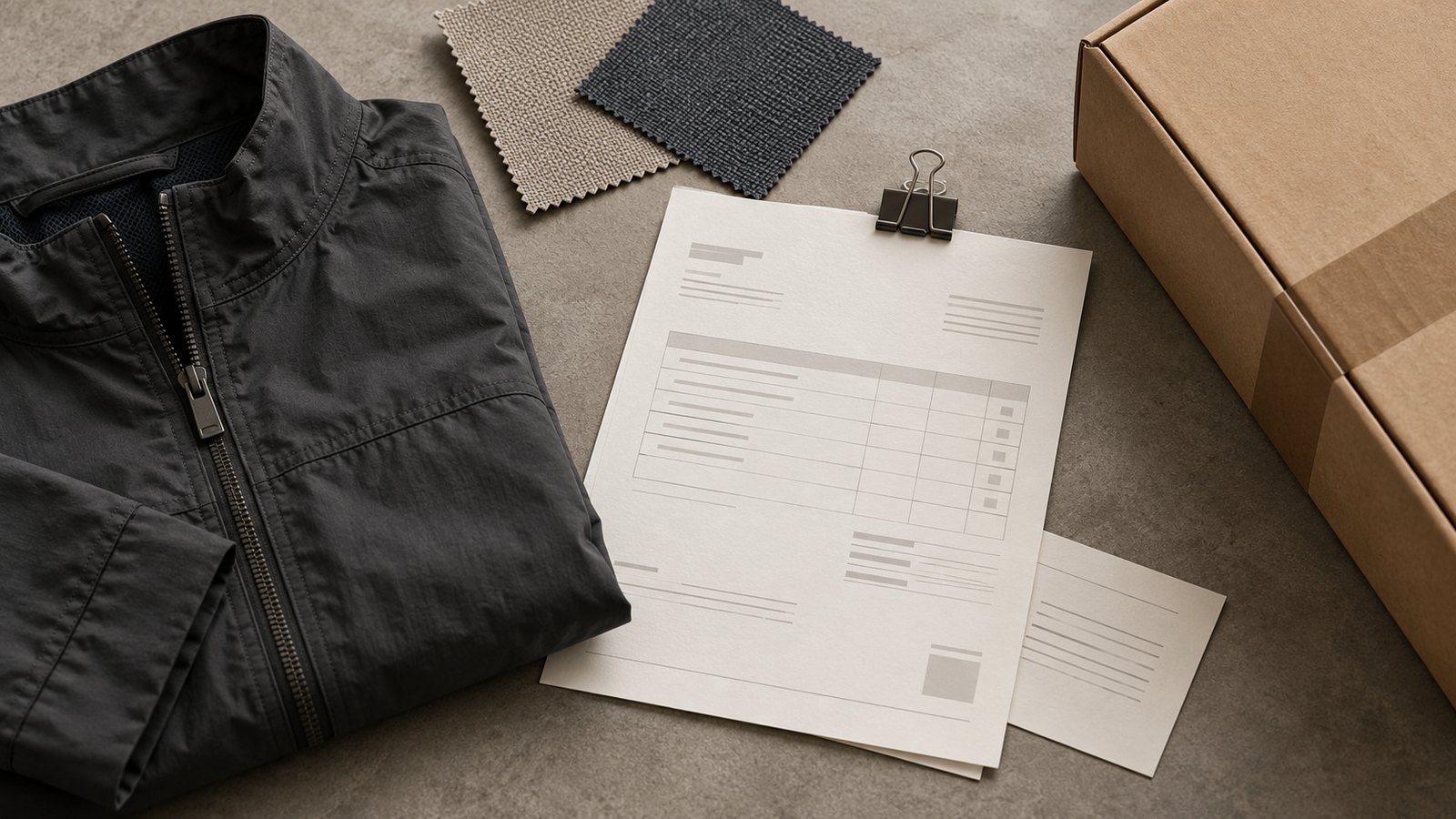
A sample can be described as “free” while the buyer still pays a development invoice, freight, and import charges. The missing detail is often whether the factory means no charge today, a possible refund later, or a credit available only after a qualifying production order.
If a clothing manufacturer advertises a free sample, start with the invoice rather than the headline offer. Read it alongside the written sample terms and shipping agreement. Together, they should explain what you are buying now, what might be credited later, and who handles the shipment at the border.
Read the sample invoice as a commercial record with contractual and customs implications, alongside the other agreed documents. Before authorizing payment, separate unconditional savings from incentives that depend on a later order. The factory example below illustrates one published policy; other manufacturers may use different terms.
What “Free” Actually Means on a Sample Invoice
Ask whether “free” has conditions. These four models give you a way to classify the answer; they do not establish what any particular factory offers.
| Commercial model | What to clarify before paying |
|---|---|
| No sample charge upfront | Whether development, freight, and import charges are also covered |
| Pay now, possible refund later | The refund trigger, eligible amount, and payment method |
| Credit after a qualifying bulk order | The order requirement, deadline, and invoice receiving the credit |
| Waiver for an approved account | Who qualifies and which sample services the waiver covers |
The second and third models can sound identical in a sales conversation. They are not necessarily equivalent for your cash flow. A cash refund returns money; a production credit reduces a later bill. If that later order never happens, a conditional credit may offer no usable saving.
For buyers comparing sample policies, the useful answer is a written definition of “free.” Ask the supplier to identify the model and list the exclusions. Do not assume a waiver for one account, garment, or development stage carries over to another.
Nor should you assume that a factory describing a sample as free is doing the development without compensation. A credit tied to production connects the sample incentive to a later order. A waiver may cover the garment but leave transport outside the offer. Evaluate the quoted structure instead of trying to infer the factory’s margin or motives.
Before comparing suppliers, give each offer the same label in your sourcing notes: payable now, recoverable later, and permanently payable. That simple distinction is more useful than comparing the word “free” across quotations.
The Three Layers of a Sample Cost
Keep the development charge, recovery conditions, and landed shipment cost separate. A reduction in one layer does not establish a reduction in the others.
| Layer | What it records | What you need in writing |
|---|---|---|
| Development service | The sample work being purchased | Included work and excluded revisions |
| Credit or refund | Potential recovery of eligible fees | Trigger, deadline, and settlement method |
| Cross-border shipment | Freight, duty, and VAT where applicable | Shipping allocation and import responsibilities |
The sample invoice should identify the service clearly enough to compare it with the promised credit. If the quotation groups the first sample, corrections, and other development work together, ask for an itemized explanation of which charges qualify. Otherwise, “sample fee refundable” leaves the recoverable amount unclear.
Runtang Textile’s MOQ explanation says sample orders are priced and managed separately from bulk production, and that some factories may credit part of the sample cost under their commercial policy. Samples do not bypass MOQ; for the development context, see the clothing sample development process. Use the manufacturer MOQ guide to clarify the production requirement without treating it as a guarantee of sample reimbursement.
For your approval budget, keep the potential credit outside the amount you expect to pay today. Record it as conditional until its requirements are met. This avoids approving a sample on the assumption that the factory will eventually return the entire payment.
Also distinguish the invoice’s service description from the shipment’s declared value. A commercial discount does not, by itself, answer the customs valuation question. The US guidance below specifically warns against undervaluing samples to obtain relief. Resolve the shipping documentation before dispatch, not after the supplier has issued a tracking number.
The third layer is where most disagreements start. A sourced estimate puts standard courier cost at $30–$150 depending on region and weight, and notes that most manufacturers ask the buyer to supply either a Freight Collect account or a prepayment. That estimate comes from one sourcing page rather than a published survey, so treat the proportion as indicative of practice rather than a measured rate.
Two consequences follow. First, if the factory books the courier on its own account, a markup is common; a gap of $30 or more between the quoted freight and a directly booked rate is worth challenging, according to a freight booking guide for samples. Second, the number of rounds multiplies the layer: a single package typically runs $50–$100+, the figure used in Techpacker’s sampling cost breakdown, so four rounds of sampling can consume $400 in freight for one style before any development work is credited.
Freight is also the layer least likely to come back. Where a policy states that courier charges are not refundable, the credit stops at the development fee. Share the account number only, never the login credentials, when a supplier asks for a Freight Collect account.
Credit Note vs Cash Refund: Read the Conditions
A credit note is not cash back. If recovery depends on placing a production order, the buying decision includes a future condition, not just the price of the sample in front of you.
GAT Fashion Lab’s Sample Development Policy provides a useful worked example. This is one Colombian factory’s published policy, not an industry standard. Its English text is a courtesy translation; the policy identifies the Spanish version as legally binding.
Under that policy:
- Only amounts paid to develop the first sample of a reference qualify for credit.
- Corrections and adjustments, size sets, and client-requested counter-samples are non-refundable and do not qualify for the discount.
- Credit is assessed reference by reference. Different references cannot be combined to reach a higher discount tier.
- The credit applies only to the first production order for that reference placed with GAT Fashion Lab.
- The production order must be formalized within two (2) months of physical sample approval; after that period, the discount no longer applies.
- Recovery is applied as a credit note or discount on the production invoice, not a cash refund.
- Taxes paid are not refunded by the factory; its calculation excludes VAT.
Two tiered schedules, from two different factories, show why the breakpoint matters more than the promise. Both are single-factory policies, not industry rates.
| Production order value | GAT Fashion Lab | Hula Global |
|---|---|---|
| Under $4,200 | 0% | 0% |
| $4,200–$8,500 | 25% | 0% |
| $8,500–$10,000 | 50% | 0% |
| $10,000–$12,500 | 50% | 50% |
| $12,500–$16,700 | 75% | 50% |
| $16,700–$25,000 | 100% | 50% |
| Over $25,000 | 100% | 100% |
Read the first breakpoint. GAT Fashion Lab credits nothing below $4,200; Hula Global credits nothing below $10,000. The two thresholds differ by more than twice, and their ceilings separate them further: GAT Fashion Lab reaches a full credit above $16,700, while Hula Global reaches it only above $25,000. That is why “we credit your sample” says very little until the trigger is named. The bases differ too: GAT assesses the gross value of the production order for that reference, while Hula refers to purchase order value. The two schedules are not directly convertible, so they should not be averaged into an industry figure.
Consider the decision this creates for a buyer developing several styles. Paying development charges across those styles does not mean the amounts can be pooled to qualify for a better credit tier. Approving a sample also does not create an unrestricted cash claim. The buyer still needs to place the qualifying first production order within the stated period.
When evaluating a supplier’s sample offer, ask the factory to translate its promise into an invoice action: which eligible line will be credited, on which order, and by when? Keep that answer with the payment approval. A general assurance that the fee is “refundable” is not a substitute for those terms.
Piece-count thresholds are the second common form, and they spread widely. Published factory policies set thresholds ranging from 50 units per style at one factory, through 200 and 200–300, up to 300 at three others, including this published sample-fee schedule. One of those 300-unit policies credits only the sample printing fee rather than the full sample cost, so a threshold without a statement of what it covers is not a comparable number.
Revision counts hide a similar mismatch. A policy allowing two minor adjustments at no additional cost counts individual adjustment actions, while a factory budgeting “one to two sampling rounds” counts complete rebuilds, with the same sources putting the figure at three to five rounds when no complete tech pack exists. Two adjustments and two rounds are not the same quantity of factory time.
Two further charges sit outside the credit entirely. Storage can be charged when a finished sample is not collected: one published policy applies 20% of the sample’s value per month after 30 calendar days. Cancellation is rarely free either. The same policy sets out four outcomes, offering either full credit toward production or an 80% cash refund when a buyer cancels after development begins, with the retained share described as administration already incurred.
Who Pays Duty and VAT? Set DAP or DDP Before Payment
Agree on import responsibilities before accepting the sample quote. A sample-fee waiver does not establish who handles customs clearance or pays import charges.
The ICC Academy explanation of DAP and DDP distinguishes the buyer’s import obligations under DAP from the seller’s obligations under DDP. In plain buying terms:
| Delivery term | Import handling | Budget implication |
|---|---|---|
| DAP: Delivered at Place | Buyer handles import clearance and import charges | Allow for charges on arrival where applicable |
| DDP: Delivered Duty Paid | Seller handles import obligations, including duty upfront | Confirm what is included in the quoted total |
Under DAP, the seller delivers at the agreed destination with the goods ready for unloading; unloading is typically the buyer’s responsibility. Do not read “delivery included” as “import taxes included.” Ask separately about duty and VAT treatment for the destination.
Under DDP, establish how the seller or its partner will handle import charges. A quotation labeled DDP should be discussed as a delivered arrangement, not simply as a cheaper courier option. Ask the supplier to confirm the destination and the tax treatment in writing so your team does not approve one cost allocation while the shipment follows another.
Neither term tells you whether a development fee is refundable. Keep the shipping allocation separate from the sample-credit clause, then check that the invoice and shipping instructions agree with both.
If you are comparing sample quotations across countries, use the same cost boundary: development payment plus the shipment costs allocated to you. The USA vs China clothing manufacturing comparison can support the broader sourcing decision, but a supplier-location comparison cannot replace shipment-specific delivery terms.
The 2026 EU €3 Duty: Check Whether Your Shipment Is a Distance Sale
Do not assume that every low-value garment sample entering the EU is charged €3. Since 1 July 2026, Council Regulation (EU) 2026/382 has removed the former €150 customs-duty exemption and introduced a temporary €3 duty per tariff-classified item for qualifying distance sales of imported goods in consignments not exceeding €150. The temporary arrangement is scheduled to apply until 1 July 2028. The European Commission’s official guidance explains the scope and calculation.
Distance sales are not the same as B2B development samples. The €3 measure addresses eligible cross-border distance sales, such as e-commerce purchases by consumers. It should not automatically be applied to a factory-to-brand sample shipment, an ordinary B2B consignment or a prototype sent for fit testing. France’s customs authority expressly distinguishes B2B imports from the €3 flat-duty regime; applicable standard tariffs or another relief procedure must be assessed separately.
For qualifying distance sales, €3 per item does not necessarily mean €3 per garment. The Commission calculates items by tariff classification: its example treats five identical T-shirts as one tariff-classified item (€3), but a T-shirt and a watch as two (€6). This is a customs classification rule, not a courier fee or a statement that all sample parcels cost €3 to import.
There may also be separate relief for commercial samples of negligible value under Article 86 of Regulation (EC) No 1186/2009 where its conditions are met. A shipment must genuinely qualify; writing “free sample” on an invoice does not establish eligibility. See the Spanish Tax Agency’s guidance on commercial-sample imports and confirm the declaration route with the importer or customs broker before dispatch.
For EU-bound samples, request a destination-specific assessment of the shipment purpose, customs value, tariff classification, available relief, duty and VAT. Keep those border charges separate from the factory’s sample-fee refund or credit. Your DAP or DDP agreement should identify who handles clearance and pays any applicable charges.
The UK is separate. Do not import the EU’s €3 rule into a UK sample quotation. Check UK customs and commercial-sample relief rules independently. If the charges are not confirmed, retain an unresolved import-cost line rather than budgeting zero.
Sending Samples Into the US: What HTS 9811.00.60 Actually Covers
US tariff provision HTSUS 9811.00.60 provides a possible duty-free route for qualifying commercial samples used in the United States only to solicit orders for products of foreign countries. It does not exempt every garment that a manufacturer or buyer calls a sample. A prototype imported for fitting, product development, laboratory testing or everyday use should not be assumed eligible merely because it is not intended for retail sale.
Under the tariff wording, the sample must be valued at no more than US$1 each or be marked, torn, perforated or otherwise treated so that it is unsuitable for sale or for use other than as a sample. This value-or-treatment test is additional to the restriction on use for soliciting orders, not a substitute for it. See US Customs and Border Protection ruling N352131 and CBP’s Importation of Commercial Samples guidance.
For textile and apparel samples valued over , the position, permanence and effectiveness of any indelible “SAMPLE” mark, cut or other alteration matter. A hangtag, invoice description or removable sticker is not sufficient by itself. CBP assesses whether the treatment genuinely prevents ordinary sale or use; marking and cutting requirements can differ by article. Do not treat a particular cut length or invoice phrase from one ruling as a universal rule for all garments.
There is a practical trade-off: a destructive alteration that helps demonstrate sample-only use may make the garment unsuitable for fit approval or wear testing. Decide first whether the purpose is sales-order solicitation or development/testing, then ask the US importer or licensed customs broker which entry procedure, classification and documentation are appropriate.
Never declare an artificially low value to obtain relief. A waived development charge or “no charge” invoice does not automatically make the shipment’s customs value zero or a nominal US$1. Use a defensible declaration based on the goods and applicable valuation rules; see CBP’s commercial-invoice valuation guidance. When eligibility is uncertain, obtain a shipment-specific assessment before the factory dispatches the parcel. Any later sample-fee credit is a separate commercial arrangement, not proof of a customs exemption.
What to Put in Your Sample Request
Ask for answers that purchasing and finance can use without having to interpret a sales conversation. When comparing b2b supplier free sample policies for clothing manufacturers, record the conditions beside each quoted fee. A list of suppliers advertising free samples will not tell you which payment you can recover.
Include these questions in the request:
- Scope: What does the development fee cover? Please identify the first sample and any separately charged development work.
- Recovery: Does the fee offset 100% against bulk production, or only an eligible portion? Which invoice lines qualify?
- Trigger: What MOQ or production-order requirement activates the credit? Is eligibility assessed by style or reference?
- Revisions: How many revision rounds are included, and what work requires a new charge? Please distinguish corrections, size sets, and counter-samples.
- Deadline: When does the credit period start, and when does it expire? What counts as sample approval?
- Settlement: Will the offset appear as a credit note, a production-invoice discount, or an actual cash refund?
- No production order: What happens to the payment if we approve the sample but never place bulk production?
- Shipping: Who pays outbound freight? Which Incoterms and named destination apply? Who handles import clearance, duty, and VAT?
Send the questions with your product requirements rather than after the invoice arrives. The clothing manufacturing RFQ checklist helps organize the information needed for the quote. Keep the commercial answers alongside that brief so a product change does not become detached from its pricing discussion.
Define physical approval carefully when it starts a credit deadline. For jacket development, the sample approval checklist addresses product acceptance; this article addresses the separate payment consequences. Ask the supplier to acknowledge the approval record and the commercial deadline instead of assuming that a comment such as “looks good” answers both questions.
Finally, request a revised written quotation if the answers differ from the invoice. Do not pay a document that still says only “refundable sample” while relying on a separate conversation for all the exceptions. Your record should let another buyer see the payable amount, recovery conditions, and shipping allocation without reconstructing the negotiation.
A Pre-Payment Checklist for the Sample Invoice
Before approving a supplier’s offer of free samples, reconcile the documents. Use this as a stop-or-proceed check, not as a reason to insist that every supplier offer the same concession.
| Check | Evidence to retain |
|---|---|
| The work is defined | Itemized service description and revision scope |
| The credit is conditional or unconditional | Eligible charges, trigger, and exclusions |
| Timing is clear | Approval record and order deadline |
| Recovery method is explicit | Cash refund, credit note, or invoice discount |
| Shipping responsibilities agree | Delivery term, destination, and freight allocation |
| Import treatment is addressed | Destination-specific duty and VAT assessment |
If any answer remains open, identify it in the payment approval rather than silently assuming the most favorable interpretation. You may still choose to buy a non-refundable sample. The important distinction is that your team knowingly approves development spending instead of treating a possible future credit as money already recovered.
Before payment, have finance check the no-production scenario against the written terms. If the team cannot determine which charges remain payable, send that specific question back to the supplier and retain the answer with the invoice.
FAQ
Does “free sample” mean there is nothing to pay?
Not necessarily. The offer may waive the sample charge, make recovery conditional on production, or leave freight and import charges payable. Ask which model applies and obtain the exclusions in writing.
Is a sample credit the same as a cash refund?
No. A production credit reduces a later invoice; a cash refund returns money. GAT Fashion Lab’s published example uses a credit note or production-invoice discount, not a cash refund, subject to its stated conditions.
Can I combine several styles to qualify for sample credit?
Do not assume so. GAT assesses its credit reference by reference and does not allow different references to be combined to reach a higher tier. Ask each supplier for its own rule.
Are low-value EU and UK sample shipments treated alike?
No. The EU’s temporary €3 rule applies to qualifying low-value distance sales, not automatically to every B2B sample shipment. Commercial-sample relief may be available where its conditions are met. The UK has separate import and sample-relief rules; ask the importer to check the treatment for each destination.
Can a factory declare a US sample at $1 to avoid duty?
No. The declared customs value must be defensible; a sample being free to the buyer does not make its customs value $1. HTSUS 9811.00.60 also requires that qualifying samples be used only to solicit orders for foreign merchandise. If the real purpose is development or testing, do not assume this provision applies.
What exactly has to be done to a garment to import it duty-free under 9811.00.60?
There is no universal cutting or labeling shortcut. The garment must qualify as an order-solicitation sample and meet the provision’s value or effective permanent-marking, cutting or other treatment requirements. CBP’s rules for textile samples depend on the article and circumstances; a removable label, invoice wording or cut dimension taken from one ruling does not guarantee eligibility. Ask the US importer or customs broker to assess the specific garment before shipment.
If the EU now charges €3 per item, does the same apply to UK shipments?
No. The EU’s temporary duty is for qualifying low-value distance sales; “item” refers to tariff classification rather than every individual garment. It does not apply automatically to B2B development samples, and the UK has its own customs regime. Check commercial-sample relief, standard duty and VAT separately in each destination.