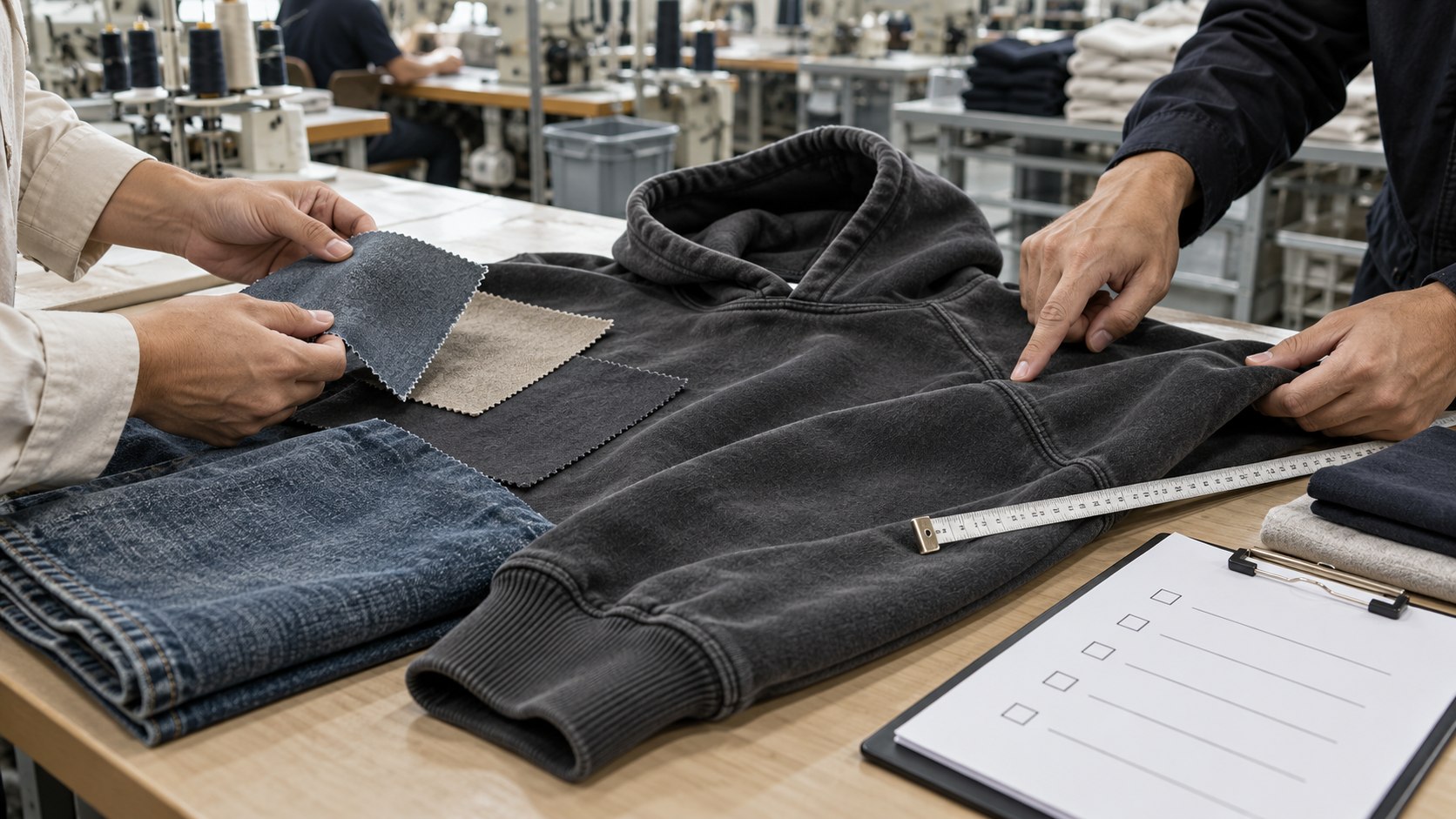
A streetwear manufacturer can show a heavyweight hoodie, a faded tee and a puff-print logo without proving it can reproduce your collection. For a brand owner, the useful evidence is more specific: an agreed fabric specification, a sample made through the proposed production route, measurable acceptance criteria and a quote that explains its exclusions.
Use this guide to turn supplier claims into approval decisions. It covers heavyweight tees, hoodies, sweatpants and denim, with particular attention to the wash and decoration details that product photographs cannot settle.
Why search results are only a starting point
Factory landing pages describe capabilities. Manufacturer lists help you find names. Neither format confirms who will make your garment, whether a displayed sample matches your construction, or what happens when bulk goods miss the approved standard.
Treat search results as leads for a shortlist. Ask each streetwear manufacturer to respond to the same specification and evidence request. For portfolio garments, ask which processes the factory performed, which it subcontracted and how it checked the result.
Keep a supplier comparison sheet with a place for unresolved questions. Separate a claim from its supporting document and record who approved that document. If a factory says it can match a wash but has only shown an unrelated garment, leave that capability open. Do not let a confident sales response become an approval by default.
Define the garment before comparing a streetwear manufacturer
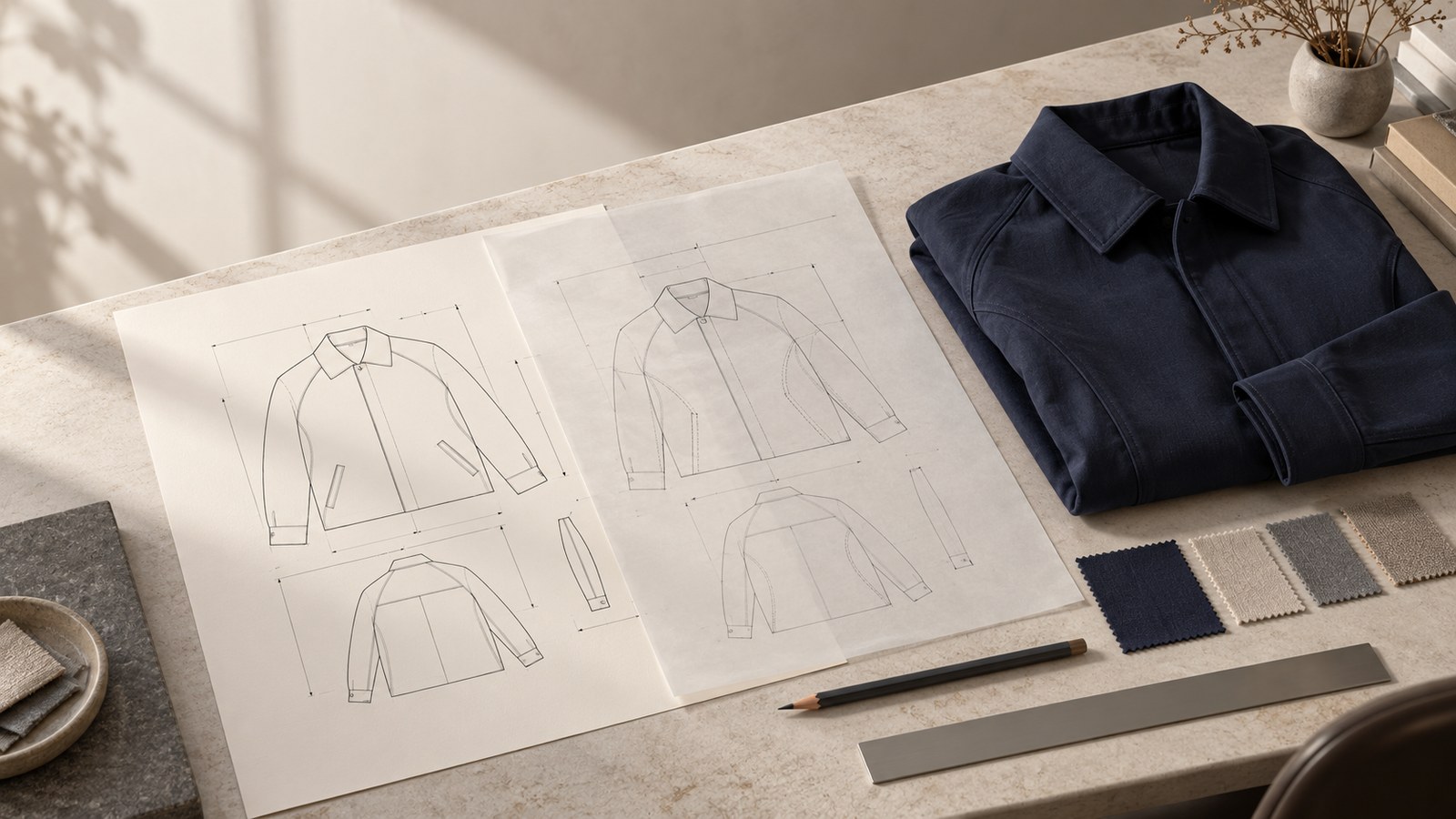
Your product brief determines which factory is suitable and which minimum applies. For a heavyweight tee, specify the intended fabric composition, construction, weight, hand feel and finished measurements. For a hoodie or sweatpant, add the fleece surface, rib specification, waistband or hood construction and relevant seam details.
Describe the fit through measurements and reference garments. Words such as “boxy” and “oversized” leave room for different patterns. Identify which reference controls the silhouette and which controls the fabric or wash; otherwise, a supplier may copy the wrong feature accurately.
For private label streetwear, establish whether the starting point is an existing style with branding changes or a newly developed pattern. Ask what can change without moving the order into a different material or development route.
Find the highest minimum in the supply chain
Ask for separate minimums for sewing, fabric, dyeing or washing, decoration and custom trims. A sewing minimum alone does not establish the quantity needed for your chosen specification.
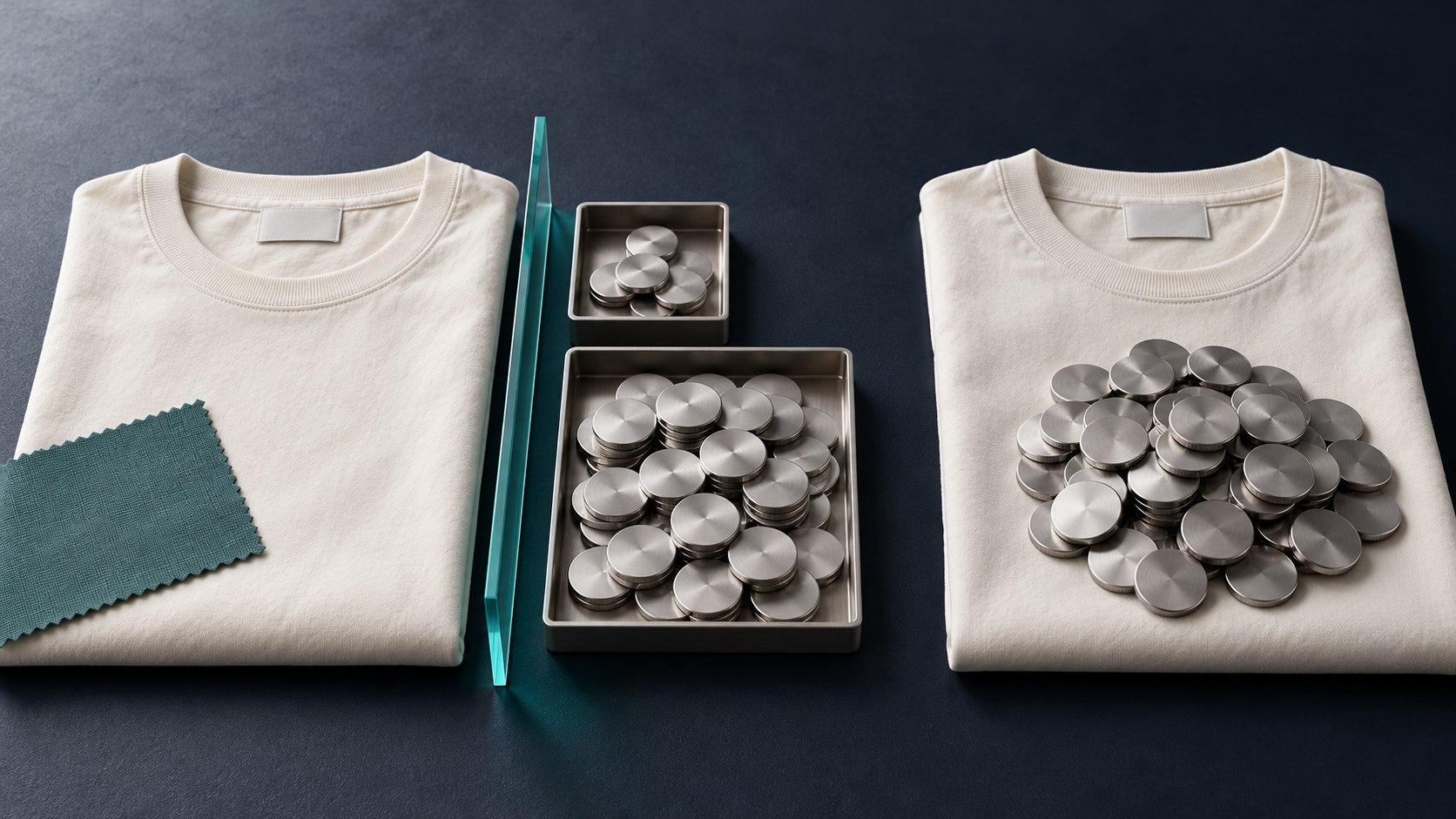
The following worked example comes from NOVITA’s minimum order quantity guide. Its material figures illustrate the calculation; they are not a quotation for your garment.
| Layer | Source-based example | Implication |
|---|---|---|
| Garment assembly | 100 pieces per style per colour; mixed sizes allowed | The factory-level minimum |
| Fabric colour lot | 300 metres per colour | The material commitment to check |
| Fabric consumption | 1.4 metres per garment | Convert fabric commitment into garment quantity |
| Effective minimum | 300 ÷ 1.4 ≈ 215 garments, rounded up | The fabric layer exceeds the sewing minimum |
The real minimum is the highest applicable tier after converting commitments into comparable units. Ask how the supplier handles leftover fabric and who owns it. Stock fabric, a different trim or a revised colour plan may make the order workable, but each change needs your approval.
Claims to test before choosing a streetwear manufacturer
Use this evidence matrix during supplier discussions. The decision column identifies what should remain unapproved until the evidence is available.
| Supplier claim | Evidence to request | Decision it controls |
|---|---|---|
| “We make heavyweight garments” | Fabric specification, weight check and measurements before and after the agreed wash test | Fabric and fit approval |
| “We handle enzyme wash, acid wash and distressing” | Named processing route, responsible subcontractors, washed garment and approved shade range | Wash approval |
| “We can do puff print, embossing or chenille” | Decoration trial on the intended fabric, artwork revision and agreed appearance checks | Decoration approval |
| “We offer a low minimum” | Written minimums at material, colour, trim and garment levels | Order quantity and inventory commitment |
| “We inspect to AQL” | Named plan, inspection level, defect classes, sample size and acceptance/rejection counts | Shipment acceptance |
| “Sampling is fast” | Confirmed inputs, start trigger, exclusions and revision schedule | Development calendar |
Heavyweight fabric and wash capability
Check fabric weight alongside the finished garment’s fit and feel. Ask the factory to identify the fabric used in the sample and explain how it will reserve or reproduce that material for bulk. Check the finished garment after the agreed care procedure, with measurements taken at the same points and under the same conditions.
For washed products, request an acceptable shade range alongside the target garment. Examine seam areas, rib, pocket edges and printed surfaces. Ask whether the wash happens before or after decoration and whether the sample follows that same sequence.
An outsourced wash process can be acceptable if responsibilities are clear. Request the processor’s role, the factory’s inspection procedure and the approval point before bulk processing. “In-house” alone tells you little about shade consistency or accountability.
Decoration needs its own approval
Approve puff print on the intended fabric with the proposed placement and artwork size. Record the surface appearance and feel, then agree how it will be checked after care. An attractive strike-off on a different substrate leaves the garment result unresolved.
Keep the approved artwork revision with the decoration sample. Ask the supplier to retain its production settings and identify who signs off any change. Apply the same discipline to embossing and chenille, using appearance and attachment checks appropriate to the treatment.
Make the inspection promise usable
AQL alone does not specify how many garments to inspect. NOVITA’s AQL sampling guide gives these examples for General Inspection Level II, single sampling, normal inspection, at AQL 2.5:
| Lot size, garments | Code letter | Sample size | Accept at or below | Reject at or above |
|---|---|---|---|---|
| 91-150 | F | 20 | 1 | 2 |
| 501-1,200 | J | 80 | 5 | 6 |
These counts apply to nonconforming garments within the agreed defect class. They are acceptance decisions, not a permitted defect percentage across the shipment. The linked guide reproduces reference tables; the contract-named standard and edition must govern the inspection.
Define which faults are critical, major or minor, and agree how garments with multiple faults are counted. Ask for a report showing the sample selection, findings and photographs. A pass without the underlying report gives you little to audit.
Put the sample clock in writing
NOVITA’s sample development process states 7-14 days after materials and construction are confirmed, with ready or stock styles starting from 50 pieces. These are NOVITA-specific terms, not a benchmark every supplier must meet.
Ask any supplier what starts its clock and whether sourcing, courier transit or revisions sit outside it. A dated approval log makes a delay easier to diagnose than an exchange of messages saying the sample is “almost ready.”
Use the sample round as a supplier audit
Assess how the factory handles the work as well as the garment it sends. A streetwear clothing manufacturer should be able to connect your comments to a revised specification and explain any change it proposes.
Use these questions in the sample review:
- Which fabric and trims are production-intent, and which are substitutes?
- Who made the pattern, and what will change during size grading?
- Which measurements changed after the agreed care test?
- Does the wash sample follow the proposed bulk processing route?
- Was the decoration approved on this fabric and finish?
- Where has the supplier departed from the tech pack, and why?
- Which components still need buyer approval?
- Can the supplier explain how it will check bulk against this sample?
Record each answer beside the relevant photograph or measurement. Your sample acceptance sheet should identify the garment, specification revision, fabric, artwork and wash reference. Give each open item an owner and an approval condition. “Improve the fit” is hard to act on; identify the measurement or construction change you want.
Retain matching approved samples with the buyer and supplier. Mark whether approval covers appearance, fit, construction or all specified features. If a fabric substitute remains in the sample, explicitly withhold approval of the final fabric. Otherwise, a conditional acceptance can become an argument about what you signed off.
Pay attention to the response when you reject a detail. A useful reply identifies the cause, proposes a correction and explains whether it affects cost or timing. Repeated promises to “fix in bulk” leave you without a verified reference.
Ask for a quote you can compare
Send the same product brief and assumptions to every shortlisted streetwear manufacturer. NOVITA’s clothing manufacturing RFQ checklist is a useful starting point for organising the request.
Ask the quotation to identify fabric, garment making, washing, decoration, trims, labels and packaging. Request separate treatment of development charges, artwork or screen setup, testing and inspection. The supplier should state what the garment price includes and which charges recur on a repeat order.
Specify the delivery basis, destination assumptions and payment terms. Clarify whether freight, duties and other destination costs are excluded. A quote with an unspecified delivery basis is difficult to compare with a detailed offer, even when the headline price is lower.
Then test the quote against your design. If you change a plain fabric to a washed finish or add custom hardware, ask for the revised price and minimum before approving the change. Keep the accepted quote tied to the same specification revision as the sample. Do not compare a stock blank with a developed cut-and-sew garment as though their scope were identical.
Write the approval rules into the order
Attach the accepted specification and references to the purchase order or manufacturing agreement. Where documents disagree, state which takes priority and require written approval for substitutions.
Agree the measurement tolerances and the care procedure used to assess dimensional change. For washed garments, identify the target shade and acceptable shade range. For denim, include the agreed rubbing or colour-transfer assessment where relevant to the product. A photograph alone cannot define every acceptance condition.
The inspection clause should name the standard and edition, inspection level, sampling plan and defect classifications. Specify who appoints the inspector, when inspection can happen and who pays for reinspection after a failure. Agree what corrective action is available and how shipment release relates to payment.
Address ownership separately. Clarify rights to patterns, graded files, artwork, screens or tooling that you pay to develop. If exclusivity matters, define the products, territory and duration covered rather than assuming a custom logo prevents similar products being sold elsewhere. Have appropriate legal counsel review terms intended to protect your intellectual property.
Stage the decision around evidence, not a fixed calendar
Begin with document screening. Confirm the contracting entity, production location and outsourced processes, then resolve the brief and quote assumptions. Move into sampling once the supplier has identified missing inputs and agreed the approval procedure.
After sample approval, consider a limited production order whose quantities still meet the confirmed supply-chain minimums. Use it to check production communication, inspection records and consistency with the approved reference. A successful development sample does not prove that bulk will match it.
Keep the launch calendar separate from the vetting checklist. NOVITA’s published MOQ and production terms state bulk production at 60 days after sample approval. A short vetting schedule cannot compress that stated production period, and logistics need their own agreed allowance.
Release a larger commitment when the evidence you required is complete. If a wash reference, material approval or corrective-action plan is still unresolved, carry it forward as an explicit hold. Commercial pressure should not silently change an acceptance condition.
Frequently asked questions
How do I vet a streetwear manufacturer in China remotely?
Ask for documents and live evidence connected to your garment: the production route, material references, sample review and inspection records. Confirm which entity takes the order and responsibility for subcontracted work. Where the order warrants it, arrange an independent factory assessment or inspection with a clearly defined scope.
Is the lowest minimum the best choice for a new brand?
Compare the complete commitment. A low sewing minimum may depend on stock fabric, standard trims or limited colour options. Check the applicable material minimums and the cost of unused inputs before deciding whether the offer suits your launch.
What should I approve for puff print or acid wash?
Approve the treatment on the intended garment or fabric using the proposed production sequence. Keep the artwork or shade reference with the sample, define the checks after care and record which variations you accept. Request another trial when a material or process change affects that approval.
Can a streetwear manufacturer guarantee every garment through AQL?
Sampling supports a batch acceptance decision under the agreed plan. It does not establish that every garment is fault free. Keep safety requirements, product specifications and corrective-action responsibilities explicit alongside the sampling clause.
Does private label mean I own the pattern?
Do not assume it does. Branding an existing style and commissioning a new pattern can involve different rights. Record ownership, access to files and restrictions on reuse in the agreement, including any separately negotiated exclusivity.
Discuss your next sample with NOVITA
Send NOVITA your tech pack or reference garment with the intended fabric, fit, wash, decoration and order breakdown. Ask which inputs need confirmation before sample development and request written minimums, exclusions and approval steps for your proposed style.