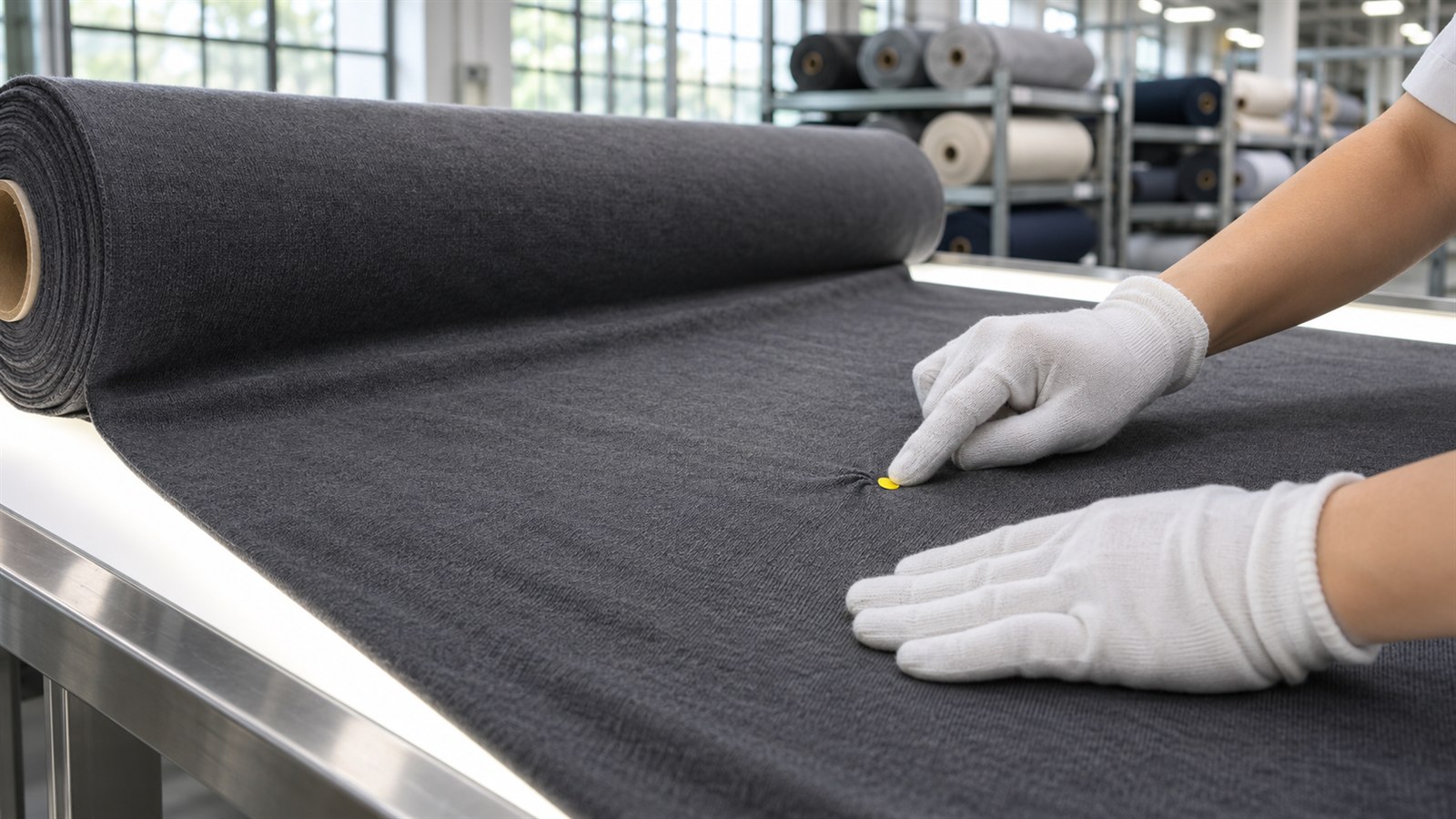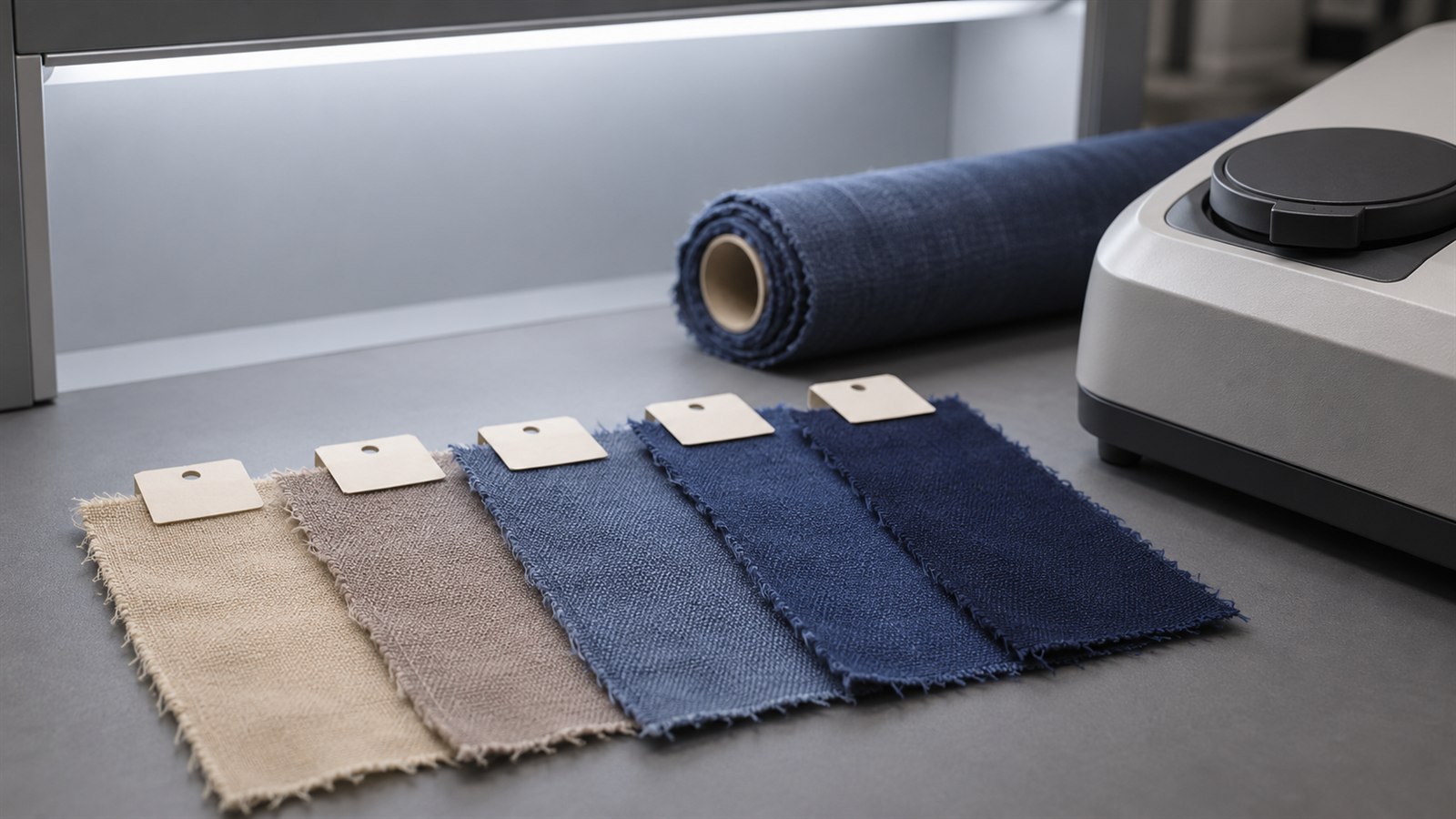
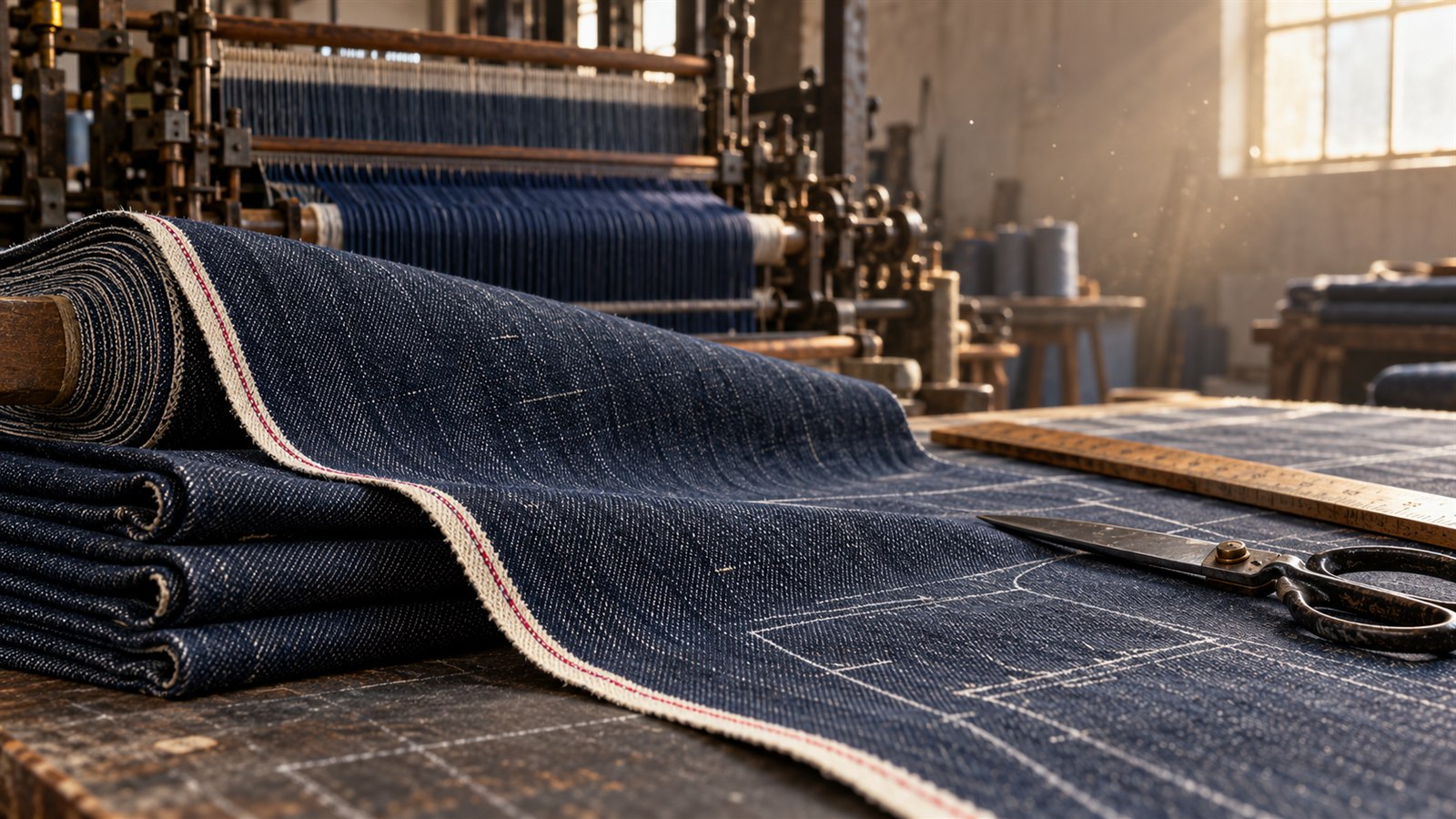
A fabric swatch cannot tell you what a denim order will consume. Before committing to selvedge denim fabric, ask for a marker, a shrinkage report and a written fabric commitment by color. Those documents connect the material you approve to the garment cost and fit you expect.
An attractive edge is only part of the specification. Check whether the usable width and chosen finish can deliver your silhouette at the target cost. Settle those decisions during development, before the factory commits cloth to cutting.
What the edge changes
On a shuttle loom, the selvedge forms as the shuttle carries the weft back across the cloth. In its denim-mill reporting, WWD/Sourcing Journal describes traditional shuttle-loom selvedge goods as typically 28–34 inches wide. A colored identification line may make the edge recognizable, but it does not establish the finished garment’s quality.
For a jean designed to show authentic selvedge inside a turned-up hem, the relevant leg-panel edges must follow the fabric edge along the outseam. That requirement fixes part of the layout. It does not mean every pocket, facing or other small component must use the edge.
Start with the intended garment detail, then choose the cloth. NOVITA’s denim fabric guide provides the broader material context; the issue here is what the selection permits you to cut.
The width problem starts in the marker
A marker lays the pattern pieces within the usable cloth width. With selvedge denim fabric, edge placement can restrict layouts that would otherwise improve utilization. A leg panel required to follow the selvedge cannot simply move into the center or turn across the grain to fill a gap.
| Marker question | Shuttle-loom selvedge | Standard wider denim |
|---|---|---|
| Reported width | WWD: typically 28–34 inches (other trade references commonly cite 28–32) | Trade references: 58–60 inches |
| Leg panels across | Limited by usable width, panel shape and required edge positions; confirm in the marker | More room to arrange panels; the actual count still depends on the pattern |
| Rotation and nesting | Edge-following panels have restricted placement; other pieces may use available spaces | More nesting options, subject to grain, shade and fabric-direction rules |
| Buying implication | Obtain consumption for the approved size mix and edge detail | Obtain comparable consumption rather than assuming perfect utilization |
Width references: WWD/Sourcing Journal for shuttle-loom widths, plus general trade references for standard 58–60 inch goods. These are separately attributed descriptions, not a combined specification.
There is no reliable universal panels-across figure. Ask the cutter to show your largest graded panels as well as the base size. Narrow width denim becomes a practical problem when the required panel and edge placement no longer fit together.
Convert cut yield into fabric cost per garment
Compare consumption before comparing prices per yard. WWD/Sourcing Journal quotes Cone Denim senior denim designer Kelvin Sin giving a regular requirement of 3.5 yards for a five-pocket selvedge jean, versus 1.6 yards for wider fabric. This is an attributed example, not a consumption standard for every style.
The following figures are original multiplication of those reported inputs. They are planning illustrations, not purchase quantities with allowances included.
| Order quantity | At 3.5 yd per selvedge jean | At 1.6 yd per wider-fabric jean | Additional linear yards |
|---|---|---|---|
| 1,000 garments | 3,500 yd | 1,600 yd | 1,900 yd |
| 5,000 garments | 17,500 yd | 8,000 yd | 9,500 yd |
Calculation source: WWD’s reported consumption comparison. Linear yards describe different cloth widths here; the table is not a comparison of equal fabric areas.
To price selvedge denim fabric, multiply approved yards per garment by the quoted price per yard. For an illustrative planning example only, assume $18–$42 per yard. Applied to WWD’s 3.5-yard example, that produces a calculated fabric-only cost of $63–$147 per garment. The assumed price range is not market pricing or a supplier quote; replace it with the actual quote before approving a budget.
For wider cloth, use its own yard price and approved consumption. Then reconcile shrinkage compensation, defects, cutting losses and roll rounding with the factory. Ask what is already included so the same allowance is not charged twice. Document denim cut yield for this style instead of carrying a figure over from another jean.
Separate garment MOQ from fabric commitments
The denim MOQ for finished garments does not establish how little cloth you can buy in each color. Ask whether the offer uses available inventory or requires a new weaving or dyeing commitment, and who pays for unused fabric.
As a separate illustrative planning example, budget for a fabric commitment of about 500 yards per color. This is not a supplier or mill minimum; use it only to test whether the proposed color range fits your budget. Mill-side dye-lot and put-up minimums vary by supplier and must be confirmed per quote.
Request separate written answers for color minimums, dye-lot allocation, roll lengths, full-roll purchasing and permitted quantity variation. A roll’s put-up is its supplied length. Confirm separately whether you must buy full rolls.
Keeping fewer colors can reduce separate commitments, but only the actual offer establishes the saving. Agree whether shade lots may be mixed and how remnants will be identified and owned before placing the fabric order.
Unsanforized shrinkage is a measurement problem
Specify the shrinkage condition, not just the fabric name. DenimHunters describes sanforization as compressive preshrinking and reports about 2–3% shrinkage for sanforized denim, sometimes more, versus as much as 10% for unsanforized denim. Use these figures for context, not as a substitute for testing your lot.
Raw selvedge denim and unsanforized are often confused in buying conversations. Ask the supplier to define the washing and preshrinking treatments behind each term. Do not infer either treatment from a product name.
With unsanforized selvedge denim fabric, budget for both the required cut dimensions and the layout those dimensions create. Lengthwise shrinkage may require longer pieces; widthwise shrinkage may require wider ones. Buying extra yards cannot make an oversized pattern piece fit across a fixed usable width.
Use direction-specific test results. The calculation is: required prewash dimension = target postwash dimension ÷ (1 − measured shrinkage). As an original arithmetic illustration using DenimHunters’ reported 10% ceiling, a 100 cm target would require about 111.1 cm before washing if that dimension actually lost 10%. This is not a recommended pattern allowance; the source reports a possible shrinkage level, not your lot’s result.
Choose whether the measurement chart governs the garment before washing or after the agreed wash. If the design cannot accommodate compensation, change the fabric treatment, fit or finished specification. Do not let the measurement chart silently change during sampling.
Wash restrictions must be established on the garment
Selvedge construction alone does not establish a safe wash recipe or a prohibition on distressing. The question is whether the chosen finish leaves the approved dimensions, seam strength and visible edge detail acceptable. For finish options, compare NOVITA’s guide to denim washes before selecting the sample route.
Approve the wash on a sewn garment with the intended outseam and hem, not just a loose swatch. Inspect edge waviness, seam puckering, leg twist and the appearance of the turned-up cuff. Record what is acceptable rather than assuming an identification line will remain unchanged.
For abrasion, holes or whiskering near an outseam, require a placement reference and a finished sample. Do not approve aggressive treatment through a structural seam from a photograph alone. Validate the permitted intensity and distance from the edge on the garment rather than applying a universal distressing limit.
Release cutting through sample and test gates
Use distinct approvals for fabric identity, washed fit and bulk readiness. For selvedge denim fabric, approving the look of a development sample should not release an untested production lot for cutting.
Establish the starting condition
Request a loom-state reference where relevant, plus a sample of the fabric in its actual delivery condition. Label any finishing or preshrinking already applied. A loom-state reference helps establish the starting cloth; it does not settle the finished garment’s measurements or bulk consumption.
Approve the one-wash result
Make the fit sample in the intended cloth, measure it before washing, apply the proposed recipe and measure it again after agreed conditioning. Record changes at the waist, hip, rise, thigh and inseam, along with twist and edge appearance.
For a garment sold unwashed, use this exercise to validate the intended customer-care instructions and expected fit change. For a garment sold washed, use it to approve the delivered fit and finish. Keep those acceptance conditions separate.
Test the production lot before cutting
Identify the delivered rolls and shade lots, confirm usable widths and agree representative sampling across the lot. Test shrinkage under the approved process before finalizing compensation and rerunning the marker. Escalate variation rather than averaging away a roll that falls outside the agreed tolerance.
Seal the pre-production, or PP, sample with its measurement chart, fabric identity, wash reference and edge detail. The written cutting release should identify these approved records. For help preparing your approval documents, use NOVITA’s wash sample approval checklist alongside the custom denim manufacturing guide. Agree the proposed checks with your factory before development starts.
Put these questions in the RFQ
Send the factory a package that allows it to quote the garment you intend to approve:
- Fabric article, stated origin, delivery condition and usable width.
- Required selvedge position, outseam construction and cuff reference.
- Graded size range, order size ratio and target measurement condition.
- Marker-based consumption, with each allowance identified.
- Price unit, color commitments, dye-lot rules and roll purchasing terms.
- Proposed wash, distressing placements and aftercare instructions.
- Production-lot shrink testing, shade controls and acceptance tolerances.
- Responsibility for unused cloth, rejected rolls and replacement material.
If Japanese selvedge denim is part of the brief, request evidence supporting that origin claim. The description alone does not identify a mill or establish availability through your garment supplier. In your denim jeans development inquiry, ask the supplier to confirm whether it can obtain the specified cloth.
When wider denim is the better choice
Reject selvedge denim fabric if the visible edge does not justify the consumption cost, the required silhouette cannot fit the usable width, or the color commitments exceed your sales plan. Wider cloth deserves consideration when the product brief prioritizes those requirements over an authentic selvedge outseam.
FAQ
Does selvedge denim fabric always need more yards?
The cited WWD example does, but do not turn it into a universal ratio. Your pattern, size mix, usable width and edge placement determine consumption. Compare approved markers for the same garment brief.
Can the cutter rotate pieces to improve yield?
Not freely. A leg panel that must follow the selvedge has constrained placement, and grain and shade rules still apply. Smaller components may fit unused spaces; ask to see the layout rather than assuming all nesting is impossible.
Is a garment MOQ enough to plan the fabric purchase?
No. Obtain separate color, dye-lot and roll terms. Also establish whether the quote relies on stock or a new production commitment, and who owns surplus cloth. Mill-side minimum figures remain unverified until the supplier confirms them.
Should the brand approve a loom-state or washed sample?
Use them for different decisions. The loom-state reference documents the starting material; the washed garment tests fit and finish. Neither replaces shrink testing on the actual production lot before cutting release.
Can unsanforized jeans be sold unwashed?
If that is the product brief, validate expected fit change under the intended care instructions and state the measurement condition clearly. Do not approve only the unwashed appearance while leaving the aftercare result unresolved.