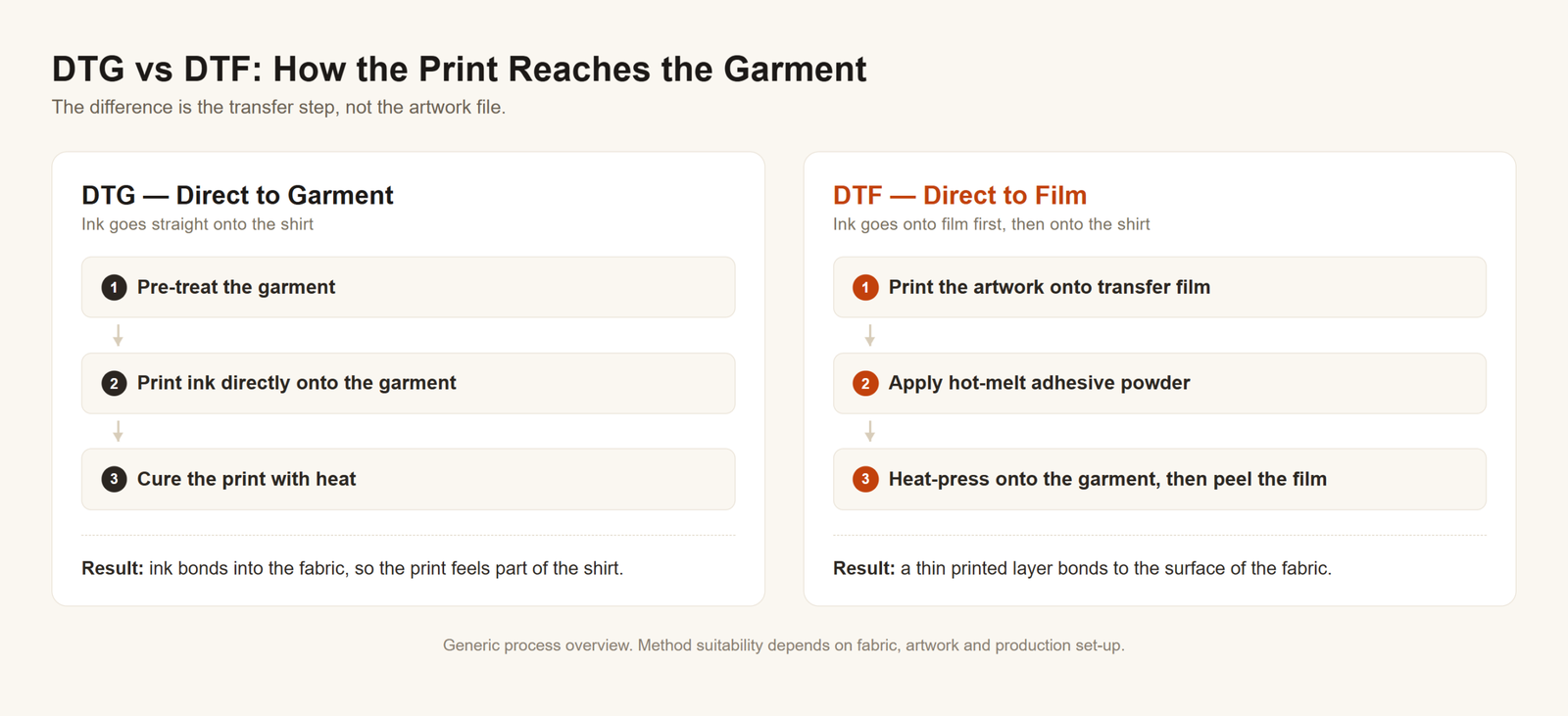
DTG vs DTF is really a question about how the ink reaches the garment. DTG prints ink directly onto the garment, while DTF prints the design onto a transfer film before applying it to the garment. That single difference explains most of the practical trade-offs that follow: fabric compatibility, hand feel, how colour behaves on dark garments, and how each method behaves through sampling and bulk production.
This guide is written for clothing brands, wholesalers, private label buyers and sourcing teams who are planning custom T-Shirt production and need to decide which decoration route to specify — and what to confirm before the order is placed.
What Is DTG Printing?
DTG stands for direct-to-garment. A digital print head applies water-based ink straight onto the surface of the garment, in the same way a desktop printer lays ink onto paper.
In production the garment is normally pre-treated first. Pre-treatment helps the ink bond to the fibres and keeps the ink from spreading beyond the edges of the artwork. The garment is then loaded onto a platen, printed, and cured — usually with heat — so that the ink sets into the fabric.
The characteristics that matter most for buyers:
- The ink bonds into the fibres rather than sitting on top of them.
- The method performs best on cotton and cotton-rich garments.
- Pre-treatment and curing are part of the process, not optional extras.
- Because there is no film and no screen, detailed artwork can be produced without extra tooling.
What Is DTF Printing?
DTF stands for direct-to-film. The artwork is printed in reverse onto a special transfer film, coated with a hot-melt adhesive powder, and then heat-pressed onto the garment. The carrier film is peeled away after pressing, leaving the printed layer bonded to the fabric.
Because the design is built on film first, DTF does not depend on the garment absorbing ink. That changes what is possible.
The characteristics that matter most for buyers:
- The print sits on the fabric as a thin, flexible layer rather than soaking into it.
- A wider range of fabrics can be decorated, including polyester and blends.
- Colour can be held more consistently on dark garments, because the printed layer is not affected by the base fabric colour.
- Pressing parameters — temperature, pressure and dwell time — directly influence the final result.
DTG vs DTF: Key Differences
| Factor | DTG | DTF |
|---|---|---|
| Print process | Ink is printed directly onto the garment and then cured | Artwork is printed onto a transfer film and heat-pressed onto the garment |
| Best suited for | Cotton and cotton-rich garments with detailed, soft-hand artwork | A broad fabric range, including polyester, blends and textured knits |
| Fabric compatibility | Strongest on cotton and high-cotton blends; results vary as synthetic content rises | Wider compatibility, because the print layer does not rely on the fabric absorbing ink |
| Hand feel | Ink bonds into the fibres, so the print feels integrated with the fabric | A thin film layer rests on the surface, so the print feels slightly raised |
| Detail | Holds fine linework and smooth photographic gradients well on cotton | Holds fine detail and opaque lines well, including on dark bases |
| Color | Ink interacts with the base fabric, so the final colour can shift with garment colour | Colour sits in the printed layer, so appearance on dark garments is more consistent |
| Order flexibility | No screens or film, so artwork can change between units and short runs stay practical | No screens, and the same film workflow can cover several fabric bases in one order |
| Main consideration | Pre-treatment and fabric choice drive the final appearance | Pressing control and film handling drive the final appearance |
The table above is a starting point, not a verdict. Two suppliers using the same method can produce noticeably different results depending on their equipment, chemistry, curing discipline and quality control.
Print Quality and Detail
Both methods are digital, and both can hold a level of detail that would be impractical for screen printing on a short run. The differences appear in specific kinds of artwork rather than in a single overall ranking.
Screen printing is the other common route for T-shirt decoration; our guide to DTF vs screen printing compares setup cost, minimum order quantities and durability.
DTG tends to handle smooth tonal transitions, soft edges and photographic imagery well on cotton, because the ink is absorbed into the fibre structure. Fine linework is achievable, but very thin lines can soften once the ink spreads into the fabric.
DTF tends to hold crisp, opaque edges and small text reliably, including on dark and synthetic bases, because the printed layer is formed before it ever touches the garment. Extremely fine detail still depends on the film, the print resolution and how evenly the design is pressed.
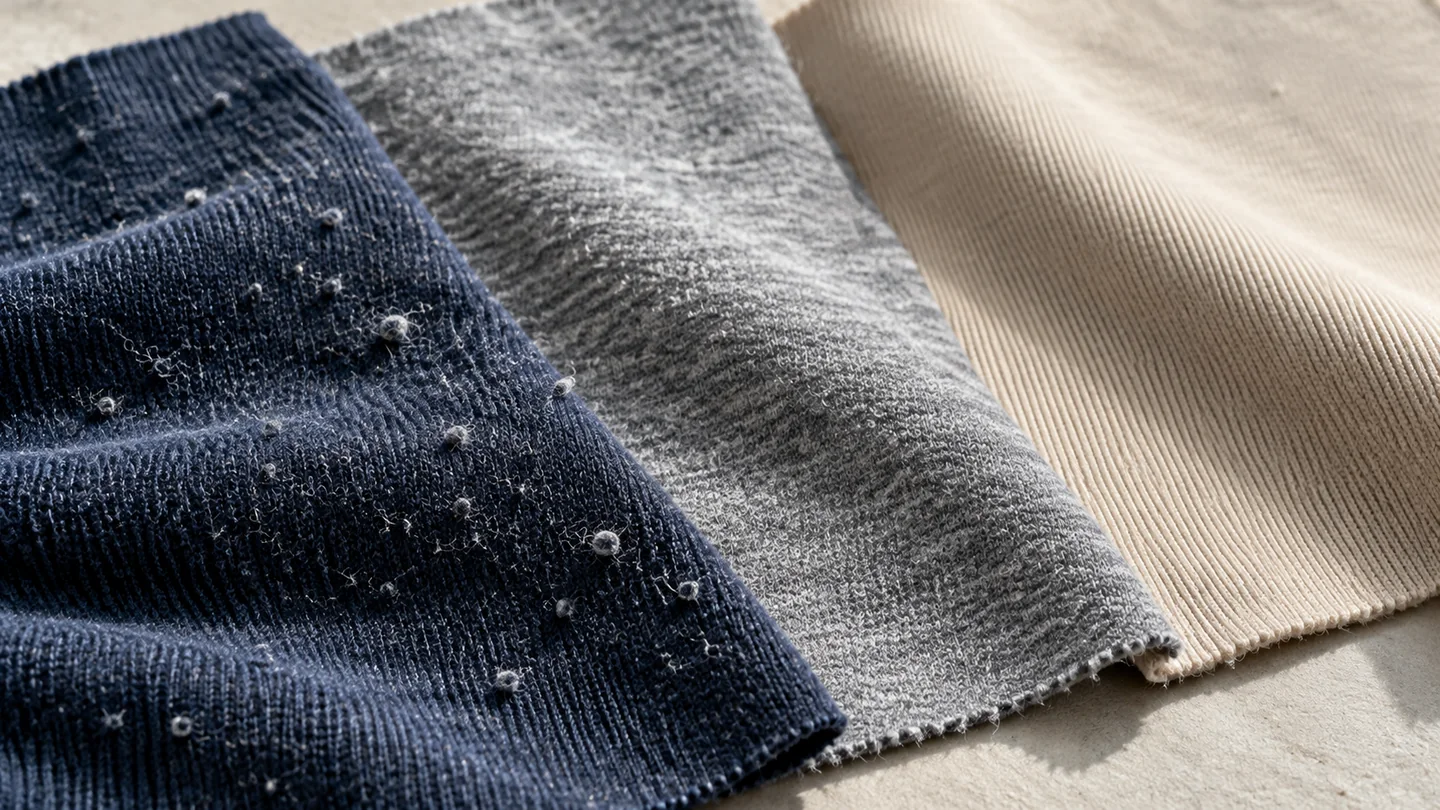
Where the two methods diverge most is on textured surfaces. On slub yarns, heavy fleece or open-weave knits, a print that reads as clean on a flat jersey swatch may look uneven once applied. That is a fabric question as much as a print question, and it is one of the reasons sampling matters.
Fabric Compatibility
Fabric composition is usually the first filter when choosing between the two methods.
DTG depends on the ink bonding with the fibre. Cotton and cotton-rich blends give the most predictable result. As polyester or other synthetic content increases, ink absorption becomes less consistent, and that can affect both the depth of colour and how the print behaves over time. Tight, ringspun cotton surfaces generally print more evenly than loose or hairy surfaces. When selecting a base from a blank T-shirt programme for DTG, confirm the fibre composition and test the intended fabric rather than assuming every blend will print like cotton.
DTF is less dependent on absorption, which is why it is often used where the garment is not pure cotton — polyester performance knits, poly-cotton blends, and fabrics that would be difficult to print directly. The trade-off is that the print is a layer on the surface, so fabric texture shows through less and the method is more sensitive to how the surface accepts the adhesive.
Other fabric decisions matter too. Fibre type, yarn structure, knit density and finishing treatments all change how a print sits on the garment, not just how it looks. For a fuller breakdown of how cotton, CVC, polyester and blends behave in production, see our guide to T-Shirt fabric types.
Hand Feel
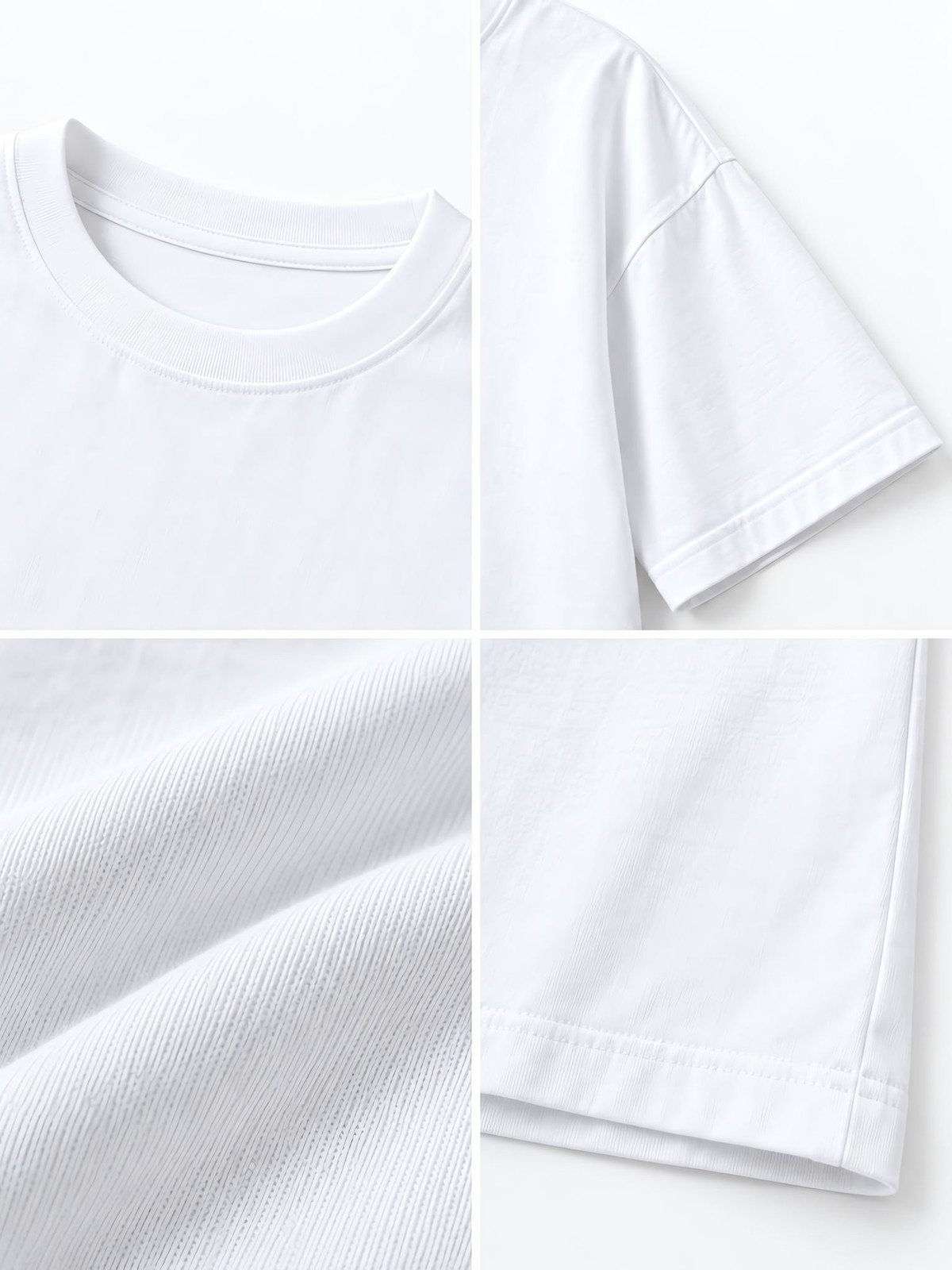
Hand feel is the difference buyers notice first when they compare samples side by side.
With DTG, the ink is bonded into the fabric, so a light print on a soft cotton jersey can feel close to the original fabric. Coverage changes that. A large, heavy print can add weight and slight stiffness to the panel, and the pre-treatment can affect the surface feel of the printed area. On a 260gsm oversized boxy tee, assess the intended print coverage on a garment sample rather than using fabric weight alone to predict the finished hand.
With DTF, the printed layer sits on top of the fabric. Well-made transfers are thin and flexible, and a light design can feel surprisingly soft. Heavier coverage, thicker adhesive layers or an under-pressed transfer will feel more like a decal, and that is typically what buyers are reacting to when they describe DTF as having a firmer hand.
Neither method can be assessed from a swatch in isolation. Fabric weight and structure change how the same print feels in the hand, which is why it is worth reading our T-Shirt fabric weight and GSM guide alongside any print trial.
Durability and Wash Performance
Wash performance is not determined by the name of the method. It is determined by how well the process was executed and how the garment is laundered.
For DTG, the common failure modes are an uneven pre-treatment, insufficient curing, and printing onto a fabric the ink does not bond with well. A correctly cured print on a compatible cotton base generally performs very differently from an under-cured print on the same garment.
For DTF, the common failure modes are under-pressing, over-pressing, inconsistent pressure across the platen, and stretching the print while the adhesive is still setting. Once bonded correctly, the print layer is flexible, but it is still a layer — repeated high-heat drying and aggressive washing will affect it faster than it affects the base fabric.
In both cases, what buyers should specify is the laundering instruction that will ship with the garment, and the test that the supplier will use to verify the print before bulk. Stretch panels, seams and areas over elastane deserve separate attention, because a print that performs well on a flat panel may behave differently where the fabric moves.
Color and Artwork Considerations
Colour on a garment is produced by combining ink with a base fabric, and both methods have to deal with that.
On dark garments, DTG normally requires a white underbase to make colours visible. The underbase adds opacity, and it also adds a layer that can affect both the hand feel and how the print reads under different lighting.
DTF produces its own white layer as part of the transfer, which is one reason it is often chosen for dark garments and for colours that must stay consistent across a mixed fabric order.
Neither method should be treated as a true spot-colour process in the way screen printing can be. Brand colours, Pantone references and previously approved shades should be treated as targets to be matched on the actual fabric, not as guaranteed outputs. The safest workflow is to approve a physical sample on the production fabric and keep it as the reference for bulk.
On artwork preparation, the practical points are consistent across both methods: supply vector artwork where possible, keep raster files at a resolution that suits the largest print size you intend to use, avoid relying on very thin strokes, and confirm the exact print dimensions rather than a percentage of the garment. Methods differ in how they render a file, so the same artwork should be proofed rather than assumed.
DTG vs DTF for Small and Bulk Orders
Both methods are digital, which means neither requires screens, plates or a long setup. That has two consequences for buyers.
First, both are practical for small runs, sample rounds and repeat drops. Artwork can be changed between units, so a size run does not have to be locked to a single graphic, and a test order can be produced without the tooling cost that other decoration methods carry.
Second, both can be scaled to bulk, but the constraint usually moves away from the print method itself. In bulk production the questions become fabric availability, colour consistency across lots, print placement repeatability, and finishing capacity for pressing and curing. Those are production questions, and they are best answered by the supplier before the order is confirmed.
Where several fabric bases are involved — for example a cotton tee and a polyester performance top in the same collection — the two garments may not be best served by the same method, even when the artwork is identical. That is a normal outcome, and it is worth planning for rather than treating as an exception.
For context on how these decisions sit inside a private label T-Shirt programme, our T-Shirts range shows how blanks, garment-dyed styles and labelled private label programs are structured.
For custom T-Shirt projects, the commercial framework is usually straightforward:
- Custom MOQ: 100 pcs per color.
- Mixed sizes: allowed.
- Sample: 7–15 days.
- Bulk: generally around 60 days after sample approval, depending on quantity, fabric availability and customization.
Which Printing Method Should Clothing Brands Choose?
There is no universally better method. The right choice follows from the product, the fabric and the artwork — not from the label on the process.
DTG is usually the more natural starting point when the garment is cotton or cotton-rich, the artwork is detailed or photographic, and a soft hand feel is a priority. It suits brands building a consistent cotton basics line or a graphic range where the print should feel like part of the shirt.
DTF is usually the more natural starting point when the fabric range is mixed, when polyester or synthetics are involved, when the artwork needs opaque colour on a dark base, or when one artwork has to run across several garment types in the same order.
There are also cases where neither method is the best answer. Very high-volume single-colour graphics, or artwork that is built around a specific brand colour that must be matched exactly, are often better served by a different decoration route — and embroidery remains a strong option for logos and small emblems where texture and longevity matter more than photographic detail.
At NOVITA, custom T-Shirt projects are developed through OEM, ODM and private label production, and custom printing and embroidery are part of that work. Printing methods can be selected according to artwork, fabric, order requirements and production feasibility. For a specific printing method, feasibility should be confirmed during sampling, because that is where the fabric, the artwork and the finish are tested together. Our private label clothing manufacturing guide explains how those production models differ.
What Buyers Should Confirm Before Production
Most disagreements in custom T-Shirt printing trace back to something that was not written down before the order. The following points are worth confirming in writing.
- Garment specification: style, fabric composition, fabric weight, colour and the exact base the print will be applied to.
- Artwork file: vector or raster, resolution, colour mode, and whether the file is final or still subject to change.
- Colour reference: the target shade, the reference sample, and how colour variation will be judged on the production fabric.
- Print size and placement: exact dimensions and position for each size, including how placement scales across the size run.
- Print type: which method will be used, and on which garment in the order.
- Sample approval: a physical sample approved on the production fabric that becomes the reference for bulk.
- Laundering instruction: what the care label will say and how the print was tested against it.
- Labelling and packaging: neck label, woven label, hang tag, polybag and carton requirements.
- Tolerance: the accepted range for colour and placement variation, agreed before production rather than after.
A structured sample round is the least expensive place to resolve all of this. Our breakdown of the clothing sample development process covers what a T-Shirt sample round typically includes and what each stage is meant to prove.
FAQ
Is DTG better than DTF?
Neither is better in general. DTG is often the stronger fit for cotton and cotton-rich T-Shirts where a soft hand feel and detailed artwork matter most. DTF is often the stronger fit where the fabric range is mixed, where polyester is involved, or where opaque colour is needed on dark garments. The deciding factors are the fabric, the artwork and the intended finish, not the method name.
Is DTF more durable than DTG?
Not automatically. Wash performance depends on whether the process was executed correctly. DTG relies on correct pre-treatment and full curing; DTF relies on correct pressing temperature, pressure and dwell time. When both are done properly on compatible fabrics, either can perform well. When either is done poorly, both can fail early. A wash test on the actual production fabric is the only reliable way to judge this for a specific order.
Which is better for cotton T-Shirts?
For a 100% cotton or high-cotton T-Shirt, DTG is usually the more natural fit, because the ink bonds into the fibre and the print tends to feel integrated with the fabric. DTF is also workable on cotton and is sometimes preferred when the artwork needs very opaque colour or when the same design also has to run on a non-cotton garment in the same collection.
Can DTG and DTF be used for bulk orders?
Yes. Both are digital methods without screen or plate setup, so they can be used for small runs and scaled to bulk. In bulk production the practical constraints are usually fabric availability, colour consistency between lots, placement repeatability and finishing capacity, rather than the print method itself. These should be confirmed with the supplier against the specific order plan.
Which printing method has a softer feel?
DTG generally feels softer on a light print over soft cotton, because the ink sits within the fabric rather than on it. DTF can also feel soft when the transfer is thin and correctly pressed, but a heavier print or an under-pressed transfer will feel firmer because the print forms a layer on the surface. The difference is most obvious on large coverage areas and is best judged on a physical sample of the actual garment.
How should brands choose between DTG and DTF?
Start from the garment rather than the process. Confirm the fabric composition and weight, define the artwork and where it sits on the shirt, decide how the print should feel in the hand and how it must behave after laundering, then test the candidate method on the production fabric. If the collection spans several fabric bases, expect that more than one method may be needed. Feasibility for a specific method should be confirmed during sampling.
Final thoughts: the useful question is not which method wins in general, but which method fits this garment, this artwork and this order. Settle that during sampling, agree the tolerances in writing, and the production stage becomes far more predictable.
At NOVITA, we support OEM, ODM and private label men’s apparel production in China, including custom printing, embroidery and private label finishing on T-Shirt programs. If you are planning a custom T-Shirt order, contact us to discuss the fabric, artwork and production plan for your project.