Seam allowance needs a defined measurement reference as well as a value. This guide explains how to distinguish the pattern dimension from the sewn-seam dimension, specify requirements by seam location, and confirm a governing unit before approval. It also covers how changes can affect fit, material use and production planning.
Why seam allowance is a commercial decision, not a sewing detail
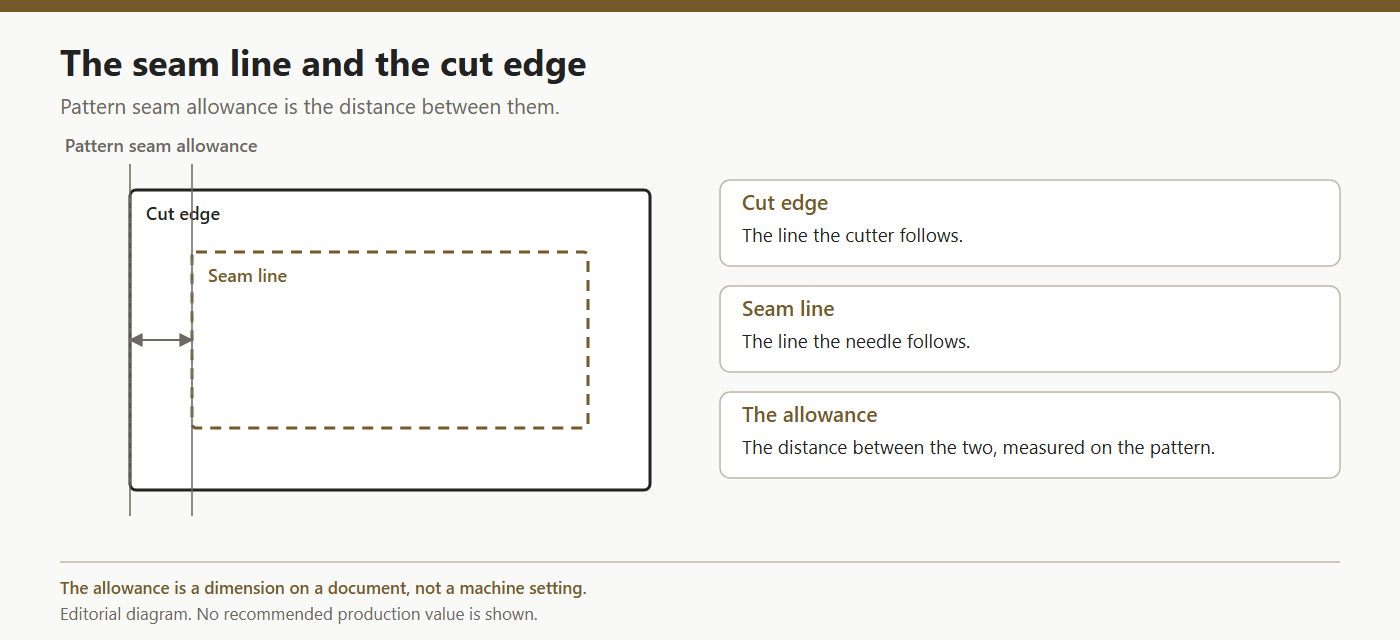
A seam allowance is the width of fabric between the seam line and the cut edge. On a pattern it is the space between the line the needle follows and the line the cutter follows. It is a small number, measured in millimeters or fractions of an inch, and it is one of the few numbers in a specification that moves three things at once: where the finished seam sits, how much fabric the order consumes, and how much material the factory has to work with at the seam.
It should be defined in the approved production specifications, whether through the tech pack, the production pattern, or the relevant sewing instructions, because a garment cannot be made without it. Something will be cut. If the buyer has not settled a value, the value that gets used is the one held by whoever prepares the pattern and sets up the machine — an inherited default, a number carried over from a previous order, or a width the existing folder and guide can accommodate.
None of those outcomes is automatically wrong. A default can be perfectly suitable for the garment. But it is not a number the buyer has chosen, costed or checked. When a finished measurement later sits outside the specification, or when fabric consumption comes back above the quotation, there is no agreed figure to compare against — because no figure was ever agreed.
That is the commercial argument in one line: a seam allowance is a specification field, and an empty field is still a decision. It is simply a decision made by someone else.
Two different things are both called “seam allowance”
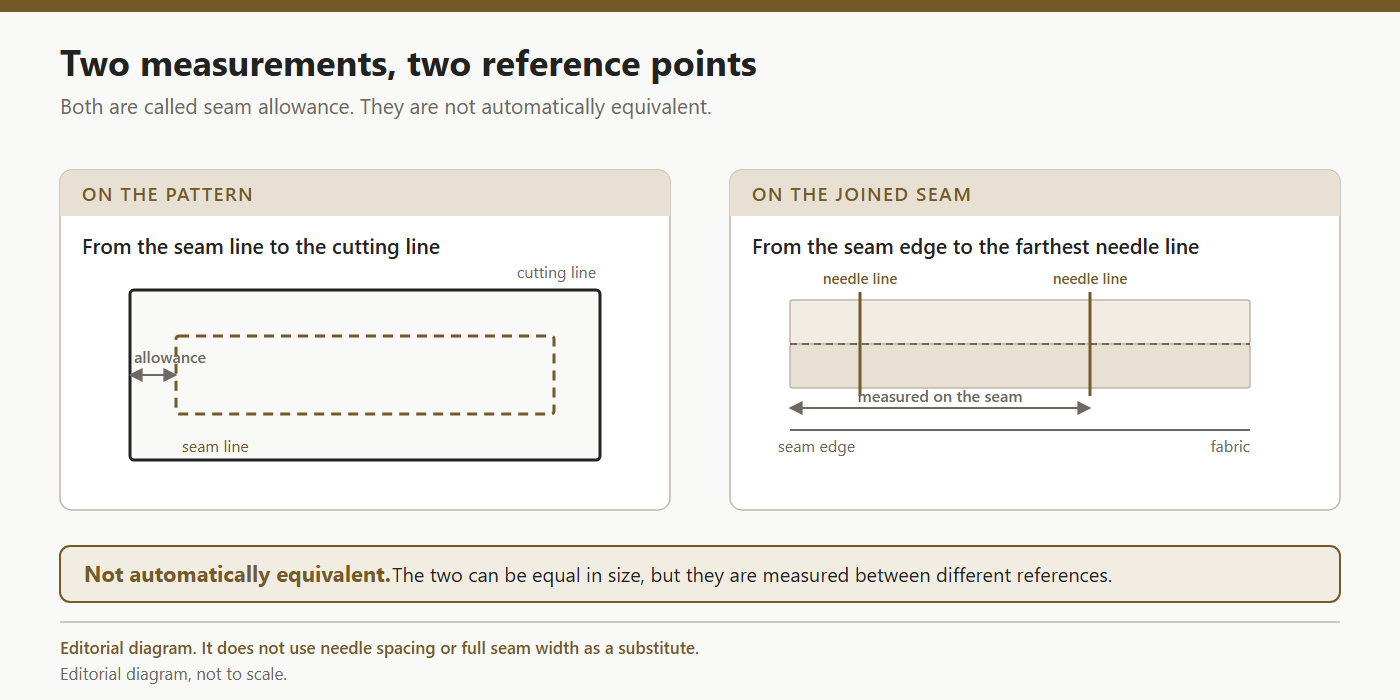
The phrase covers two related quantities that are not interchangeable, and the difference creates a particular kind of ambiguity: both sides can name the same number and still be describing two different measurements.
The NIST Apparel Manufacturing Glossary separates them explicitly. Its first definition of seam allowance describes the pattern: “Portion of the muslin or paper pattern extending a determined amount from the seam line to the pattern edge.” That is an allowance measured on paper, from the stitching line to the cutting line. Its third definition describes the seam: “The distance from the edge to the needle hole in the seam’s stitching line that is most distant from the seam edge.” That is a dimension measured on the joined seam. The same entry then states the relationship directly: “Seam-dimension seam allowance is not equivalent to pattern-drafting seam allowance, although they may sometimes be equal in size.”
The glossary is equally clear that the term depends on the document. A draft — the working development of a pattern — “does not include seam allowances.” A basic block, or sloper, “generally has no seam margins”, which is part of what makes it easier to manipulate. Drawing an outline from a sloper or draft is defined as drawing “without seam allowances”. Allowances are described as appearing when the pattern becomes a production tool: a trade block is described as “including seam allowances, notches, and details”, and a production pattern as including “the specified seam allowances”.
So which document a buyer is looking at matters, and the answer has to be established rather than assumed. These entries describe how documents are conventionally defined; they are not a guarantee about what any particular supplier will send. Pattern files are named, exported and bundled differently from one factory to another, and a file called a production pattern may still carry the allowance only as a stated value on a particular seam, or as a convention the pattern room applies unless told otherwise.
Two consequences follow for the buyer. First, reviewing a sloper or a development draft is not the same act as approving a seam allowance, because the document may not contain one. Second, a production pattern is described as including “the specified” allowances — which means the buyer still has to confirm that a value was specified, for which seams, and on what basis. Approving a document and agreeing a value are separate steps, and one does not automatically deliver the other.
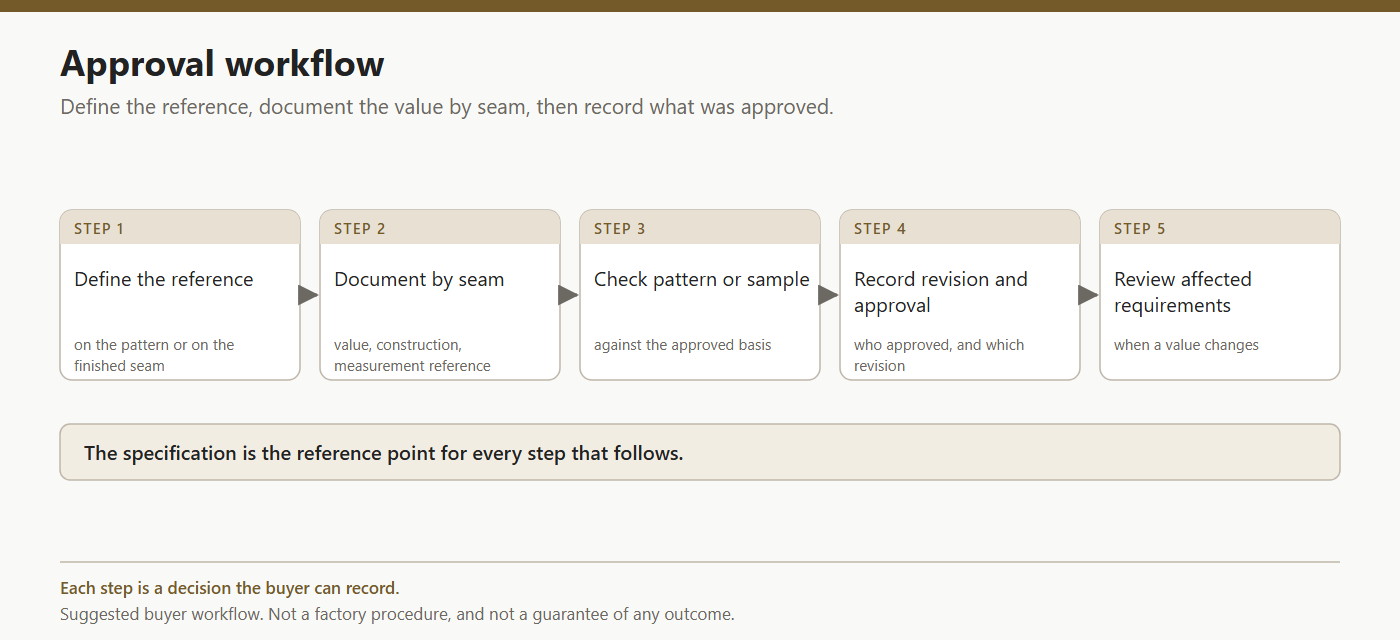
Because both quantities can legitimately be called the seam allowance, the specification has to be more specific than the term itself. It should state which document the value is defined on and where it is measured: on the pattern between the seam line and the cutting line, or on the finished seam between the edge and the stitching line. It should also record how the buyer will verify the agreed value — at sample approval, on the finished seam, or both — so that the number can be checked against the same basis it was written on.
What the number controls: fit, fabric consumption and rework
Changing this number does not automatically change the size of the finished garment. What it changes depends on which of two lines is being held fixed, and the two cases are easy to confuse because both are described in conversation as “changing the seam allowance”.
In the first case the seam line stays where it is and the cutting edge moves. The pattern seam allowance changes, and the pattern piece changes with it. Whether the finished garment changes dimension is a separate question, because the seam is still joined along the same seam line; the finished measurements may be unchanged. What has changed is how much fabric is carried inside the piece and how much material remains at the seam.
In the second case the cut edge stays where it is and the stitching moves away from or closer to it. Here the seam position on the garment moves, and the finished measurement can move with it. A garment is joined along many seams, so a difference at the side seam, the armhole, the shoulder and the hem can accumulate in the same direction when the same shift is repeated. Whether it accumulates, and by how much, depends on how many seams are affected, how the fabric behaves and how the garment is assembled, so no single consequence follows from the allowance change itself. How much variation is acceptable on any one seam remains a value the order has to set.
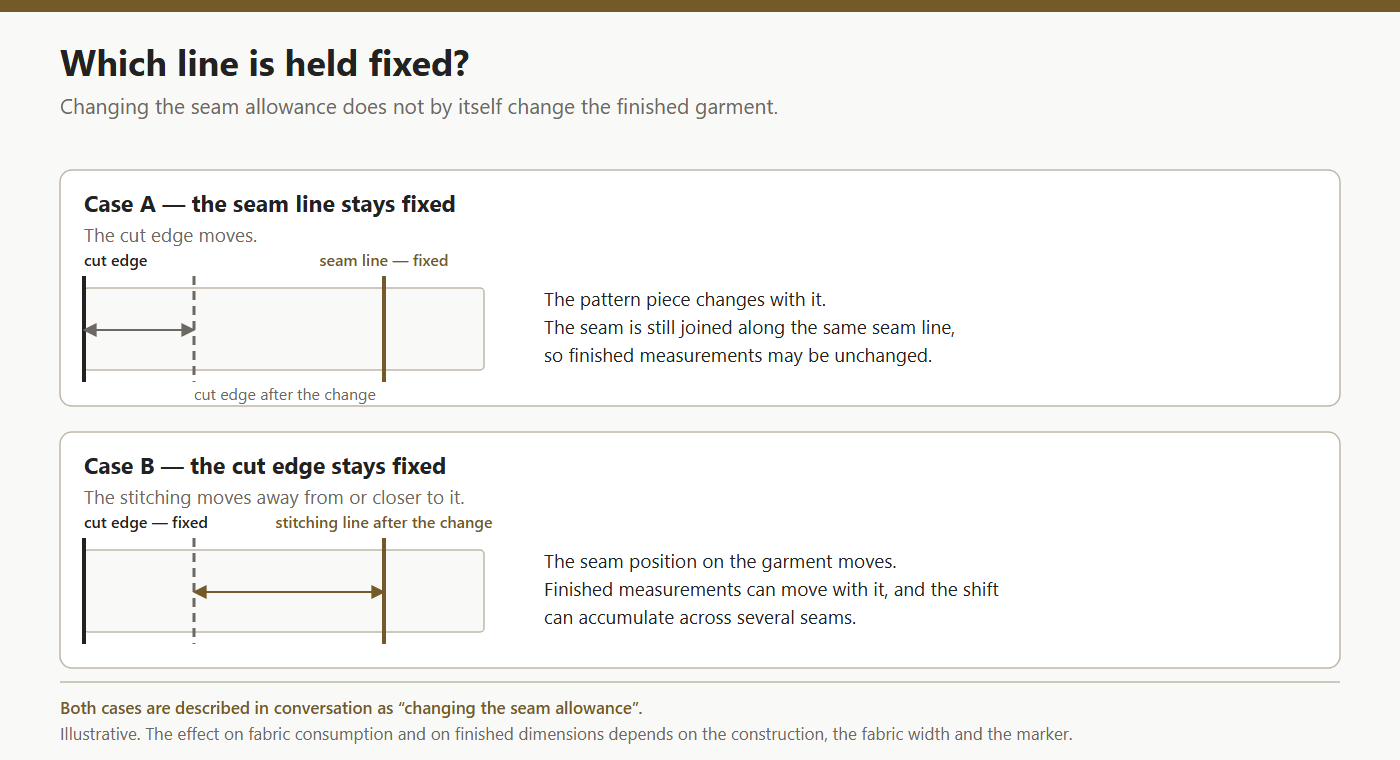
The distinction matters because the two quantities are not the same thing. Pattern seam allowance is a dimension on a document. The actual stitching distance is what happens at the machine. A specification that does not say which of the two it is fixing leaves the other one open, and a sample can be approved against one reading while bulk production follows the other.
Fabric consumption can change when the cutting outline or marker changes, but not by a fixed proportion. The allowance is part of every pattern piece, and consumption is calculated from those pieces, so a wider allowance makes the pieces larger and the marker has to be laid again. Changing seam allowances can affect pattern-piece dimensions and marker efficiency, but the actual impact on fabric consumption depends on garment construction, fabric width and marker layout. A buyer-facing consumption guide sets out the relationship as pattern-piece area divided by cuttable width and marker efficiency; the allowance sits inside that numerator, and the rest of the calculation is specific to the style, the fabric width and the way the marker is laid. No single percentage follows from the allowance alone.
The third thing is the material the factory still has to work with at the seam. Additional untrimmed allowance may provide some adjustment options, but actual rework possibilities depend on seam construction, fabric properties and the production stage. Once the allowance has been trimmed, enclosed inside a finish, or marked by earlier stitching, the material available to correct a problem may be gone no matter how wide the original allowance was. A wider allowance is therefore not a general advantage; it is an option that exists only while the material is still present and still usable.
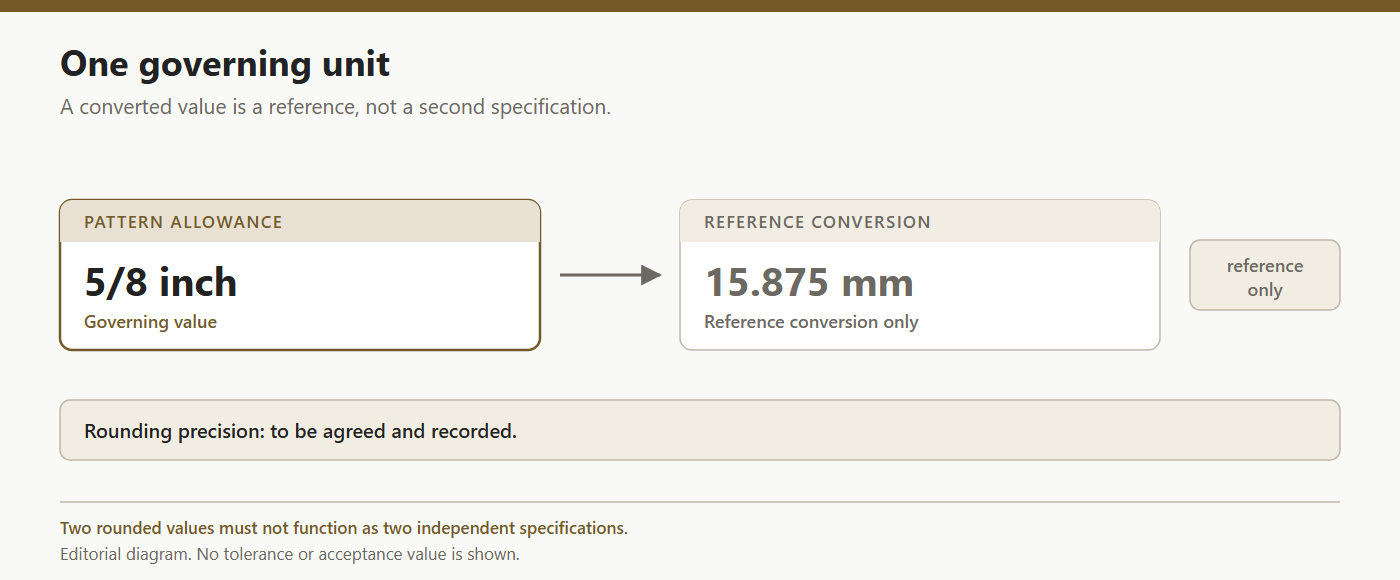
There is one more reason the written value needs a governing system. The two common conventions are not round numbers in each other’s system: 5/8 inch is 15.875 mm, and 1 cm is 0.394 inch. A specification that mixes the systems without saying which one governs can be read two ways from the same written value.
All of this is why the value belongs in the approved specification rather than in a conversation after the first sample, and why the specification has to make clear how the allowance is defined, where it is executed, and where it will be measured.
Write it per seam, not per garment
A single allowance for the whole garment is a convenience that hides a decision. Seams do different jobs, and the allowance that suits one is not automatically right for another. The trade’s own seam terminology treats the width as something the seam type requires someone to state, not something the seam type supplies. In the A&E technical seam-type listings, for example, a felled seam used on jeans, shirts and jackets is written as “Specify needle spacing & seam width. (Ex: 1/4 needle spacing w 3/8″ seam width).” and a corded seam used on jeans, chinos and jackets is written as “1st Operation – specify seam width; 2nd Operation – specify number of needles (1, 2, 3) and needle spacing.” The pattern is consistent: the seam type carries a requirement to state a value, and the value is not implied by the seam’s name.
One caution on mixing vocabularies. A&E’s listings use seam width and needle spacing as things an operator must be told, and NIST’s glossary defines its own related terms. The two systems are used together in practice, but they were not written as one system, and a value carried from one document to another should not be assumed to mean the same thing without being checked against the definition it was written on.
The second reason is terminology, because several different quantities sit next to each other in a specification. NIST’s glossary distinguishes the seam dimensions below; needle spacing is the separate parameter used in A&E’s seam listings.
| Field | What it describes | Where it is measured |
|---|---|---|
| Seam allowance | the fabric between the seam line and the cut edge | on the pattern, or on the joined seam |
| Stitching seam width (SW) | the distance between the two outermost parallel lines of needle holes | on the surface of the seam |
| Full seam width (FSW) | stitching seam width plus the heading and/or the let-out | on the seam; depends on the seam type |
| Seam heading (SH) | the distance from the seam’s folded edge to the nearest line of needle holes | on the seam |
| Seam let-out (SLO) | the distance from the seam edge to the needle line — the material available to let out | on the seam |
| Needle spacing | the distance between needles on a multi-needle machine | on the machine setup and the seam |
If a specification says “seam width” without saying which of these is meant, two people can read it as two different measurements and each be describing the document in front of them. The same caution applies to “grading”: in the glossary it also means trimming the plies of a seam allowance inside a finished seam, which has nothing to do with sizing a pattern across a size run.
The third reason is location. One allowance applied everywhere ignores what happens at the seam. The table below sets out why a value may differ by location; it is a list of questions to settle, not a schedule of values.
| Location | Why the value may differ |
|---|---|
| Side seam | a long straight run; often the default the rest is written against |
| Armhole / armscye | curved, so a bulky allowance is harder to press and to conform |
| Collar and placket | visible edges, frequently topstitched or corded |
| Sleeve hem and bottom hem | may need material held back for a later let-out |
| Curved seams and corners | clipping and notching need material to work with |
| Seams trimmed or enclosed | part of the allowance is removed or hidden in the finish |
A pattern maker’s example of how this is written for a client reads: “Unless otherwise specified, all seams are 3/8″. Collars, neckline and outside edges are 1/4″. Sleeve hem allowance is 1.5″. Sweep hem is 2″.” Those figures are one supplier’s shorthand, not an industry schedule, and they are not a recommendation. The form is the point: a default, then the locations that differ from it, written down where both sides can see them.
Four questions keep a per-seam specification usable once it leaves the buyer’s desk. What needs to be specified — which value, on which seams, and on which basis it is defined. Where it should be documented — the tech pack, the production pattern, or the sewing instructions, and which of those governs if they disagree. Who needs to confirm it — the buyer approving the value and the pattern room or production team confirming that the stated value is the one they will run. How the approved value should be verified — the stage at which it is measured, on the pattern or on the finished seam, and what record shows it was checked.
How fabric weight, seam type and stretch change the value
The allowance that works on a cotton poplin side seam is not automatically right on a stretch jersey armhole or on a bound edge. The value has to suit the fabric and the seam construction it will be run on, and several properties of that fabric decide what this means in practice.
Fabric properties first. What the allowance can carry depends on how the fabric behaves rather than on a single weight figure. Thickness and weight affect how much bulk the seam holds. Stability affects whether the piece keeps its shape while it is handled and sewn. Fraying behavior affects whether a narrow edge can be left exposed or has to be enclosed. Edge geometry affects how the allowance sits on a straight run compared with a curve. Handling and pressing requirements affect whether a wide allowance can be pressed flat or will show along the seam. A heavier fabric is not automatically more stable, not automatically easier to feed, and not automatically suited to a wider value; a lighter fabric does not automatically need a narrower one. The value has to suit the actual fabric, and that is settled against the material in front of the pattern room rather than against a general rule.
Seam type second. NIST’s glossary defines this allowance as planned according to the width needed for the type of seam, seam finish, or garment design — the seam type is an input to the number, not a consequence of it. Some seam types enclose the raw edge instead of leaving a margin. A binding has a finished width, and the technical listing for a mock clean finish binding asks only to specify the width of the binding. A felled or French seam folds the raw edges inside, so both the fabric consumed and the material available to let out differ from an open seam carrying the same nominal allowance. A graded seam presses the two plies to one side with the larger allowance enclosing the smaller, which again changes what is actually present at the seam.
Stretch third. Where the fabric has to extend and recover with the seam, seam performance depends on the stitch construction, the thread behavior, the fabric structure, and how the fabric itself extends and recovers — not on the seam allowance alone. A change to the allowance does not by itself repair or cause a stretch-related seam failure; the construction, the thread and the fabric are the first things to examine. The allowance still has to be written down, but it is one variable among several rather than the controlling one.
| Variable | What changes | What it means for the written value |
|---|---|---|
| Fabric thickness and weight | how much bulk the seam holds | the value has to suit the actual fabric, not a general weight rule |
| Stability | whether the piece keeps its shape in handling and sewing | a less stable fabric is one to confirm at sample stage rather than assume |
| Fraying behavior | whether a narrow exposed edge is acceptable | a fabric that frays may need a value that keeps the raw edge enclosed |
| Seam construction and edge geometry | whether a margin exists at all, and how it sits on a curve | bound or folded constructions may require finished-width or other construction dimensions; curved and straight locations should be evaluated separately |
| Handling and pressing requirements | whether a wide allowance can be pressed flat | a value that presses cleanly on one fabric may show on another |
| Stretch and recovery | whether the seam must extend with the fabric | performance depends on stitch construction, thread and fabric, not the allowance alone |
Where the allowance shows up in cost and lead time
Seam allowance reaches cost through fabric consumption, which is why a change to it is a commercial question and not only a sewing one.
The chain from the allowance to the quotation is short. Consumption per garment is derived from the marker: marker length divided by the number of garments in the marker, adjusted by an allowance percentage for end loss and other waste. Marker efficiency is the share of the marker area covered by pattern pieces — the remainder becomes cutting waste — and it is used to compare marker options for the same style and size ratio. Change a seam allowance and the pattern-piece area changes, which can change how the pieces nest. Whether consumption actually moves, and by how much, depends on the garment construction, the fabric width and the marker layout, so the effect cannot be quoted from the allowance change alone and has to be recalculated for the actual style, width and marker.
There is a second cost that does not appear on the fabric booking. A narrower pattern allowance may reduce fabric use, depending on the marker, but can leave less material at the seam, and material that has been trimmed, enclosed in a finish or perforated by earlier stitching may no longer be available to correct a problem. That trade is not a fixed ratio, and it belongs in the same conversation as the price.
Timing matters more than the amount. The allowance is settled while the pattern and the marker are being developed, before the fabric is booked. A change made late in the process can require revised patterns, new marker calculations, updated consumption estimates, sample reapproval, revised quotations and a review of the production schedule. Whether any of those follow, and how much they cost, depends on the stage at which the change is made and how large it is; a change agreed before the marker has been finalized or before the fabric has been cut is a different proposition from one raised after the fabric is on order. Fixing the value before the order is placed is cheaper than renegotiating it afterwards.
What goes wrong when seam allowance is not specified and approved
An allowance that is never written down does not stay neutral. Different teams may interpret or apply an undefined value differently across pattern development, sampling and production, and the resulting values are not guaranteed to agree. What follows is rarely one dramatic error. It is a mismatch that appears at the point where the garment is measured.
The direction of the mismatch changes the symptom. An allowance that is too small for the construction can leave the raw edge too close to the stitching to be enclosed cleanly, which matters most on a fabric that frays, and it reduces the material available to let out if a fit correction is needed later. Where the fabric structure allows yarns to move rather than rupture, a seam under load can open without the thread or the fabric breaking; the technical bulletin covering that failure mode recommends increasing the seam allowance or seam margin as one response, once the problem has been identified. An allowance that is too large is not automatically safer. It adds bulk where the seam has to be pressed flat, and it is harder to press or conform on a curve.
Where the mismatch surfaces changes what it costs. A value found to be wrong at sample stage may require a pattern correction and sample reapproval. The same value found after approval and after the fabric is cut is a problem in the bulk, where the material may already have been cut with the wrong allowance or cut-edge geometry and the correction options are narrower. The two stages are not comparable in effort, and the later one is the reason the value belongs in the approved specification rather than in a conversation.
One pattern of failure is easy to prevent. Where the allowance is applied inconsistently across sizes, the result depends on the grading system the pattern was built on rather than on the base size alone. In the cited patternmaking method, seam allowance is kept constant across the graded sizes while the underlying body dimensions change. Other grading or construction systems should follow the approved pattern specification rather than assuming this rule universally. A second comes from the handover. A value changed in the pattern is not always carried through to the marker, the cutting ticket and the folders, so the change reaches the sewing floor in a different form from the one that was approved.
Who absorbs the cost is not settled by the seam itself. It returns to the order terms, the acceptance basis and the records kept at sample approval — the same documents that make a discrepancy provable rather than arguable.
A pre-order checklist for fixing the allowance
The checklist below is the shortest form of the specification this article has been describing. It is not a form to copy as-is; it is a list of questions that has to be answered before the order is placed, with one row for each place on the garment where the allowance is set differently.
| Seam location | Pattern allowance | Seam construction | Measurement reference | Approval status |
|---|---|---|---|---|
| Side seam | ______ | ______ | ______ | ______ |
| Armhole | ______ | ______ | ______ | ______ |
| Shoulder | ______ | ______ | ______ | ______ |
| Collar or placket | ______ | ______ | ______ | ______ |
| Sleeve hem | ______ | ______ | ______ | ______ |
| Bottom hem | ______ | ______ | ______ | ______ |
Each column exists for a reason. Pattern allowance is the number the pattern carries, and it is the number that has to change if the value changes. Seam construction records what happens at that seam, because bound or folded constructions may be controlled by finished-width or other construction dimensions in addition to, or instead of, a simple let-out margin, and the same nominal value does not mean the same thing across two constructions. Measurement reference says where the value is defined and where it will be checked — on the pattern, on the sample, or on the finished garment — because a value that is correct on one of those is not automatically correct on another. Approval status records who has confirmed it and against which revision.
Three rules make the table usable. First, specify one governing unit. If a converted value is also shown, label it as a reference conversion and state the required rounding precision, because a fractional inch and a metric value do not convert to each other cleanly and two rounded values must not function as two independent controlling specifications. Second, state whether the value stays constant across sizes or changes with them, and record the decision either way. Third, tie the table to a revision, so that when a value changes it is possible to say which material and which approval it applies to.
The table should also name the two actions that follow approval. One is what happens when a measurement does not match: who is notified, under what terms, and what evidence is kept. The other is what a change costs and who approves it, because a value changed after the marker has been finalized or after the fabric has been cut is a different commercial event from one changed before sampling. Neither has to be answered in this table, but both have to have an owner.
Seam Allowance FAQ
Can I approve seam allowance from a sloper alone?
Confirm what the file contains before approving it. A sloper or development draft may not include allowances. Ask for the applicable production pattern or written seam specification, with the value, measurement reference and revision identified.
Will increasing seam allowance make the garment smaller?
It depends on which line changes. Moving the cut edge while holding the seam line fixed may leave finished dimensions unchanged. Moving the stitching while holding the cut edge fixed can change finished measurements. Confirm the affected seam and construction.
Can the same seam allowance be used throughout a garment?
A common default can be used where it suits the construction, but exceptions need to be specified by location. Fabric behavior, edge finish, seam geometry and adjustment requirements may call for different values. Confirm the default and exceptions before approval.
What should the tech pack say when both inches and millimeters are shown?
Name one governing unit. Mark the other value as a reference conversion and state the required rounding precision. The converted figure should not become a second independent controlling specification.
Does an allowance change require a revised fabric quotation?
Reassess consumption if the change affects the cutting outline or marker. A late change may also require pattern updates, sample reapproval or a schedule review. Revise the quotation where those project-specific consequences warrant it; no fixed saving or cost increase follows from the allowance alone.
Discuss Your Garment Specifications
Share your tech pack, fabric details, and sample comments with NOVITA. Tell us which seam locations or construction details you’d like to review.
References
- Read, Michael E. Apparel Manufacturing Glossary. NISTIR 5572, February 1995.
- American & Efird. Seam Type Matrix. No confirmed edition or publication date is assigned here.
- American & Efird. Seam Engineering. No confirmed edition or publication date is assigned here.
- TextileNotes. Fabric Consumption Calculation: Knit and Woven Garments and Marker efficiency Formula.
- Burhan Enterprises. Fabric Consumption per Garment. Supplier guidance.
- Fashion-Incubator. Designers must know seam allowances and specifications. Supplier-specific example.
- Apex Fashion Lab. Seam-allowance glossary entry. Method-specific training guidance.