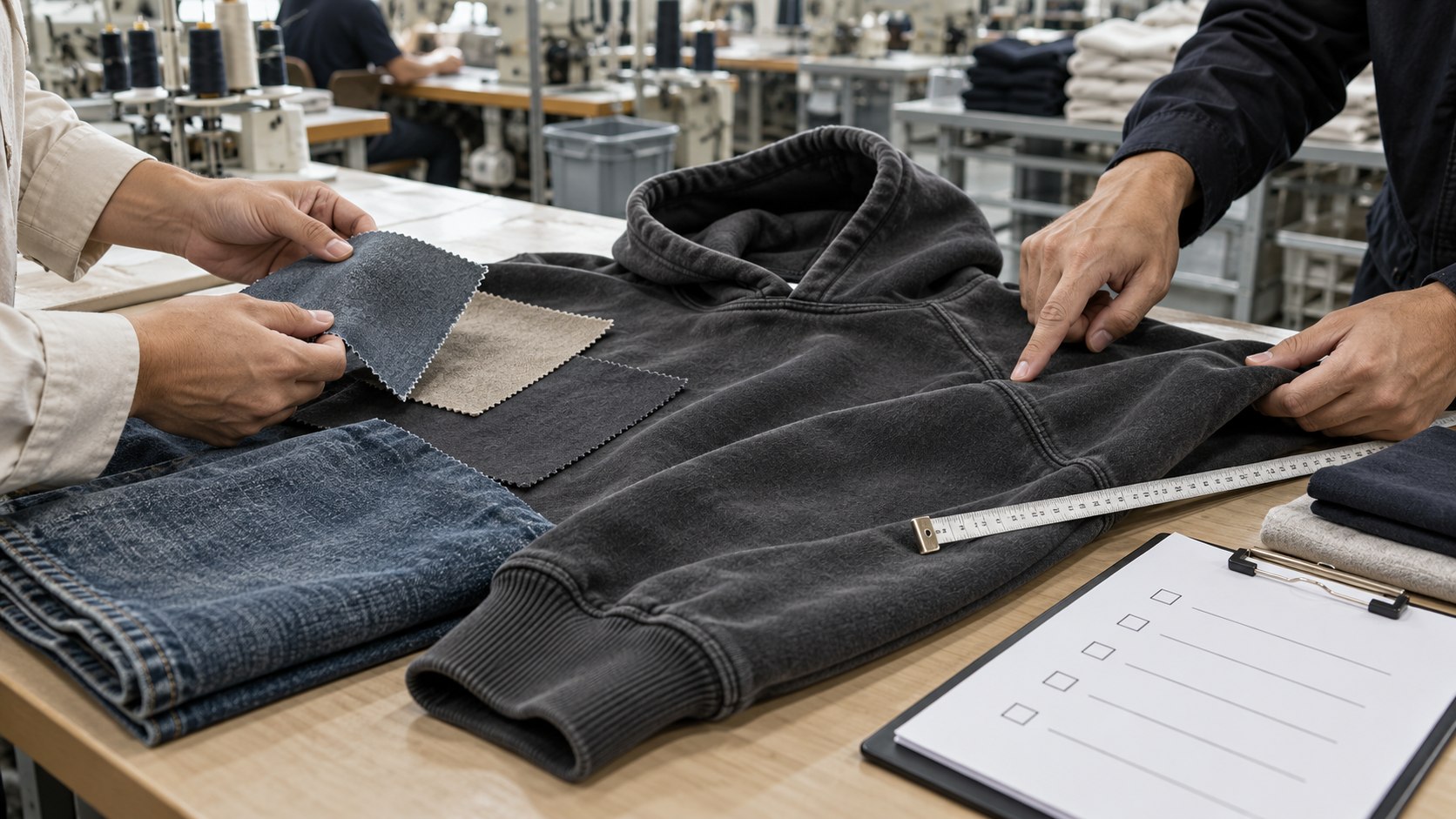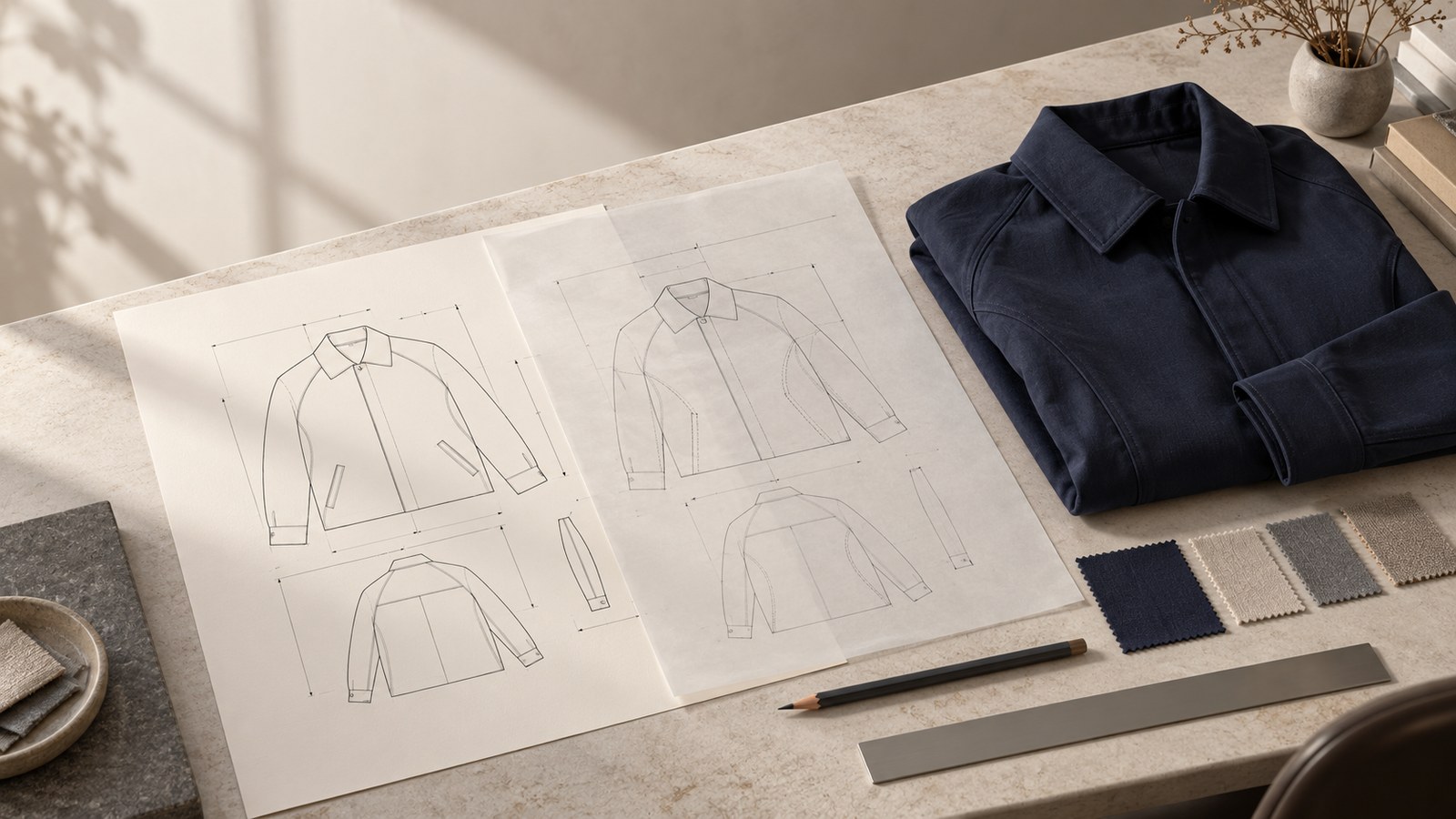
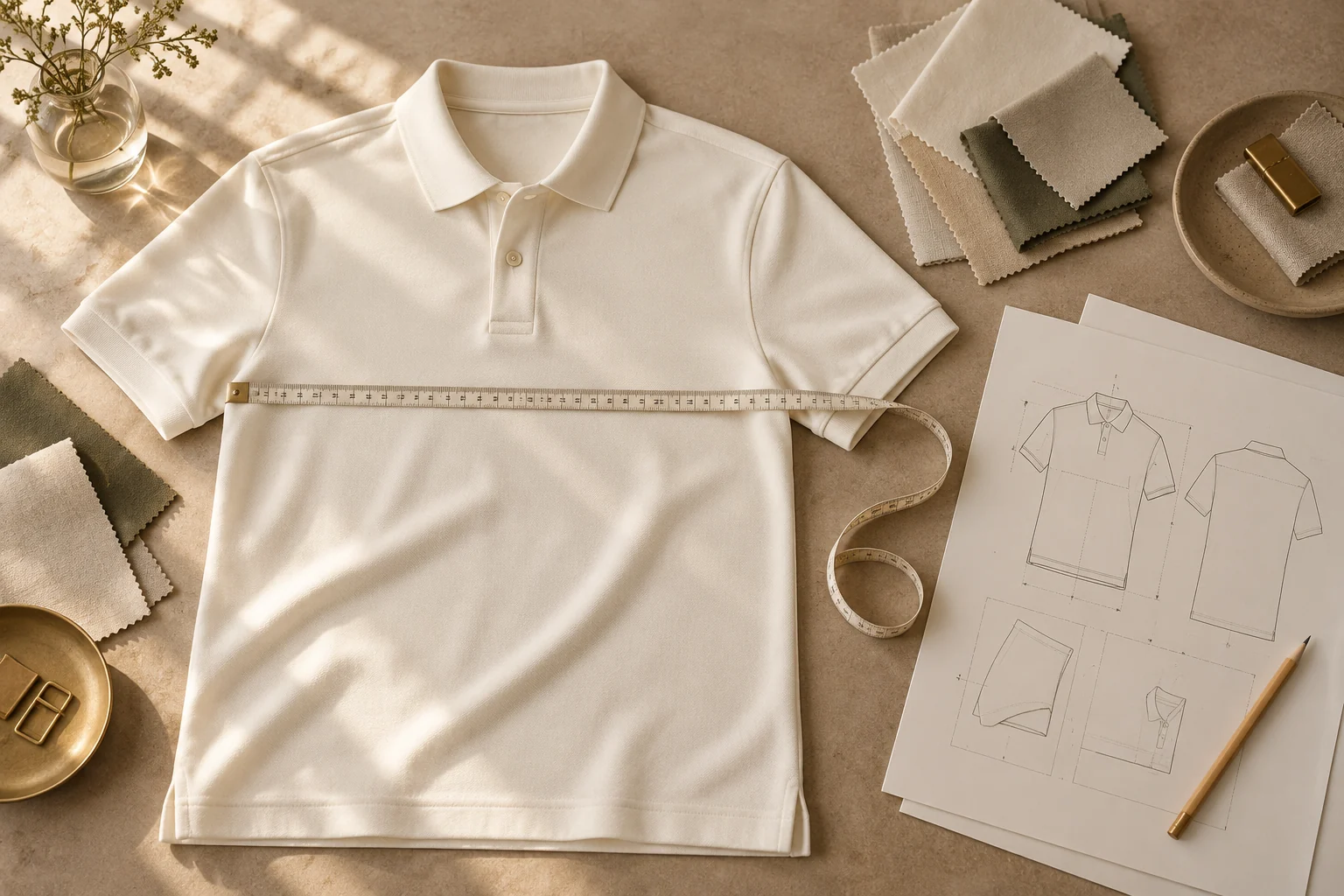
A reference garment shows a manufacturer what you mean. It does not automatically explain which details should be repeated, which should change or whether its current condition represents the product you want to sell.
That gap matters when a buyer asks for “the same shirt, but heavier and more relaxed.” Does the factory preserve the shoulder and add body width? Change the sleeve as well? Match the worn fabric’s softness or develop the original, unworn feel?
The solution is to transfer the reference into a clothing production specification: an identified garment, a record of observations, explicit changes and a current set of approved requirements. This guide focuses on that transfer—not the sequence of sampling stages.
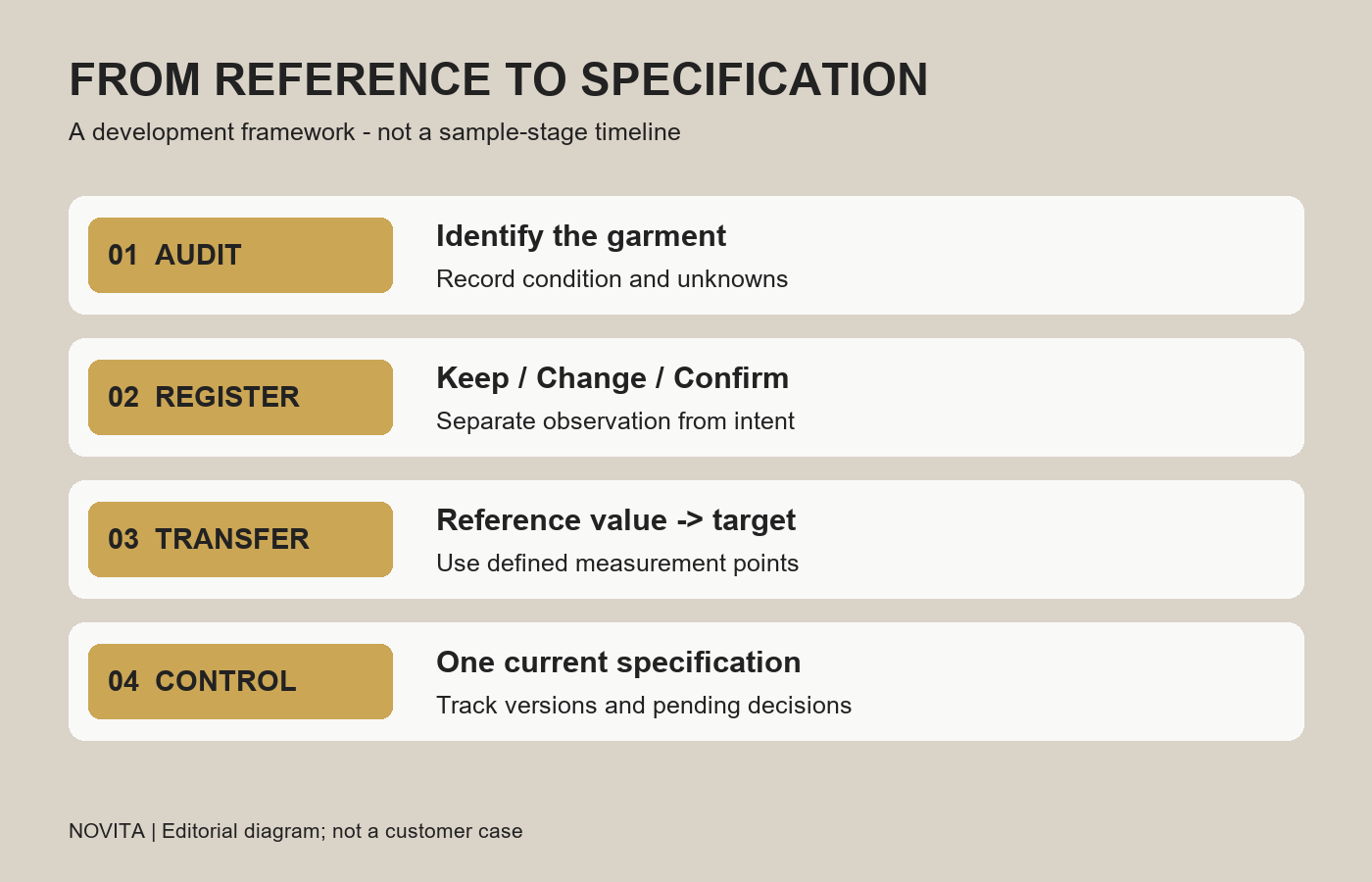
1. Audit the reference before treating it as a standard
Give the reference a unique identifier, such as REF-P01. Record its labeled size, whether it has been worn or washed, and the date you measured it. Photograph the front, back and important details using that identifier.
Separate what you can observe from what you still need to establish.
| What the reference can show | What it does not establish by itself |
|---|---|
| Current measurements and silhouette | Intended original measurements or the size progression |
| Visible seams, collar and placket | Every internal construction detail |
| Current softness, drape and appearance | Exact fiber, yarn, finish or manufacturing history |
| Present color | An approved color standard for a new production lot |
A well-worn garment may have softened, stretched or shrunk. Do not quietly turn those changes into bulk requirements. Specify whether you want its current appearance or a newly developed interpretation of the original product.
The same GSM can also produce different fabric behavior. Structure and finishing influence firmness, drape and recovery. If the reference’s material is unknown, mark it as unknown rather than assigning an exact composition or weight from appearance alone.
Use reference garments as development references, not as permission to reproduce another brand’s protected artwork, trademarks or design features.
2. Create a Keep / Change / Confirm register
The reference is evidence; the register tells the manufacturer what to do with it.
- Keep: features to preserve, with a defined comparison method.
- Change: departures from the reference, stated explicitly.
- Confirm: unresolved details requiring a proposal, swatch or inspection.
Here is an illustrative polo brief, not a universal specification or a NOVITA customer case.
| Feature | Status | Instruction and check |
|---|---|---|
| Body length | Keep | Transfer the reference’s base-size length using the agreed high-shoulder-point method |
| Sleeve | Change | Add 1 cm to the measured reference sleeve; use the same starting point |
| Body fit | Confirm | Propose a more relaxed body without assuming the shoulder, length and neck must all increase |
| Main fabric | Confirm | Propose a heavier option with similar drape; approve against an identified swatch and garment |
| Collar shape | Keep | Compare the outline and proportions with the photographed reference |
| Collar recovery | Confirm | Assess behavior under the agreed care conditions; do not approve from a photograph |
| Branding | Change | Use the brand’s original artwork with specified dimensions and placement |
A request for “more relaxed” remains unresolved until the relevant dimensions are agreed. That is preferable to giving the manufacturer a vague phrase and later treating its interpretation as an error.
For fabric selection, the T-shirt fabric weight guide explains why weight is only one part of the brief. Here, the task is to record which material characteristics you want to retain or change.
3. Transfer measurements without losing their meaning
Keep the observed reference value separate from the target production value. Otherwise, it becomes difficult to tell whether a number describes the original garment or an approved modification.
An illustrative transfer record could look like this:
| Point of measurement | Reference observation | Change | Target |
|---|---|---|---|
| Sleeve length | 22 cm | +1 cm | 23 cm |
| Body length | 70 cm | No change | 70 cm |
| Laid-flat half-chest | 56 cm | Pending fit decision | Not yet approved |
These figures are examples, not fit recommendations. The last row deliberately has no target: an unresolved measurement should not become a production instruction merely because a spreadsheet expects a number.
Each row also needs a measurement definition. “Chest” must distinguish a laid-flat half-chest from circumference. “Length” must identify its start and end points. Specify units, garment position, base size, agreed tolerance and whether the value applies before or after a defined wash.
A diagram or annotated photograph is useful when words leave room for interpretation. Use the same measuring method for the reference and proposed garment. Do not treat a base-size transfer as an approved size chart; size progression needs its own review.
4. Transfer construction details selectively
You do not need to prescribe every machine setting. You do need to record details that could change the product if the factory interprets them differently.
For a polo, inspect the placket, collar attachment, cuff finish and button spacing. Use detail photographs and notes to identify which are essential. If an internal detail is not visible, label it for inspection or confirmation rather than guessing.
Ask a proposed alternative to state its effect on appearance, strength, bulk or care behavior. “Easier to produce” alone is not enough to approve a substitution.
Keep general process questions separate. The OEM and ODM comparison helps distinguish development responsibilities; this register records what is required for this particular garment.
5. Make the specification version-controlled
A reference, measurement sheet and comment thread can disagree even when each appears complete. Give the specification a version and make every approved change traceable.
A useful record is:
Version 03 — based on REF-P01: body length transferred unchanged; sleeve target changed from 22 cm to 23 cm; fabric swatch FAB-02 approved; body-fit target and collar recovery remain pending. Earlier versions are superseded.
This is more useful than “V03 approved.” It states what has changed and what remains unresolved.
Identify the reference garment, fabric swatch, measurement sheet and eventual approved sample together. When a later comment changes a requirement, update the relevant record instead of leaving the decision only in a chat. Keep one current specification and retain earlier versions as history, not competing instructions.
The sample development guide covers the subsequent sampling stages. The reference-transfer record should travel into those stages and be updated when decisions are approved.
For a trouser development brief, compare the pocket map and leg shape in our baggy cargo pants reference with the waist and leg proportions in our straight chino reference. Record which visible details to keep, which to change and which still need confirmation.
Leg silhouette also needs its own reference measurements. Compare tapered casual pants with wide-leg casual trousers to identify the intended thigh, knee and hem proportions. Convert those visual differences into points of measure and sample comments rather than relying on the fit label alone.
A final check before requesting a quotation
Can another person distinguish the reference’s observed condition from the target product? Are the preserved details identifiable? Are proposed changes measurable? Are unresolved requirements visibly marked?
For a NOVITA men’s casualwear project, send the reference identifier, photographs and Keep / Change / Confirm register when discussing your development requirements. Our tech pack checklist helps organize those details before quotation, and the manufacturing RFQ guide helps you request comparable pricing. Feasibility, quantities and missing technical details should be confirmed for the actual garment.
A reference shows the starting point. A production specification records the destination—and the decisions needed to get there.