Polo shirt embroidery is usually settled by four decisions: which decoration method to use, which fabric the logo will sit on, where on the garment it goes, and how the order will be sampled and scaled. Get those four right and production becomes predictable. Get them wrong and the same logo can look crisp on one polo and heavy or distorted on another.
For apparel brands, wholesalers and sourcing teams running private label polo programs, the practical starting point is to treat custom polo embroidery as a construction decision rather than a cosmetic one. Thread, backing, stitch direction and fabric structure interact, and the result can only be judged on a finished garment — not on a screen proof.
This guide covers how polo shirt embroidery works, how a logo embroidered on a polo compares with the printed alternative, how the embroidery work changes when the fabric base changes, what has to be fixed before bulk, and how digitizing, sampling and private label programs are handled.
What Is Polo Shirt Embroidery?
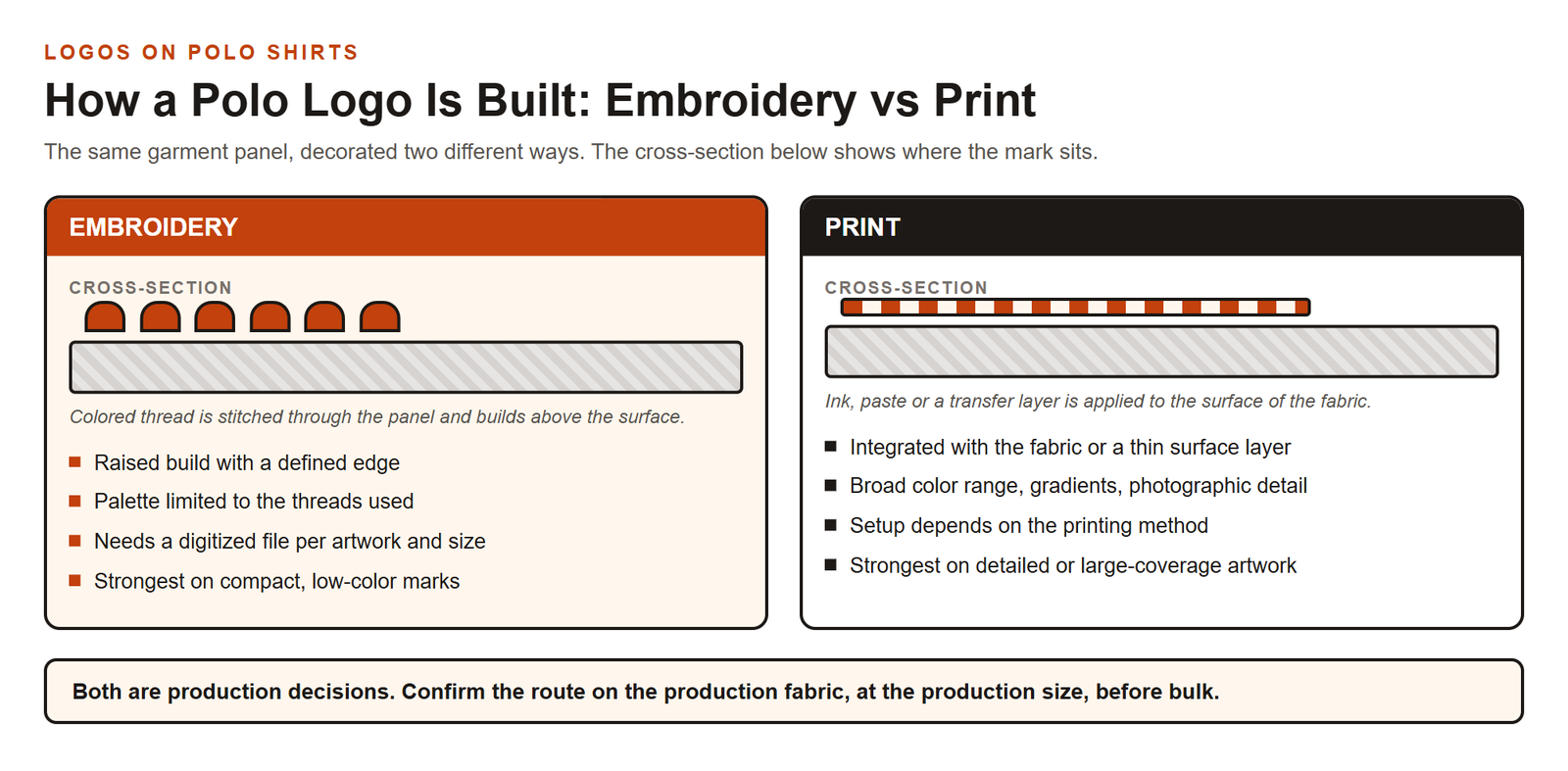
Polo shirt embroidery is a decoration method in which colored thread is stitched directly into the garment panel to build the logo or artwork, whereas printing applies ink, paste or a transfer layer to the surface of the fabric.
That single difference — thread anchored into the fabric versus color applied onto it — drives nearly every downstream consequence: hand feel, how fine the detail can go, how color behaves, which fabrics accept the decoration comfortably, and what has to be confirmed before bulk.
Because embroidery is stitched rather than deposited, the decoration has a physical build. A well-executed chest crest sits slightly proud of the panel, with a defined edge and a tactile surface. The surrounding fabric is not saturated or coated, which is why embroidery is often chosen for marks that should read as permanent and structural rather than applied.
The method is also file-driven. Before anything is stitched, the artwork is converted into a machine file through a process called digitizing. Digitizing determines stitch type, stitch direction, underlay, density and the sequence the machine runs — and it is the step where most quality differences between two suppliers of the same logo are actually created. A logo that was digitized carelessly will not be rescued by good thread.
Polo shirts are a natural fit for embroidery because a compact mark reads clearly on a small area such as a left chest. The mark is usually a crest, a wordmark, a monogram or a corporate identity rather than a full-color illustration.
For the range of finishing and decoration services that sit around embroidery — including patches and garment decoration for OEM and private label production — see our custom apparel finishing services.
Embroidered vs Printed Polo Shirt Logos: The Decision Framework
A buyer comparing polo shirts with logo embroidered against the printed alternative is not choosing between a good method and a bad one. The question is which decoration fits this logo, this fabric and this order. Both routes are established production methods, and the same method run by two different suppliers can still land at very different quality, decided by digitizing, process control and finishing discipline.
Quality, Hand Feel and What Decides Them
Embroidery builds the mark from thread, and the behavior of that mark is decided by three variables a buyer can write into the specification. Thread type sets the surface: a rayon or viscose thread gives a bright sheen, a polyester thread holds color and abrasion better across repeated industrial washing, and a cotton or chenille thread reads matte and heavier. Stitch density and coverage decide how solid the mark looks and how much thread is packed into the panel — a dense fill on a light or stretchy knit pulls the fabric around the stitches, which shows up as puckering rather than as a clean edge. Backing, or stabilizer, is the third variable: a cut-away, tear-away or wash-away backing is selected against the fabric weight and the placement, and it is what keeps the panel from distorting while the machine runs.
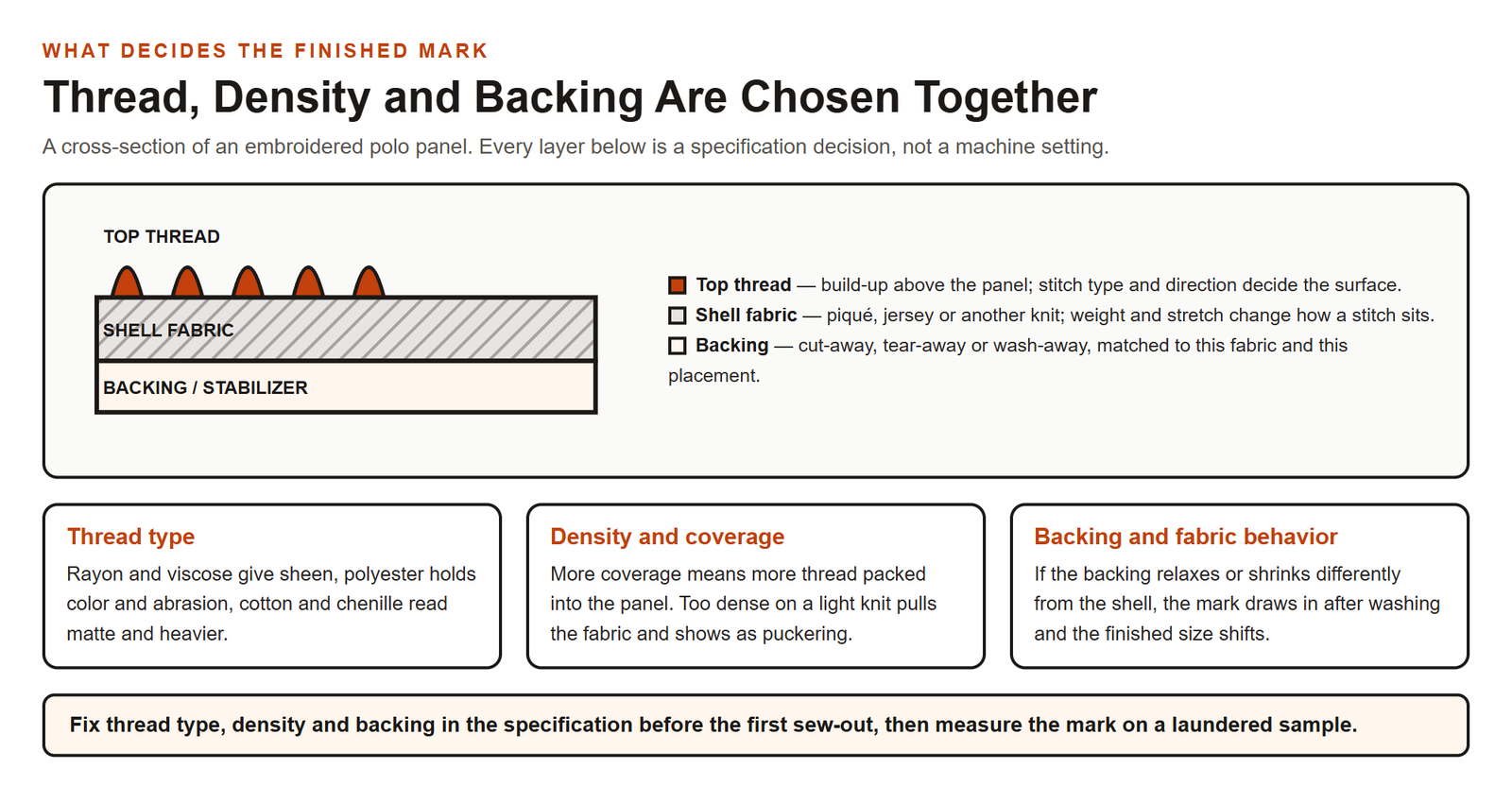
Backing has a second-order effect that buyers usually notice only after the first bulk wash. If the backing relaxes or shrinks differently from the shell fabric, the mark draws in, and a crest that measured correctly on the flat sample no longer measures the same after laundering. Thread, density and backing are interacting choices made against one specific fabric, which is why an embroidered mark has to be judged on a laundered production garment rather than on a digital proof.
Abrasion is the other long-term variable. Stitched thread does not crack the way a cured surface layer can, but a mark stitched at high density on a coarse knit will fuzz and dull at the stitch crowns as it rubs, and a mark stitched too sparsely will show the panel through the fill. Both are density and coverage decisions taken at the digitizing stage, so the number that matters is the one written into the file, not the one discussed after the sample arrives.
The practical consequence for the specification is short. Before the first sew-out, fix the thread type and its color reference, the target stitch count or coverage for this artwork, the backing class chosen for this fabric and this placement, and the wash instruction the garment will carry. With those four written down, one approved garment becomes a reproducible reference instead of a lucky sample.
Detail, Color and Fabric Compatibility
The two methods diverge most clearly on detail. Embroidery is built from stitches, so very small lettering and hairline strokes can close up and become illegible. Minimum letter height and minimum stroke width have to be verified on the production thread and the production fabric at the actual production size, because a mark that is readable on a screen at display size does not automatically survive being stitched at the size it will ship at. Printing reproduces fine linework and small text more easily, because it does not depend on thread geometry.
They also diverge on color. Embroidery is matched from a color reference against a thread range, so the palette is limited to the threads actually used in the design. That is a strength for a two- or three-color corporate mark and a limitation for artwork with many tones. Printing covers a broader color range and handles smooth blends, including photographic gradients, which embroidery is not a natural fit for.
Artwork type follows from the same logic:
- Compact, high-contrast marks — crests, wordmarks, monograms, corporate identities — suit embroidery well.
- Multi-color artwork, large coverage, gradients and photographic imagery generally suit printing better.
- A single polo program can legitimately use both: an embroidered crest on the chest and a printed element elsewhere on the same garment.
Fabric compatibility depends heavily on the specific printing method and the fiber content, which is why feasibility for a printing route should be verified on the actual production fabric rather than assumed from a generic chart. Embroidery runs across woven and knitted polo fabrics, but the surface texture of the panel and its stretch change how a stitch sits and how stable the mark stays.
When Printing Is the Better Route
Embroidery is often the stronger choice when the logo is compact, the color count is low, the mark needs to read as permanent and structural, or the same file has to run repeatedly across colorways and repeat orders.
Printing is often the stronger choice when the artwork needs broad color, gradients or photographic detail; when coverage is large; or when the artwork is likely to change between runs, since digital routes avoid the setup that screen-based routes require.
The decision is rarely binary across a whole collection. A program that spans several fabric bases or several kinds of artwork will often need both, and that is a normal outcome rather than a compromise.
NOVITA handles printing in-house as well as embroidery, and the printing route for a specific artwork is chosen on the artwork itself, the fabric, the order requirements and what is feasible in production. For the process-level differences between two common digital printing routes, see our guide to DTG vs DTF printing — but the choice between embroidery and printing is a separate decision from the choice between two printing methods.
Side-by-Side Comparison
The table below is deliberately qualitative. It describes how each route behaves, not measured performance figures, because the numbers that matter belong to a specific fabric, artwork and supplier rather than to the method name.
| Factor | Embroidery | Printing |
|---|---|---|
| How the decoration is formed | Colored thread is stitched into the panel and builds the design stitch by stitch | Ink, paste or a transfer layer is applied to the surface of the fabric |
| Hand feel | A raised, textured build with a defined edge; the surrounding panel stays soft | Either integrated with the fabric or a thin surface layer, depending on the method |
| Durability behavior | Thread is anchored into the panel, so thread type, stitch density and backing choice decide how the mark holds its shape; dense fills on light knits are the usual cause of puckering | Depends on the method, the ink or film chemistry, curing or pressing control, and the laundering instruction |
| Fine detail and small text | Very small lettering and hairline strokes can close up; minimum letter height matters | Fine linework and small text are generally easier to reproduce |
| Color range | Matched from a thread reference, so the palette is limited to the threads used | Broader color range, including smooth blends and photographic gradients |
| Gradients and photographic artwork | Not a natural fit — the method builds solid shapes rather than tonal transitions | The natural fit for gradients, high color counts and photographic imagery |
| Fabric compatibility | Works across woven and knitted polo fabrics; surface texture and stretch change the result | Depends heavily on the specific method and the fiber content; verify on the production fabric |
| Best suited to | Crests, wordmarks, monograms and corporate marks that should read as permanent and tactile | Multi-color artwork, large coverage, gradients and artwork that changes between runs |
| Artwork setup | Requires digitizing; the file is specific to the design and the size | Setup varies by method — digital routes avoid screens, screen-based routes need them |
| Order flexibility | Once digitized, the same file can be repeated across orders and colorways | Varies by method; digital routes handle artwork changes between runs more easily |
| Main consideration | Digitizing quality and placement discipline decide the final result | Method selection and process control decide the final result |
Changing the Fabric Base: What Embroidery Work Has to Be Redone
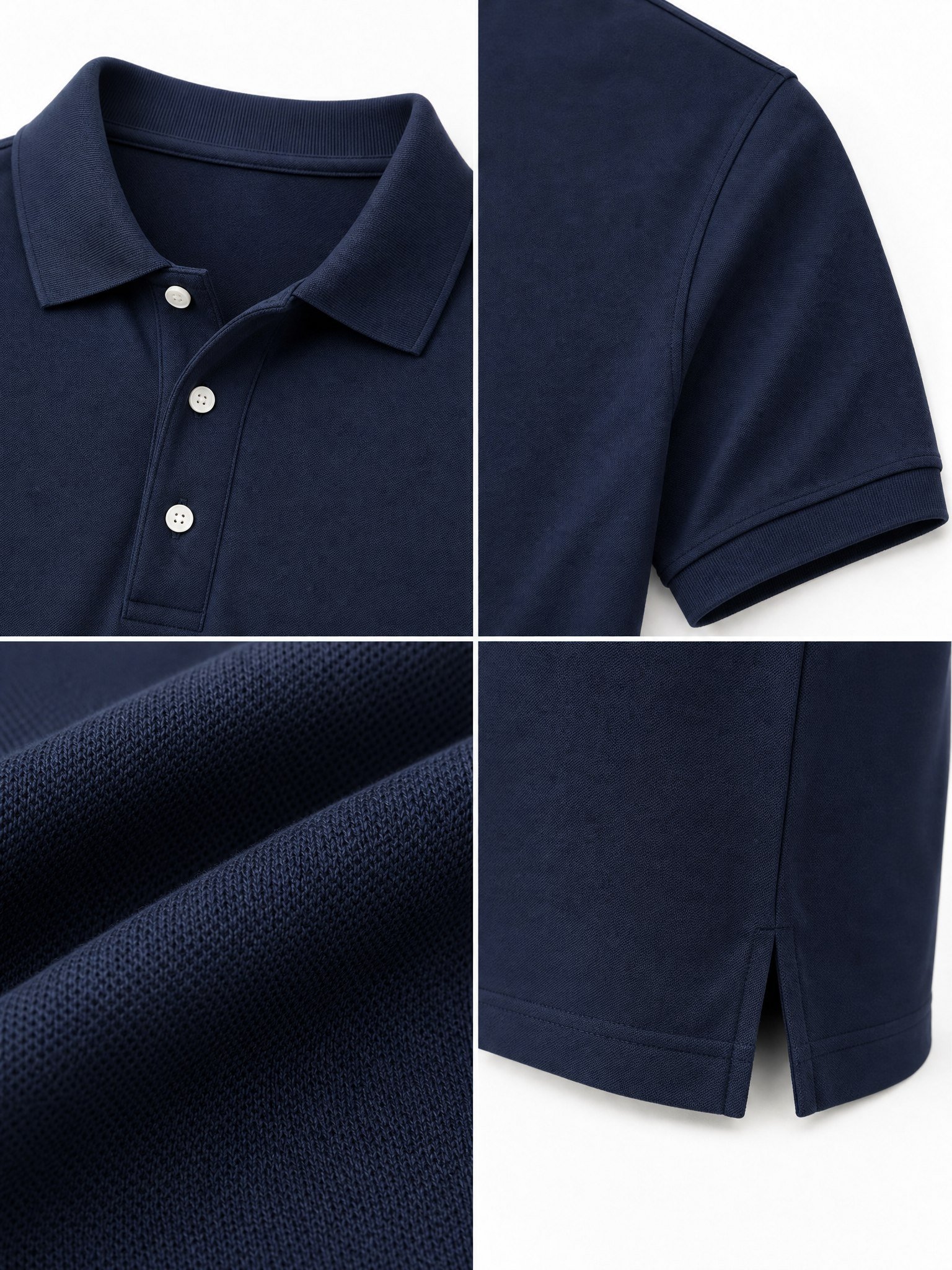
Embroidery is compatible with the knitted fabrics normally used for polo shirts, but the embroidery work is not transferable between them. Moving a logo from one fabric base to another is a re-development step rather than a settings tweak, and it helps to know in advance which parts of the work are repeated.
The piqué-versus-jersey fabric comparison itself is not the subject here; it is covered in full in our guide to how piqué and jersey compare as polo fabrics. What follows is the embroidery-side consequence of changing the base.
- Density and underlay are fabric-specific. A density and underlay combination that produces a clean fill on a firm piqué knit will pull a softer, lighter jersey out of shape. Both are re-set for the new base rather than copied across.
- Backing is re-selected, not reused. A stabilizer weight matched to one fabric weight becomes too light or too heavy on another, and the wrong backing shows up as a drawn-in mark, a stiff panel or a hoop mark that does not recover.
- The digitized file may have to be re-made. Where the mark size, the placement or the fabric stretch changes materially, the file is re-digitized rather than rescaled: rescaling an existing stitch file changes density per unit area, and it is one of the most common reasons a mark that looked right on the first base looks wrong on the second.
- A new sew-out is approved. A sample stitched on the previous base says nothing about the new one. The approval that matters is a stitched sample on the production fabric, measured after laundering.
The working rule for buyers: settle the fabric first, then confirm the embroidery on that fabric. A logo that looks excellent on one fabric base may need re-digitizing for another, and re-digitizing is a sampling-stage activity, not a bulk-stage one.
Logo Placement and Design Considerations
Placement is where an embroidery program is most often under-specified. The position that looks correct on a flat lay may sit differently once the garment is worn, because the chest panel and the sleeve move independently of the body.
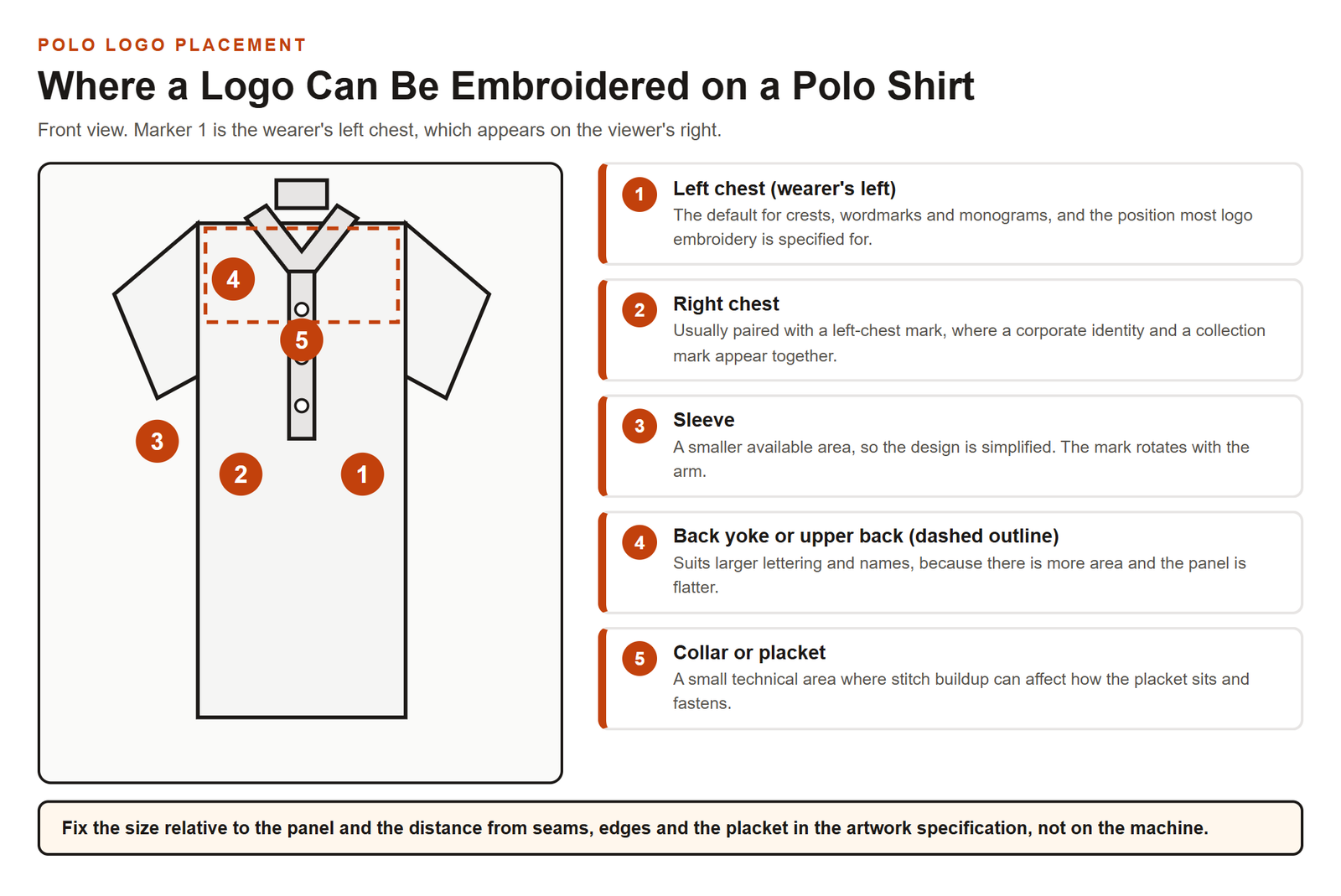
Common Placement Positions
- Left chest. The default for corporate identity, crests and small wordmarks. This is the position most logo embroidery is specified for, and the one where the digitized file is most often reused across a whole program.
- Right chest. Usually paired with a left-chest mark; common where a corporate identity and a product or collection mark appear together.
- Sleeve. A smaller available area, so the design has to be simplified, and the mark rotates with the arm.
- Back yoke or upper back. Suits larger lettering and names, because there is more area and the panel is flatter.
- Collar or placket. A small technical area where stitch buildup can affect how the placket sits and fastens.
Across all positions, the two variables that cause the most downstream rework are the size of the mark relative to the panel and the distance from a seam or edge. Both should be fixed in the artwork specification, not resolved on the machine.
Digitizing and Stitch Considerations
Digitizing is the step that converts artwork into a production file, and its settings decide how the finished mark behaves. The aspects a buyer should expect to be discussed during development are:
- Stitch type and direction, which determine how the surface catches light and how the mark reads from different angles.
- Underlay, which stabilizes the fabric beneath the stitches and influences how clean the edges are.
- Density, which affects both coverage and how much the panel is pulled by the stitching.
- Backing, which is selected against the fabric and the placement, and which affects how the mark sits against the skin.
- Minimum letter height and stroke width, which decide whether small text survives.
- Color matching, which maps the artwork to available threads and confirms what is achievable in the palette.
A logo that originates as a screen graphic is rarely production-ready for embroidery without adaptation. Reducing color count, thickening thin strokes and increasing small type are normal preparatory steps, and they are best done before digitizing rather than after the first sample.
For a live example of embroidery decisions expressed on a finished product — a piqué polo built around an embroidered chest crest with OEM and private label options — see the custom piqué polo shirt with an embroidered chest logo.
Digitizing Cost, Thread Colors and Repeat Orders
Digitizing is the one part of a polo embroidery order that is bought once. The file describes one artwork, at one size, for one placement, on one fabric, and every garment in the order is stitched from it. That single fact is what drives the cost structure of the whole program.
Stitch count is the workload unit, not the piece count. A compact left-chest crest and a large back panel can be the same quantity on the same purchase order and still be different production problems, because machine time scales with stitch count. When two quotes for the same logo look inconsistent, stitch count is usually the reason.
Every thread color is a machine position. Thread colors are matched to a color reference, and a Pantone reference is what lets a repeat order match the first one after a thread lot changes. More colors means more thread changes per garment, and a gradient or a photographic mark is not a realistic embroidery target at all.
Revisions are file work, and file work has a schedule. Reducing color count, thickening thin strokes and enlarging small type are normal preparatory steps before digitizing, and they are much cheaper at that point. A revision requested after the first sew-out reopens the file; a revision requested after bulk has started means a new file and a new approval cycle.
Agree who owns the digitized file. A buyer planning repeat orders should know whether the file is held by them, by the supplier or by the digitizer, how a revision is versioned, and what happens to the file if production moves. This is a one-line question in the specification meeting and a much more expensive question afterwards.
Know what the same file can be reused for. Once created, the file repeats across garment colorways, across additional sizes where the mark size is unchanged, and across repeat orders. It does not transfer to a different fabric base, a different mark size or a different placement without the re-development work described above.
What to Fix Before Bulk Embroidery Production
Most embroidery problems that surface in bulk were already decidable during sampling. The list below is organized by the failure modes that actually reach production, which is why it reads differently from a general decoration checklist.
Logo file and digitizing
- Has the artwork been digitized for this logo, at the production size, for this placement and for this fabric — rather than rescaled from a print file?
- Who holds the digitized file, and how are revisions versioned?
- Have minimum letter height and minimum stroke width been confirmed as stitchable at the production size?
Thread color
- Has each thread color been matched to a color reference and approved on the production fabric under production lighting?
- Has the color count been reduced to what the thread range can carry at this size?
Backing and fabric behavior
- Has a backing class been selected for this fabric weight, this stretch and this placement?
- Has the mark been measured on a laundered sample to check for puckering, draw-in and any change in finished size?
Placement and trims
- Are placement positions expressed numerically, including distance from seams, edges and the placket?
- Have zips, pocket mouths, plackets, side vents and any other trim been checked against the stitch field, so the needle path and the trim do not interfere?
- Are positions confirmed across the full size range, not only on the base size?
Sew-out and approval
- Has a stitched sew-out been produced on the production fabric and approved in writing for size, position, color and finish?
- Is the sew-out the reference the bulk order is matched against, and who signs it off?
Production control
- What in-production checks apply to stitch quality, thread fuzz and position consistency?
- Are thread lots controlled, so a repeat order still matches the approved sew-out?
If any of these is left open, the most likely outcome is not a failed order but an approval cycle that repeats — which costs more time than it saves.
How NOVITA Handles Polo Embroidery
Polo shirt embroidery at NOVITA is handled in-house. Embroidery, printing and washing all run at our own Foshan garment factory, applied to the same piqué knits, knitted polos and performance polos that ship as bulk — so decoration is developed on the production fabric and construction from the start, never added afterwards by an outside step.
On polo programs, the work is structured around the decisions above rather than around a fixed catalog: the fabric and the decoration are confirmed together, the artwork is adapted and digitized for the intended placement and size, and the decoration is proven on a physical sample before bulk. Printing is supported in-house as a decoration route alongside embroidery; printing methods can be selected according to artwork, fabric, order requirements and production feasibility, and the specific method is confirmed during sampling.
What separates a high-quality embroidered polo shirt from an average one is settled before bulk: the thread colors matched to the reference, the backing chosen for the fabric, the position tolerances held across the size range, and the sew-out that bulk is measured against.
The commercial framework for a polo order is the same as for the rest of the range:
| Item | Terms |
|---|---|
| MOQ | 100 pieces per color |
| Mixed sizes | Allowed |
| Sampling | 7–15 days |
| Bulk production | Generally around 60 days after sample approval, depending on quantity, fabric availability and customization |
Final inspection is carried out with AQL 2.5 when required. Because embroidery is judged on the finished garment rather than on a file, the approval that matters is the one taken on the physical sample.
The broader polo range — including piqué and jersey bases, performance and corporate lines, and private label polo blanks — is set out under custom polo shirt production.
Polo Embroidery Buyer Checklist
A short working list for the specification meeting:
- Confirm the method — embroidery, printing, or both, decided against the artwork rather than by habit.
- Confirm the fabric — and treat the fabric decision as settled before the decoration is finalized.
- Confirm the size — the production size of the mark, per placement and per size grade.
- Confirm the position — numerically, with distances from seams and edges, not by eye.
- Confirm the color — mapped to the thread palette, with the artwork reduced to what is achievable.
- Confirm the small type — checked against minimum letter height and stroke width.
- Confirm the backing and finishing — selected for the fabric and the placement.
- Confirm the sample — produced on the production fabric and approved in writing.
- Confirm the laundering instruction — fixed before bulk, with a verification test agreed.
- Confirm the commercial terms — MOQ per color, mixed sizes, sampling and bulk timelines.
- Confirm ownership of the digitized file — and how revisions will be versioned.
Embroidery is one stage of a longer sequence. Our polo production guide walks through the whole process, from the first specification to final inspection.
Frequently Asked Questions
How do I choose between embroidery and printing for a polo shirt?
Start from the logo and the fabric, not from the method. A compact, low-color mark that should read as permanent and tactile usually suits embroidery; broad color, gradients or photographic detail usually suit printing. Many polo programs use both on the same garment. Confirm the choice with a sample on the production fabric.
Can embroidery be used for bulk orders?
Yes. Embroidery does not depend on screens or physical tooling, so its setup cost sits in the digitized file, which is then reused across repeat orders and colorways. In bulk, the practical constraints are position consistency across sizes, fabric availability and finishing capacity. Minimum order quantity for a polo program is 100 pieces per color.
What should be confirmed during embroidery sampling?
Lock the items that cause rework: the digitized file at production size, the placement expressed numerically, each thread color against its reference, the backing selected for this placement, minimum letter height for small type, and the wash instruction. The approval that matters is the one taken on the stitched sew-out, measured after laundering.
Can embroidery be combined with private label?
Yes. Embroidery is a decoration step and sits alongside private label, OEM and ODM production rather than competing with it. A program can combine an embroidered mark with private label labelling, custom trims and packaging. The detail worth fixing early is how the embroidered mark and the brand label relate to each other.
How are thread colors matched to a brand’s logo colors?
Thread colors are matched from a color reference — normally a Pantone reference or a physical thread card — against the thread range actually available. Confirm the match on the production fabric under production lighting, not on screen. A Pantone reference is also what keeps a repeat order consistent when the thread lot changes.
Who owns the digitized file, and is digitizing charged again on repeat orders?
Digitizing is normally charged once per artwork, size and placement, because the file is created once and reused. Ownership should be agreed in writing: ask whether the file is held by you, the supplier or an outside digitizer, and how revisions are versioned. Re-digitizing is needed only when the size, placement or fabric base changes.
Does embroidery change the care label or the shrinkage of a polo shirt?
Embroidery itself does not change how the garment should be washed, but the backing and the stitch field interact with the shell fabric, and a mark can draw in if the backing relaxes differently. Measure the mark on a laundered sample, and fix the care instruction before bulk so the wash test and the label agree.
Final thoughts. The question worth answering is not whether embroidery or printing is better in general, but which route fits this logo, this fabric and this order. Settle the fabric, adapt the artwork for the decoration, prove it on a physical sample, and agree the tolerances in writing. After that, bulk runs are far more predictable.
At NOVITA we produce embroidered, printed and private label men’s apparel in China for brands, wholesalers and sourcing teams. If you are planning a polo program, contact us to go through the artwork, the fabric and the sampling schedule for your range.