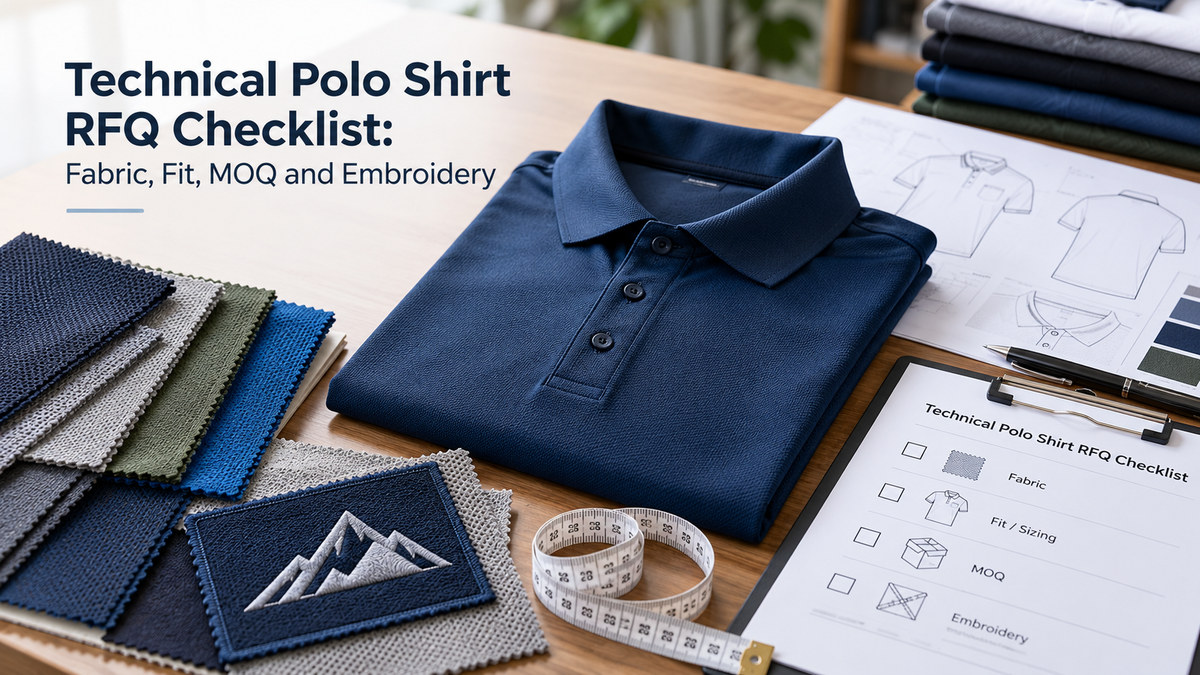
Quick answer: A useful technical polo RFQ should identify the intended fabric performance, separate fit blocks where required, collar and placket construction, embroidery artwork, size grading, MOQ assumptions, approved colour reference, labelling, sample stages and delivery terms. A supplier’s quotation is only comparable when those assumptions are explicit.
This guide is informed by a real international sourcing enquiry received by NOVITA. The buyer’s identity, brand artwork and commercial terms are omitted, and the examples below focus on broadly useful procurement decisions. It is a buyer’s specification checklist, not a claim that the project has entered bulk production.
1. Start with the wear requirement, not the polo photograph
The request concerned a uniform-style technical polo for repeated everyday use. The buyer needed a comfortable fabric, a defined colour, embroidered branding and an assortment of sizes. A catalogue picture alone cannot settle those details.
For the first quotation, state the intended environment and performance: indoor uniform, outdoor staff clothing, warm-weather event wear or sports use. Define whether moisture management, stretch, opacity and frequent laundering are requirements or merely preferences. Words such as “premium,” “breathable” and “performance” are too open-ended to be acceptance criteria.
A prospective supplier may propose cotton/polyester piqué, polyester piqué or a blend with elastane. These are alternatives to compare, not automatically equivalent fabrics. If the buyer specified polyester performance fabric and receives a cotton-blend quotation, the supplier should identify the deviation plainly before the buyer compares prices. For knit structures and hand feel, start with NOVITA’s polo fabric guide and piqué versus jersey comparison.
2. Ask for a fabric sheet you can actually approve
At minimum, request fibre composition, target finished weight in GSM, knit structure, treatment or finish where relevant, fabric width if it affects quotation, colour process, and a physical swatch or sample. A nominal GSM figure is a target, not proof of how the finished polo will behave.
Ask what supporting test results can be supplied for the final selected fabric. Do not assume a material has verified moisture-wicking, dimensional-stability or colourfastness performance because a product description uses those words. Define the test method and acceptance criteria with the supplier before production if those properties matter to the brand. For moisture-management claims, AATCC lists methods for liquid moisture management, wicking and textile drying; agree which method and acceptance threshold apply before testing (AATCC textile test methods).
3. Treat men’s and women’s patterns as separate fit decisions
A recurring sourcing mistake is to treat one size chart as sufficient for several fit blocks. A buyer who needs both men’s and women’s polos should request separate measurement sheets, grading and tolerances for each block. Confirm whether the supplier can develop both; NOVITA’s core catalogue concentrates on men’s casualwear, so any additional fit range requires a project-specific feasibility check.
Set measurement points for chest, body length, shoulder, sleeve, collar and hem as appropriate to the garment. For body-measurement terminology used in clothing development, see ISO 8559-1:2017; use it alongside the buyer’s approved garment measurements and tolerances. Keep the size reference clear: two items labelled M are not necessarily the same dimensions. For an unfamiliar fit, approve a development sample for each required pattern block and agree whether a size set is needed before cutting bulk fabric.
Use the tech pack preparation checklist to define those measurements, tolerances and approved versions.
4. Embroidery needs more information than a logo file
The enquiry included small lettering and more than one embroidery placement. Those details can change the stitch plan and sample result. Ask the supplier to confirm artwork size, placement measured from stable garment points, thread colour reference, small-letter legibility, backing, edge quality and any digitizing charges.
Do not approve embroidery solely from a digital mock-up. Review it on the intended fabric with the correct collar, seam and placket construction. If a fine logo becomes hard to read, revise dimensions or stitch choices before signing off.
For practical differences in decoration methods, see our embroidery versus printing guide and embroidered polo production checklist.
5. Write MOQ by style, colour, pattern block and decoration
For many custom NOVITA menswear programmes, the starting point is 100 pieces per style per colour, with sizes mixed within an agreed batch. That does not mean every combination of men’s and women’s patterns, dyed fabrics or different embroideries automatically shares the same minimum.
A good RFQ lists quantities by separate fit block, colourway, logo version and size. Ask whether an embroidered name or minor artwork variation changes setup charges or minimums even if it uses the same base garment. Also confirm whether a stock-colour material and a newly dyed colour carry different material minimums.
For a worked explanation of style, colour and material limits, read our clothing MOQ guide.
6. Approve physical colour, samples and version history
A screen colour value or reference photograph is useful for discussion, but it is not a factory-approved colour standard. The final shade should be compared against a physical approved reference under agreed viewing conditions. Photograph that reference for the record, but retain the actual swatch if it is the basis for production.
Record sample changes in one dated list: fabric, fit, collar recovery, placket alignment, stitching, logo position, label text and packing. Identify who is authorized to approve a revised sample. Development sampling, size-set review and pre-production approval may be distinct stages and should not be compressed into a single casual “looks good.” Our sampling and approval guide explains how to keep versions under control.
7. Request a quotation that exposes the assumptions
| Quotation line | What the supplier should state | Common comparison error |
|---|---|---|
| Garment | Fabric composition and GSM, fit block, size range and colour reference | Comparing different blends as if they were the same |
| Decoration | Number of embroidered positions, digitizing and artwork approvals | Assuming all logo costs are included |
| Labels and packing | Care, composition, origin labels, hangtags and individual packing | Leaving compliance or carton work undefined |
| Quantity | Price by style, colour, pattern block and quantity tier | Combining variants with different minimums |
| Sampling | Pattern charge, sample charge, revisions, credits and sample freight | Confusing a deposit or credit with a free sample |
| Delivery | Production basis, Incoterm, freight, duties and exclusions | Comparing EXW or FOB with a delivered quotation |
Ask each factory to price the same specification. If an alternative fabric or construction is offered, keep the alternative as a separate quote, not a silent substitution. A clear apparel RFQ checklist makes that comparison much easier.
8. What should be confirmed before bulk production?
- The intended material and physical shade reference are identified, and performance requirements are supported by agreed evidence.
- Every fit block has its own approved size specifications and tolerances.
- Embroidery artwork and physical positions are approved on an actual garment sample.
- MOQ and prices are broken down by style, colour, quantity tier and relevant decoration variation.
- Label, care, country-of-origin and packing responsibilities are assigned to the appropriate parties and checked for the destination market.
- A final approved sample, revision record, production schedule and inspection plan are confirmed in writing.
The polo collar and placket inspection checklist is useful at this stage, especially for recovery, alignment and workmanship checks.
Common questions buyers ask
Can several sizes be mixed in one custom polo order?
Often yes, within an agreed style and colour MOQ. Separate fit blocks, fabric dye lots and artwork variations can have different limitations. Send the supplier the quantity breakdown before requesting a final price.
Is a moisture-wicking claim enough to approve a fabric?
No. Agree which performance matters and ask what suitable material test evidence or production sample checks are available. A fibre label or fabric nickname is not itself a test report.
Should a small embroidered logo be approved from a mock-up?
Use the mock-up to agree placement, then approve a physical stitch sample on the intended garment fabric. Fine text and densely stitched details need special attention.
When should a price be treated as firm?
After the scope, fabric, pattern blocks, decoration, quantity mix, packaging, sampling charges and delivery terms are stated. Subsequent specification changes may require a revised quote.
Where NOVITA fits
NOVITA focuses on men’s casualwear OEM, ODM and private-label manufacturing. Review our polo shirt collection and OEM/ODM process to see how product development and approvals are handled. Share your RFQ through our contact page; any fabric performance, additional fit block, test evidence or MOQ exception must be confirmed for the particular order before quotation.
Bottom line: the best technical polo quote is not necessarily the cheapest one. It is the one where the buyer can see exactly what fabric, fit, branding, test evidence and delivery commitments are being priced.