A supplier sends a report marked “passed.” Before approving cutting, ask what passed: an individual roll, the inspected portion of a shipment, or an average across inspected rolls? Then ask which acceptance rule the inspector used.
Fabric inspection becomes useful when its findings control material release. A score alone does not authorize cutting, settle a mill claim, or prove that the finished garments will pass inspection. The buyer needs a connection between the report, the physical rolls, and the cutting instructions.
What the four point system scores
The method assigns penalty points to visible fabric defects and expresses the total against inspected area. It describes the observed material, not the percentage of defective garments you will receive. V-Trust explains this distinction: the score comes from visual defects, while acceptance depends on previously agreed criteria.
At the factory gate, start with identity. Ask receiving staff to match roll labels to the purchase order, fabric article, color, dye lot, and delivery record. Keep that identity on the inspection report. Otherwise, a correct result can be attached to the wrong material.
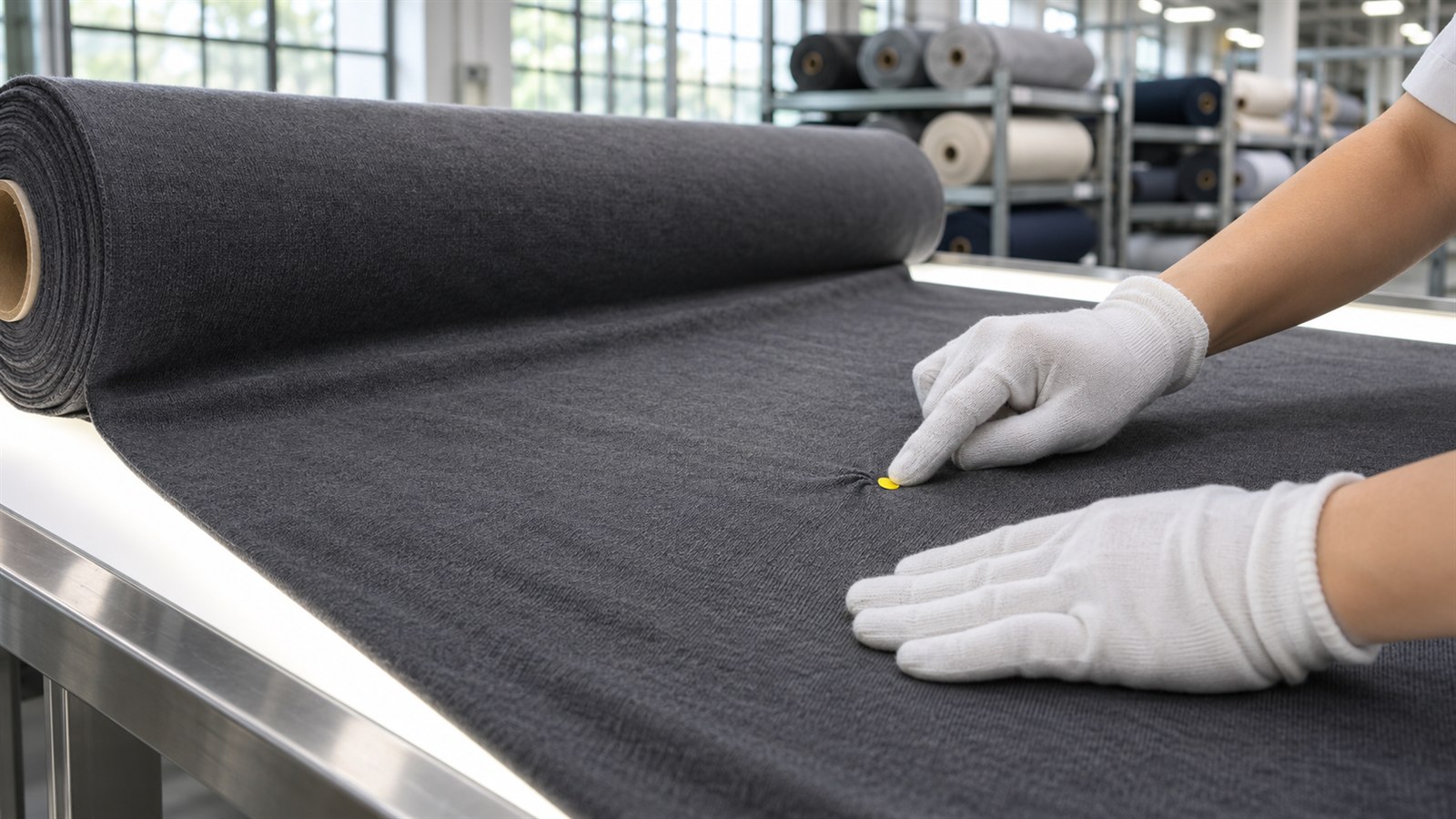
In practice the operator runs the roll over an inspection machine, checks the material as it passes the light, and records each defect as it appears. Your receiving procedure should still specify which face is examined, the viewing conditions, the measured length and width, and defect positions precise enough for someone to find them again on the roll.
Distinguish delivered stock from released stock. A roll may be physically inside the warehouse while still awaiting examination or a buyer decision. Production should be able to see that status without searching an email thread.
The trade applies the 4-point scale under ASTM D5430-26, Standard Test Methods for Visually Inspecting and Grading Fabrics. Naming it does not establish your order’s acceptance threshold. The explanations here use public industry guides, not reproduced standard text.
How defect length becomes penalty points
In a 4 point system fabric inspection, the inspector measures each defect and applies the agreed scoring rules. The following table follows the length bands and separate hole rules described in Textile Blog’s scoring guide and Textile Study Center’s inspection guide.
| Defect measurement | Penalty points |
|---|---|
| Length up to and including 3 inches | 1 |
| Length over 3 inches, up to and including 6 inches | 2 |
| Length over 6 inches, up to and including 9 inches | 3 |
| Length over 9 inches | 4 |
| Hole or opening measuring 1 inch or less | 2 |
| Hole or opening over 1 inch | 4 |
A single flaw may receive no more than 4 penalty points under V-Trust’s scoring rules. A running or continuous defect is scored 4 points per yard affected, as Textile Study Center describes. Confirm the applicable rules for continuous faults and repeated defects before inspection; do not let inspectors improvise them during a dispute.
The points are not the whole record. Preserve defect type, position, extent, and photographs so the cutting team can distinguish an isolated spot from a recurring line. NOVITA’s guide to fabric defects covers that identification task. A roll total cannot tell a pattern cutter where the usable panels are.
Calculate the area score, then apply the contract
The denominator matters in fabric inspection. A raw point total cannot fairly compare rolls with different inspected lengths or widths.
Using length in yards and width in inches, the explicit formula is:
Points per 100 square yards = (total penalty points × 3,600) ÷ (inspected length in yards × fabric width in inches).
This is the formula published by V-Trust, with its conversion factors combined. State the width basis in the report, and use the same basis as the buyer’s specification. Do not silently switch between total and usable width.
Check the reporting unit before comparing that score with a limit. Textile Study Center notes that buyers can define acceptable points per 100 linear yards as well as per 100 square yards. Some buyers and mills use the linear-yard basis. The two units are not interchangeable: the same fabric can look acceptable under one and unacceptable under the other. A clause that says “40 points” without naming the unit, width basis, and rounding rule has specified nothing measurable. Ask for those terms in the inspection clause and on the report before anyone makes a pass-or-fail decision.
Worked example: interpreting a roll report
V-Trust’s published example uses a roll measuring 120 yards long and 45 inches wide, with 22 penalty points. Using those inputs:
- Inspected area = 120 × 45 ÷ 36 = 150 square yards.
- Normalized score = 22 × 3,600 ÷ (120 × 45).
- That is 79,200 ÷ 5,400 = 14.67 points per 100 square yards, rounded to two decimal places.
The inputs come from that example; the calculations above are shown explicitly. V-Trust displays the result as 14.66, rather than rounding the recurring decimal upward.
Does the roll pass? Only against an identified rule. V-Trust reports that some factories accept up to 40 points per 100 square yards, while buyers set their own limits. Textile Blog instead says 40 or above is rejected, then describes negotiable limits. Those statements disagree at the boundary. Your contract must resolve it, including whether the limit itself is acceptable.
Under an agreed “up to 40” rule, the example meets the density limit. That still leaves shade, physical testing, and any separately prohibited defects to resolve. It does not establish how many garments can be cut around the recorded faults.
What a failing roll should trigger before cutting
After a failed fabric inspection, warehouse staff should hold the affected rolls until an authorized person decides their disposition. A workable receiving workflow separates four states: bulk release for cutting, restricted use, shade hold, and rejection. Buyers can use the responsibility split below when agreeing on an order’s receiving procedure.
| Party | Record or action to require |
|---|---|
| Receiving or warehouse staff | Identify and segregate held rolls; prevent issue to cutting. |
| Factory QC | Retain the defect map, photos, measured dimensions, score calculation, and failed requirement. |
| Merchandiser or sourcing contact | Notify the buyer and fabric supplier; record available remedies and schedule consequences. |
| Authorized buyer representative | Approve a disposition or deviation in writing, with its scope and conditions. |
| Cutting planner | Update the released-roll list and consumption plan after the decision. |
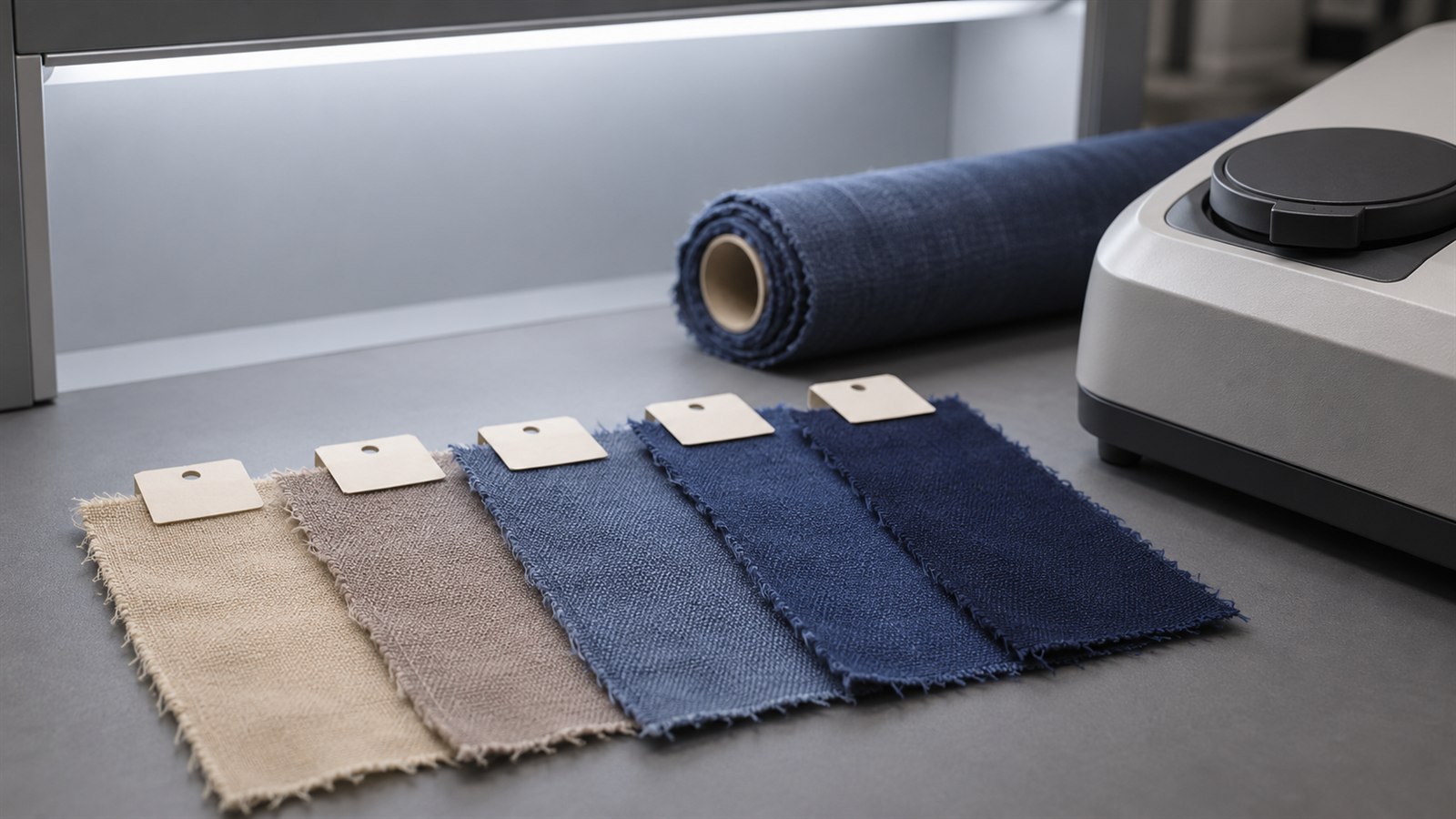
Keep both the supplier’s report and the factory’s findings if they disagree. Retain labeled swatches where useful, tied to the defect position and roll identity. A close-up photograph without a scale or location is weak evidence for a claim.
Agree on the commercial remedy with the supplier. Replacement means identifying substitute rolls and inspecting them before release. A credit can cover an agreed financial loss, but QC still needs to decide whether the material is usable. Use under deviation requires written permission identifying the affected rolls, permitted use, and cutting restrictions. For rejection, record return or disposal instructions and responsibility for the cost.
Ask who bears extra fabric consumption, recutting, and delay before accepting a credit. If a deviation cannot be followed on the cutting table, it is not a workable production instruction. Do not release held stock merely because sewing needs material.
Turn released rolls into a controlled cut plan
Send planning the fabric inspection results for each roll, including any held material within an otherwise acceptable shipment. Require a cutting list that names the released rolls, their approved shade groups, usable dimensions, defect locations, and restrictions.
Cut in a recorded sequence within the approved groups. The sequence need not follow a universal best-to-worst rule. It should follow the order’s shade requirements, marker needs, and available usable lengths. Record substitutions rather than letting a spreader replace a held roll with whichever roll is nearby.
Use shade band approval and roll release to establish which rolls may be used together. Keep panel bundles traceable to the roll and lay so shade groups do not become mixed during sewing or recutting. Passing the point limit does not establish color compatibility.
For a localized defect, ask the planner whether the marker can avoid it without losing required panels. Document any splice, omitted area, or restricted panel allocation. A long recurring fault may leave too little usable width for the intended marker even when the average score looks acceptable.
Recheck fabric consumption against the released usable stock. If avoiding faults creates a shortage, resolve replacement material or the quantity plan before spreading. A mill credit cannot supply missing panels.
Why the roll score cannot replace garment AQL
Fabric inspection and finished-garment AQL answer different questions. The former assigns visual penalty points to inspected fabric area. The latter uses a sample of finished units to support a lot acceptance decision.
The garment-side sampling plans most factories use are indexed by acceptance quality limit (AQL) under ISO 2859-1:2026. This edition supersedes ISO 2859-1:1999. The 4-point fabric scale has no sample-size table and no AQL index.
QIMA’s AQL explanation describes selecting a sample size and applying acceptance and rejection limits. For garment orders counted by nonconforming units, record whether each sampled garment fails the relevant defect class, then compare the count with the agreed plan. Do not substitute fabric points for that count.
There is no conversion from a roll’s area score to an AQL setting. Nor does a garment lot’s sampling pass retrospectively authorize a failed roll. NOVITA’s AQL sampling guide for clothing buyers explains the separate lot, sample, and acceptance decisions.
The connection is traceability. An incoming defect map can flag material risks for later checks. The pre-shipment inspection must still assess finished garments against the order requirements. Sewing, measurements, labeling, packing, and zipper function are not cleared by a roll score.
Put the decision rules in the purchase order
An inspection clause should let the buyer, mill, and garment factory reach the same decision from the same evidence. Write it before shipment, while there is still time to replace unsuitable material.
Specify:
- Name the point-assignment rules, defect definitions, and treatment of recurring faults.
- Identify which rolls will be examined, how they will be selected, and whether their full length will be checked.
- State the inspected-length and width conventions, area unit, and rounding rule.
- Set roll-level limits, any separate shipment rule, and the exact treatment of boundary values.
- Include approved shade references, usable-width requirements, testing, and separately unacceptable conditions.
- Name who can release held material, approve a deviation, settle costs, and authorize cutting.
- Define report fields, retained evidence, notification timing, and replacement-roll checks.
Avoid “pass according to industry standard” as the entire clause. V-Trust expressly describes buyer-defined acceptance criteria. A scoring method without acceptance terms leaves the commercial decision unresolved.
Recognize what the report cannot prove
Inspection coverage limits the conclusion. Examining selected rolls does not establish the condition of every unexamined roll. Examining only part of a roll does not provide a full-length defect map.
Even “100% inspected” needs a definition: all rolls, their full length, or only the selected rolls? A supplier may describe expanded sampling as full inspection, but that is not evidence that your shipment received either. Ask for the roll inventory and inspected lengths behind the statement.
Keep individual results visible. A shipment average can conceal an unacceptable roll. If combining scores, recalculate the normalized result from total points and total inspected area. Do not average normalized roll scores equally when inspected areas differ. This is an application of the area-based formula.
Visual grading also cannot establish wash durability. Keep fabric pilling and colorfastness testing as separate requirements where relevant. A clean surface at receiving is not a test result.
How this fits NOVITA
For a NOVITA OEM/ODM order, use the apparel quality control checklist to organize the receiving, cutting, and finished-garment requirements. Ask the project team to confirm the actual fabric inspection coverage, release authority, and records for your order rather than assuming a site guide proves that a particular shipment passed.
Frequently asked questions
Is there a universal passing score?
No. Buyers and suppliers must agree on acceptance limits and whether a result exactly at the limit passes. Published guides even disagree on that boundary, so the purchase order needs explicit wording.
Are penalty points the same as the number of defects?
No. The scoring table assigns different penalties according to measured defect size and type. Keep the defect list alongside the total so the result can be checked and used in planning.
Can a passing roll still be unsuitable for cutting?
Yes. Shade incompatibility, insufficient usable width, or a recurring fault can prevent the intended panels from being cut. Release should address those conditions separately from the point-density limit.
Does a supplier credit allow the factory to use a failed roll?
Not by itself. A credit settles a commercial issue, while material release requires a production decision. Any permission to use the roll should name the material and restrictions in writing.
Does inspecting selected rolls prove the whole shipment is good?
No. The observed score describes the inspected material, while any wider acceptance decision depends on the agreed sampling plan. Request the inspected-roll list and coverage details before interpreting a shipment-level pass.
Does a good roll score guarantee a garment AQL pass?
No. The roll score concerns visible fabric faults per inspected area; garment sampling assesses finished units against a separate acceptance plan. Cutting and sewing can introduce problems that were not present in the incoming fabric.