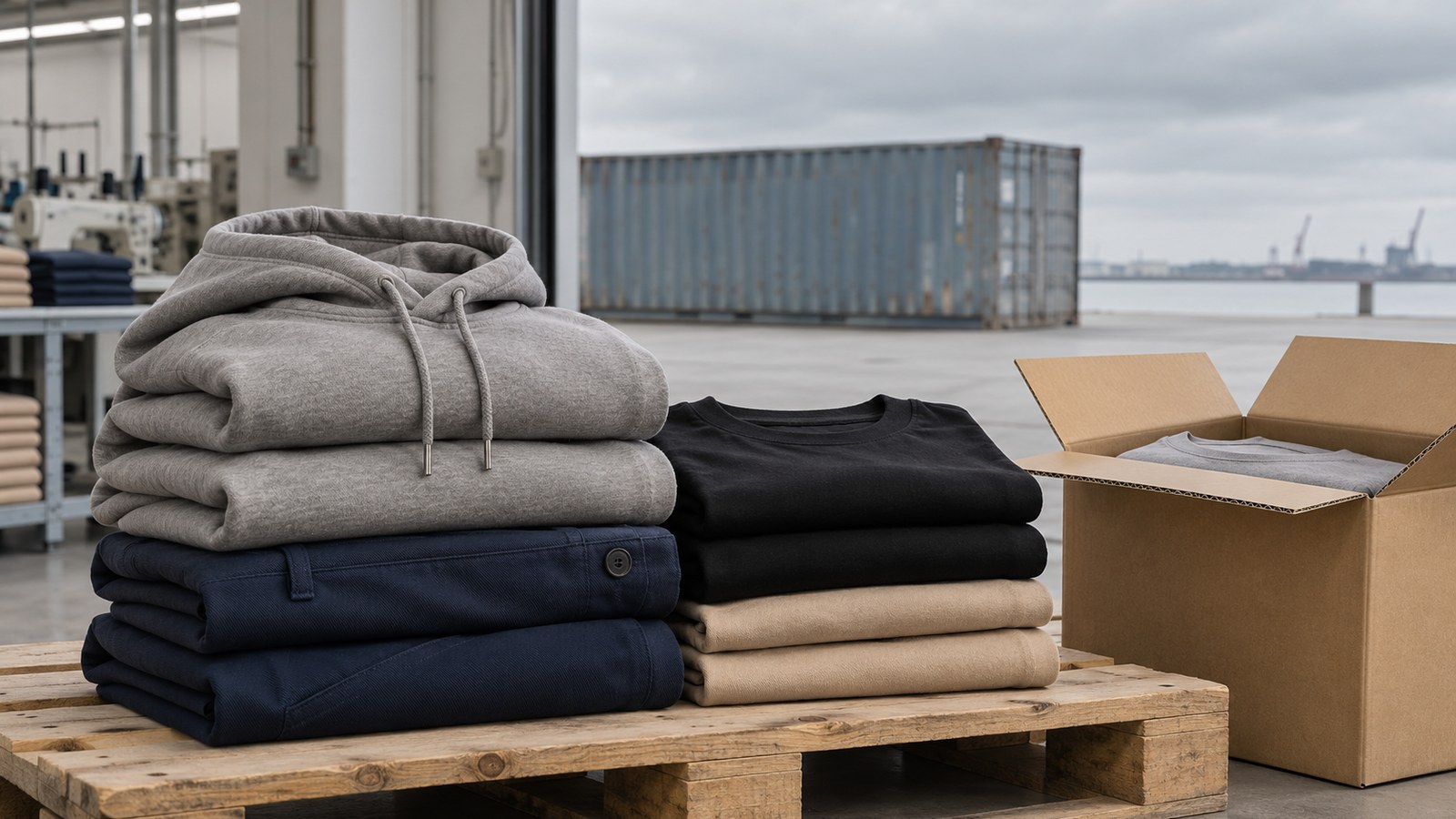
EXW Foshan factory (Incoterms® 2020) places goods at the buyer’s disposal, not loaded for collection; FOB Shenzhen (Incoterms® 2020) requires the seller to clear exports and deliver on board the vessel. Compare the same garment order and origin services before judging either unit price. Main freight remains the buyer’s responsibility under both examples.
NOVITA is a China-based men’s casualwear OEM/ODM manufacturer, with production in Foshan. This guide applies that factory-quote perspective to men’s polos, T-shirts, hoodies, jackets and denim jeans for U.S. buyers, with worked examples of orders shipped directly to the United States. We use the named places below as illustrative comparison examples; confirm available delivery terms for your destination with our sales team.
A men’s polo order can look cheaper simply because the quote stops earlier. Ask for a cost breakdown showing where delivery occurs, who handles each movement and when risk transfers.
Could your forwarder identify the collection point, export responsibilities and handover from the quote? Use the manufacturing RFQ checklist to fill any gaps before comparing totals.
Where an EXW quote actually ends
EXW Foshan factory (Incoterms® 2020) means delivery when the seller makes the goods available at the named factory, without loading the collecting vehicle. The buyer bears the export-clearance obligation as well as onward transport; a factory address alone does not tell you which garment-development or branding services the product price includes.
| Quote component | Included by the delivery rule? | What to confirm in writing |
|---|---|---|
| Goods available at the named factory | Yes, at the agreed delivery point | Collection address, contact and readiness notification |
| Loading the collection vehicle | No seller loading obligation | Who loads, who pays and who bears loading risk |
| Export clearance and onward carriage | Buyer’s responsibility | Export procedure, responsible parties and separately quoted services |
| Development, sampling and custom branding | Not established by the delivery rule | Which services are included in the commercial quotation |
| Packaging specification | Do not infer a particular specification | Agreed packing method, labels and packing-list requirements |
Contract responsibility and the party performing a task can differ. If the seller or a logistics provider agrees to assist with export paperwork, record the scope, costs and responsibility explicitly. Assistance alone does not make the seller responsible for export clearance.
For the product itself, compare the same fabric, construction, color allocation, size range and branding requirements. Keep order quantity fixed too; the MOQ guide explains the separate manufacturing decisions behind minimums. Changing both the order specification and the delivery scope makes the price difference impossible to explain.
What a FOB Shenzhen quote covers
FOB Shenzhen (Incoterms® 2020) requires the seller to arrange delivery on board the buyer-nominated vessel at the named shipment port and complete export clearance. The seller has no obligation to book the main carriage or buy insurance; risk transfers when the goods are on board, not when they reach the buyer’s country.
A shipment-port quote might name Guangzhou or Foshan instead of Shenzhen. Identify the actual port and delivery arrangements in the contract; the international-sales office address is not the shipment port.
The matrix separates payment from risk. Insurance entries describe the seller’s contractual obligation, not a recommendation to leave cargo uninsured.
| Delivery rule and illustrative named place | Export clearance | Main carriage cost | Seller must insure? | Normal risk-transfer point | Import clearance |
|---|---|---|---|---|---|
| EXW Foshan factory (Incoterms® 2020) | Buyer | Buyer | No | Goods available, not loaded | Buyer |
| FCA Shenzhen container freight station (Incoterms® 2020) | Seller | Buyer | No | Delivery to buyer-nominated carrier at agreed point | Buyer |
| FOB Shenzhen (Incoterms® 2020) | Seller | Buyer | No | Goods on board vessel at shipment port | Buyer |
| CIF Port of Los Angeles (Incoterms® 2020) | Seller | Seller, to named destination port | Yes, minimum cover | Goods on board vessel at shipment port | Buyer |
| DDP buyer’s warehouse, Los Angeles (Incoterms® 2020) | Seller | Seller, to named destination | No | At destination, on arriving vehicle, ready for unloading | Seller |
Sources: ICC rules, ICC Academy carrier-handover guidance and destination-delivery guidance.
When FCA fits better than FOB
FCA Shenzhen container freight station (Incoterms® 2020) fits an arrangement where the seller delivers export-cleared goods to the buyer’s nominated carrier at that agreed point. ICC warns against FOB when goods are handed to the carrier before vessel loading, as can happen at a container terminal.
Consider an apparel shipment sent to a container freight station, or CFS, for consolidation. Ask whether the factory’s handover occurs there or on board a vessel. For less-than-container-load cargo, the forwarder may receive cartons before consolidation and loading. The contract should describe that actual handover rather than leave a gap between physical custody and the stated delivery point.
FOB is for sea or inland-waterway transport; FCA can accommodate multimodal carriage. Match the rule to the planned transport and delivery arrangements before reusing a previous purchase order.
Ask the forwarder to identify the receiving facility, loading or unloading responsibilities and handover evidence. A domestic decorator receiving jackets is another handover to define, not automatically a shipment-port delivery; see the custom-jacket sourcing decisions for the manufacturing side of that comparison.
CIF vs DDP: freight, risk and import clearance
The destination-port quote below requires the seller to pay freight and minimum insurance, but risk transfers on board at origin. The warehouse quote keeps risk with the seller to destination, ready for unloading, and assigns import clearance to the seller.
| Question | CIF Port of Los Angeles (Incoterms® 2020) | DDP buyer’s warehouse, Los Angeles (Incoterms® 2020) |
|---|---|---|
| Where does paid carriage end? | Named destination port | Named destination place |
| Who bears transit risk after shipment-port loading? | Buyer | Seller until destination delivery, ready for unloading |
| Who handles import clearance and import charges? | Buyer | Seller |
| Must the seller obtain cargo insurance? | Yes, the rule’s minimum cover | No, despite retaining transit risk |
| What needs scrutiny? | Coverage, claims route and destination charges | Lawful import arrangement, exclusions and unloading |
Under CIF, the default minimum is Institute Cargo Clauses (C), with insurance of at least 110% of the contract price, in the contract currency. The required cover runs from delivery to at least the named destination port. Ask for the policy scope and claims procedure, and discuss broader protection if needed: minimum cover does not guarantee reimbursement for every loss. Risk still transfers at the shipment port.
For DDP, ICC Academy warns that import clearance may be difficult for a foreign seller. Ask who can lawfully undertake it, which entity will act as importer of record and how payment and clearance evidence will be provided. An attractive delivered total is not evidence that this arrangement is workable. Confirm directly with our sales team which delivery terms are available for your destination.
How to put two apparel quotes on the same basis
Comparable apparel quotes need the same garment specification, quantity, packaging and delivery scope. Build the comparison in three steps: freeze the order inputs, itemize non-overlapping origin services, then keep main freight and destination costs separate. This produces a purchasing estimate, not a change to either supplier’s contractual delivery or risk obligations.
Separate four cost blocks: goods, origin services, main carriage and destination services. For an EXW quote, calculate (E × Q) + U + X + T + H, adding only buyer-paid origin services not already included; for an FOB quote, use E_FOB × Q, where E_FOB is the seller’s FOB unit price and already includes U, X, T and H, so do not add them again. The responsibility split comes from ICC; the worksheet below is our comparison method.
1. Use matching styles, fabric, trims, branding, packing instructions and quantities. Ask whether the quoted unit is a garment, set, carton or whole order; the delivery term does not establish the price unit. 2. Request itemized quotes for missing origin services. Deduct a bundled service only when the supplier identifies its value; otherwise mark the comparison incomplete. 3. Compare onward costs using the same destination and currency basis. Record quote validity, insurance choices and destination exclusions so you can trace each difference in the total.
| Worksheet field | Meaning and calculation |
|---|---|
| E and Q | Agreed factory goods price per garment and matching garment quantity |
| Goods subtotal | E × Q, with identical product and packaging scope |
| U | Collection loading, if not already included elsewhere |
| X | Export clearance and documents, without duplicating a forwarder’s bundle |
| T | Factory-to-shipment-port inland transport |
| H | Origin handling and on-board delivery services not already counted |
| Comparable origin-stage total | EXW: (E × Q) + U + X + T + H, with U, X, T and H buyer-paid and counted only where absent. FOB: E_FOB × Q, where E_FOB is the seller’s FOB unit price, already including U, X, T and H; do not add them again. |
| Separate onward block | Main freight, chosen insurance, destination clearance, import charges and delivery, as applicable |
Apply each service once. Keep risk transfer as a separate field: adding costs cannot move the legal delivery point. For the broader sourcing decision, use the U.S.-versus-China manufacturing comparison rather than treating an origin subtotal as the full cost of importing.
What changes the freight bill on a casualwear order
Apparel freight depends on the shipment’s packed weight, volume, route and service. Air-cargo chargeable weight compares actual and volumetric weight and uses the greater. A commonly used volumetric calculation is L × W × H (cm) ÷ 6000; confirm the divisor and measurement rules on the carrier’s own quotation rather than assuming a universal calculation.
Packaging belongs in the comparison inputs. Different folding, protective materials or carton arrangements can change shipment volume without changing garment quantity. Request the proposed packing method and packed-shipment measurements before accepting a freight estimate; do not borrow carton specifications from an unrelated order.
For ocean transport, less-than-container-load service consolidates cargo; full-container-load service charges for the container even when it is not full. LCL shipments below roughly 15 CBM are usually more economical than a full container, but ask the forwarder to compare both available services for your route, including handling and destination exclusions. A volume threshold alone cannot establish which service will cost less on your route.
Keep the planned dispatch window visible too. Use the Chinese New Year factory-closure guide when planning around holiday disruption; a delivery rule is not a production or sailing-date promise.
The U.S. import checks behind a delivery quote
For U.S. buyers placing an apparel order shipped directly to the United States, document ownership and customs responsibilities need checking separately from freight payment. Confirm the commercial invoice, packing list and transport document with the responsible parties; then have the importer and broker review classification, security filing and entry requirements rather than treating a factory’s delivery label as customs approval.
Ask who prepares each document and who checks that garment descriptions, quantities, consignee details and delivery terms agree. Confirm whether origin documentation is required for the shipment. Do not assume that the party paying a carrier also prepares or files every customs document.
For U.S. imports, classification under the Harmonized Tariff Schedule affects duty treatment. CBP makes the final determination; unresolved classification questions can be taken through its binding-ruling process. This guide supplies no duty estimate. Give your broker the garment information needed for classification; a description such as “casualwear” is too broad.
CBP’s Importer Security Filing applies to ocean imports arriving in the United States. Noncompliance can mean penalties, additional inspection and delay. The cargo-release declaration is filed within 15 calendar days of arrival. The entry summary (CBP Form 7501), together with the deposit of estimated duties, is filed within 10 working days of entry and release; agree in advance with the broker who files and pays.
FAQ: factory delivery quotes
A factory delivery quote needs both a responsibility check and a price-unit check. The questions below address buyer uncertainties about origin services, ocean freight, destination clearance and quote comparison; none of the delivery labels alone establishes which total is cheaper or which import arrangement is legally workable.
Which is cheaper: FOB or EXW?
Neither label proves a lower total cost. The factory-only scope leaves services for the buyer to procure; the shipment-port scope includes seller obligations up to on-board delivery. Compare itemized services for the same order before deciding.
Does FOB include shipping to the United States?
No. The seller delivers on board at the named shipment port and clears exports, but has no obligation to arrange the main carriage. Budget main freight, destination requirements and your chosen insurance separately.
Does CIF keep risk with the seller until arrival?
No. The seller pays freight and minimum insurance to the named destination port, but risk transfers when goods are on board at the shipment port. Paying destination-port freight does not extend that risk period.
Is DDP better for a small brand?
Not automatically. Verify lawful import clearance, the responsible entity, charge exclusions and delivery evidence. The seller retains transit risk to the agreed destination but has no insurance obligation under this rule; ask how losses would be handled.
Can my forwarder collect under EXW?
The buyer can arrange collection, but must address loading and export-clearance responsibilities. Ask the forwarder and seller how those tasks will be performed; do not assume that appointing a forwarder removes an export-procedure problem.
Is the quoted price per garment or per package?
The delivery term does not answer that. Ask for the price unit, order quantity, currency and extended goods total, plus a separate list of included services. A carton price and a garment price are not interchangeable comparison inputs.
How do I compare a factory quote in RMB with a forwarder quote in USD?
First separate goods from logistics services so the same cost is not counted twice. Convert comparable subtotals to one currency using an agreed comparison basis, and record quote validity. Keep delivery scope and risk visible alongside the converted amounts.
Can I use different delivery terms across suppliers?
You can compare different arrangements, but record each supplier’s delivery point and risk transfer separately. A combined forwarder invoice is not proof that every supplier has the same obligations. Confirm who controls each collection and handover before consolidating cargo.
What to bring to a NOVITA quote discussion
Send NOVITA the men’s casualwear specification, proposed delivery point and services you want priced. A tech pack or reference garment, quantities, branding requirements and packing expectations give the team a defined order to discuss. Ask for a written breakdown of what the proposed price includes and what you must arrange separately.
Before comparing quotations, ask:
1. What are the delivery rule, edition and precise named point? 2. What are the price unit, currency and matching order quantity? 3. Which fabric, trims and garment construction are being priced? 4. Which development, sample and branding costs are separate? 5. What packing method and labeling are included? 6. Who handles collection, loading, export clearance and booking? 7. Where does risk transfer, and who arranges insurance? 8. Who undertakes import clearance and destination delivery? 9. What is the quote’s validity, and what remains excluded?
Agree the deposit and balance arrangements separately from transport responsibilities. Our manufacturing scope runs from fabric sourcing and development through sampling, bulk production, custom branding and packaging. Confirm available delivery terms for your order directly with our sales team; any destination-import role requires prior agreement.